
This article was written by Assoc. Prof. Dr. Burak Sercan Erçin and is based on clinical experience. A specialist in Plastic, Reconstructive and Aesthetic Surgery; prepared in accordance with current medical literature and personal surgical data. A consultation is recommended before making any medical decisions.

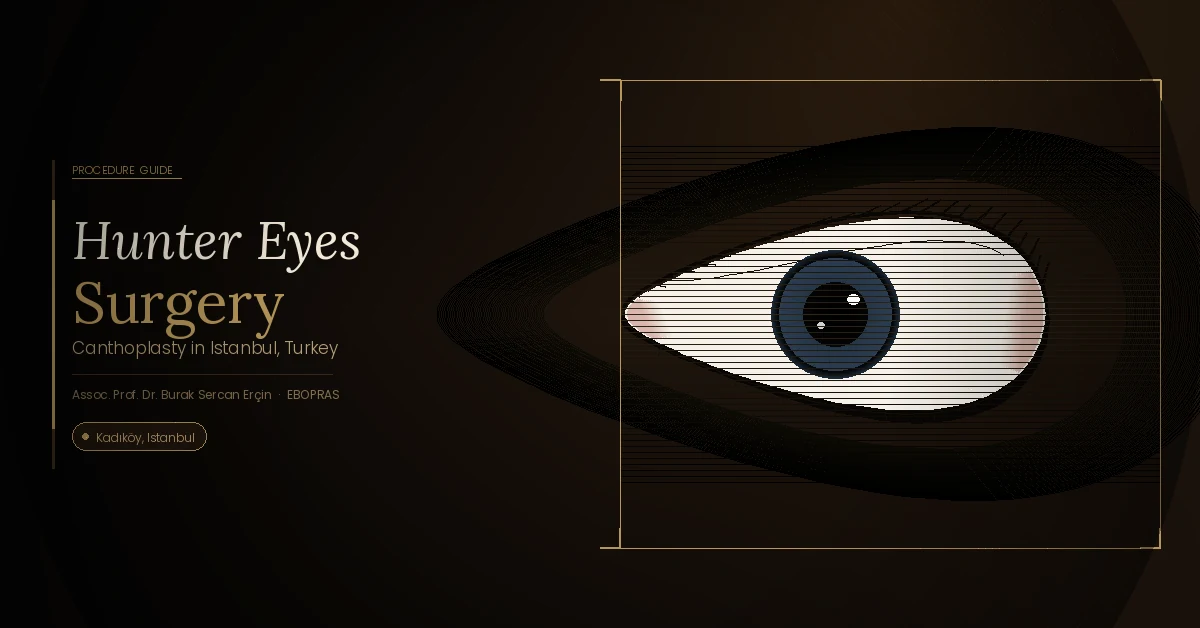
The shape of our eyes communicates so much without a single word. It can project energy, warmth, and confidence. In the world of facial aesthetics, the “Almond Eye” has become a sought-after ideal. This look is defined by a gentle, upward tilt at the outer corner, creating a bright and engaging expression. The desire for this feature is not just about following a trend. It’s about achieving a look that feels both timeless and naturally beautiful. As aesthetic procedures advance, people are looking beyond temporary fixes. They want lasting, structural improvements that respect their unique facial anatomy. This is where advanced oculoplastic surgery comes in, offering a permanent way to enhance the eyes’ natural beauty.
The eyes are often called the windows to the soul, and for good reason. They are central to how we express ourselves and connect with others. However, factors like genetics and aging can affect their appearance. A downward turn at the outer corner, known as a negative canthal tilt, can create a look of sadness or fatigue, even when you feel vibrant and full of life. The solution lies in a specialized procedure that reshapes the eye’s corner.
Almond eye canthoplasty in Istanbul combines the precision of microsurgery with a deep understanding of aesthetics. It offers a permanent way to lift the lateral canthus, resulting in a gaze that is brighter, more youthful, and captivatingly exotic. This guide will walk you through the medical details of the procedure, explain the key differences between canthoplasty and canthopexy, and show why a surgeon with a microsurgical background is essential for achieving safe, beautiful results.
The Anatomy of the Almond Eye: Understanding the Lateral Canthus
To fully appreciate the impact of almond eye surgery, it’s important to understand the anatomy involved. The shape of your eye is primarily defined by a crucial structure: the lateral canthal tendon. This is a strong band of connective tissue that acts like an anchor. It fastens the outer corner of your eyelid securely to the bone of your eye socket, known as the orbital rim. The position of this tendon dictates the tilt and overall shape of your eye.
The tilt is measured by comparing the height of the outer corner (lateral canthus) to the inner corner (medial canthus). In an eye with a “neutral” tilt, these two points are roughly on the same horizontal line. A “negative” tilt occurs when the outer corner sits lower than the inner corner, which can contribute to a tired or melancholic appearance. The goal of almond eye surgery is to create a “positive” tilt. This is achieved by repositioning the lateral canthus to be slightly higher, typically by 2 to 4 millimeters, than the medial canthus. This subtle adjustment makes a significant difference, creating the classic almond shape.
The “Scleral Show” Factor
Another important consideration in evaluating eye shape is the “scleral show.” This term refers to the amount of the white part of the eye, the sclera, that is visible beneath the colored part, the iris. In an ideally youthful eye, the lower eyelid rests just at the edge of the iris, with no white showing underneath. When the lower eyelid loses its tension and begins to droop, a condition known as lid laxity or ectropion, it exposes the sclera.
This exposure can create a “hound dog” or perpetually tired look. It can also lead to functional issues like dry eye, as the eyelid is no longer providing adequate protection and lubrication for the cornea. Almond eye surgery directly addresses this issue. By tightening the lower eyelid and repositioning the canthal tendon, the procedure provides better support. This lifts the lid margin back to its proper position, covering the lower sclera and restoring a sharp, alert, and focused gaze. This functional benefit is just as important as the cosmetic improvement.
Canthoplasty vs. Canthopexy: The Microsurgeon’s Distinction
Patients often hear the terms “canthoplasty” and “canthopexy” used together, leading to confusion. While both procedures aim to lift the outer corner of the eye, they are fundamentally different in their approach. Understanding this distinction is critical because the choice between them affects the procedure’s invasiveness, the permanence of the results, and the overall naturalness of the outcome. A skilled surgeon will carefully assess your anatomy and goals to recommend the right technique for you.
Lateral Canthoplasty (The Reconstructive Approach)
Lateral canthoplasty is a true reconstructive surgery. It is a more definitive and powerful technique designed to create a significant and permanent change in the eye’s shape and support structure. The procedure involves several precise steps. First, the surgeon makes a small incision at the outer corner. Then, the lateral canthal tendon is surgically cut and detached from the orbital bone. This step, called a cantholysis, allows the surgeon to freely move the corner of the eye.
Next, the tendon is shortened to remove any slack or laxity that has developed over time. Finally, it is carefully repositioned and re-anchored to the periosteum, the dense membrane covering the orbital bone, at a higher and more secure point. This technique is best suited for patients with noticeable eyelid droopiness, significant lower lid laxity, or those who desire a lasting alteration to their eye shape. It provides the strongest and most durable support for the eyelid.
Canthopexy (The Reinforcement Approach)
Canthopexy is a less invasive procedure that acts more like a reinforcement than a reconstruction. The key difference is that the canthal tendon is not cut or detached. Instead, the surgeon uses strategically placed internal sutures to tighten and lift the existing tendon and the surrounding orbicularis muscle. These sutures essentially create an internal support sling, pulling the outer corner into a higher position and securing it to the periosteum.
This technique is often called a “pexie,” which means to fix or secure. Because it’s less invasive, recovery can be quicker. Canthopexy is an excellent option for younger patients, typically in their 20s or 30s, who have good skin elasticity and only require a subtle lift. It’s perfect for achieving a “cat eye” look without committing to a full structural change. However, because the tendon itself is not shortened, the results may not be as dramatic or as long-lasting as those from a canthoplasty, especially in patients with significant tissue laxity.
An expert surgeon understands that the best results sometimes come from a combination of techniques. Simply pulling on the skin, as is done with thread lifts, offers only a temporary illusion of a lift and can lead to unnatural pulling and potential scarring. True, lasting transformation requires addressing the underlying anatomy. Microsurgical anchoring of the tendon ensures that the new eye shape is stable and can withstand the daily forces of gravity and blinking for many years to come.
The Procedure: Precision Meets Artistry
When you choose to have Almond eye canthoplasty in Istanbul with a specialist like Dr. Burak, you are choosing a procedure that is governed by the highest standards of microsurgical safety and precision. The entire process is meticulously planned and executed, blending technical skill with an artistic eye for facial harmony. Every step is designed to maximize safety, ensure a beautiful outcome, and make the recovery as smooth as possible.
Step 1: Anesthesia and Incision
Your comfort and safety are the top priorities. The surgery is typically performed under local anesthesia with sedation. This means the area is completely numb, and you are in a relaxed, twilight state, but you are still breathing on your own. For patients who prefer to be completely asleep or if the canthoplasty is being combined with more extensive procedures like a facelift, general anesthesia may be used. Once you are comfortable, the surgeon makes a very small, precise incision. This incision is carefully placed within the natural crease at the outer corner of your eye, ensuring that once it heals, the scar will be virtually invisible.
Step 2: Canthal Release and Resuspension
This is the core of the operation, where the surgeon’s microsurgical skills are most critical. Using specialized instruments designed for delicate work, the surgeon carefully accesses the lateral canthal tendon. If a full canthoplasty is being performed, the tendon is released from the bone. A small, measured section of the lax tendon is then removed to tighten the structure. The remaining tendon is then elevated to the new, higher position that was planned before the surgery. This new position, or vector, determines the final shape and tilt of the eye. The tendon is then securely sutured to the periosteum of the orbital rim.
Step 3: Orbicularis Suspension
To ensure a durable and natural-looking result, supporting the canthal tendon alone is not enough. The muscle that encircles the eye, the orbicularis oculi muscle, also plays a crucial role in maintaining lower eyelid position. A skilled surgeon will also tighten and suspend this muscle. This provides a second layer of essential support, acting like a hammock for the lower eyelid. This step is vital for preventing the “round eye” appearance from returning over time and helps to create a smooth, seamless transition from the eyelid to the cheek.
Step 4: Closure
The final step is closing the incision. This is where the artistry of a reconstructive surgeon becomes evident. The incision is closed with ultra-fine sutures, often thinner than a single human hair. A meticulous closure technique is essential to prevent any visible scarring or “webbing” at the outer corner of the eye. Improper closure can be a tell-tale sign of surgery, but when done correctly, the incision line heals into a faint line that is perfectly hidden in the natural skin crease, making the surgical work undetectable.
Why Istanbul? The Global Hub for Oculoplastic Excellence
Turkey has firmly established itself as a leading destination for medical tourism, with projections showing it will welcome over 2.5 million medical tourists by 2026. Aesthetic surgery is a major part of this growth, and Istanbul, in particular, has become the city of choice for patients seeking Almond eye canthoplasty. This reputation is built on a solid foundation of expertise, advanced technology, and patient-centered care.
1. The “High-Volume” Expertise
One of the key advantages of having surgery in Istanbul is the sheer volume of procedures performed. Turkish surgeons, especially those specializing in facial aesthetics, perform a significantly higher number of cases compared to many of their counterparts in Europe or the United States. This constant practice leads to a level of mastery and refinement that is hard to match. While a surgeon in another country might perform a canthoplasty once or twice a month, top surgeons in Istanbul may perform the procedure several times a week. This high volume translates into greater technical skill, more predictable outcomes, and lower complication rates.
2. Advanced Medical Infrastructure
The quality of medical facilities in Istanbul is world-class. Many of the city’s private hospitals have earned JCI (Joint Commission International) accreditation, which is the gold standard for healthcare quality and patient safety worldwide. These hospitals are equipped with state-of-the-art operating theaters, advanced diagnostic tools, and luxurious recovery suites that often surpass the standards found in hospitals in London or New York. Patients can expect a clean, safe, and comfortable environment for their entire surgical journey.
3. The Economic Advantage
Many people assume that lower cost means lower quality, but in Turkey, this is not the case. The significant cost difference for medical procedures is primarily due to the country’s lower cost of living, labor, and operational expenses. The quality of care, the technology used, and the surgeon’s expertise are all on par with the best in the world.
- Average Cost in UK/USA: $4,500 – $8,500
- Average Cost in Istanbul: $1,500 – $3,500
This economic advantage allows patients to access elite-level surgical care at a fraction of the price they would pay at home, without compromising on safety or results.
4. The “Dr. Burak” Factor: Academic & Microsurgical Credentials
In a city with many skilled surgeons, Assoc. Prof. Dr. Burak Sercan Erçin stands out due to his exceptional training and background. His credentials provide patients with an extra layer of confidence.
- EBOPRAS Qualification: Holding the diploma from the European Board of Plastic Reconstructive and Aesthetic Surgery is a prestigious honor. It signifies that a surgeon has met the most rigorous training and examination standards recognized across Europe, ensuring a high level of competence and ethical practice.
- Microsurgery Background: Dr. Burak has trained and worked with some of the world’s foremost reconstructive microsurgeons, including the legendary Dr. Pedro Cavadas. This background is incredibly valuable. Microsurgery involves reattaching tiny nerves and blood vessels under a microscope. Applying this level of precision to a delicate cosmetic procedure like canthoplasty, which involves working near the vital structures of the eye, is a significant advantage that minimizes risk and enhances the quality of the result.
- Academic Rigor: As an Associate Professor, Dr. Burak is not just a practitioner; he is also a teacher and a researcher. This commitment to academia ensures that he is always at the forefront of the latest peer-reviewed techniques and evidence-based practices. His patients benefit from care that is based on proven science, not just passing trends.
Your eyes are one of your most precious features, and they deserve the meticulous care and precision of a true microsurgeon. When considering a procedure as delicate as almond eye surgery, you should not compromise on your vision or your aesthetic outcome. Assoc. Prof. Dr. Burak Sercan Erçin, an esteemed reconstructive surgeon in Istanbul, brings together more than a decade of reconstructive expertise with a refined artistic vision. This unique combination allows him to deliver natural, beautiful, and lasting Almond Eye results. With a specialization in Plastic, Reconstructive, and Aesthetic Surgery and a qualification diploma from EBOPRAS, MD. Burak has worked alongside some of the world’s leading reconstructive microsurgeons. His commitment to excellence in both clinical practice and academic research means he is dedicated to providing his patients with the highest quality care possible. Book a consultation today and take the first step towards your physical transformation.
What Dr. Burak Specifically Offers in Turkey:
PRP Treatment (Platelet Rich Plasma), Breast Augmentation Surgery, Preservé™ Breast Augmentation, Breast Lift Surgery, Breast Reduction Surgery, Male Breast Reduction Surgery, Nose Aesthetics (Rhinoplasty), Almond Eye Surgery (Canthoplasty), Non-Surgical Aesthetics, Botox, Skin Rejuvenation (Microdermabrasion), Gummy Smile Botox, HIFU: Non-Surgical Facial and Skin Rejuvenation, Phototherapy (IPL) (Light Therapy), Chemical Peeling, Masseter Botox, Mesotherapy, Brow Lift Surgery, Prominent Ear Surgery (Otoplasty), Chin and Face Correction, Facial Feminization (FFS), Eyelid Aesthetics (Blepharoplasty), Lip Lift, Face Lift Surgery, Endoscopic Face Lift, Facial Masculinization (FMS), Alpha Male Treatment, Mommy Makeover, Liposuction, Vaginoplasty, Labiaplasty, Sex Reassignment Surgery, Jaw Surgery, Congenital Anomalies, Post-Cancer Reconstruction, Abdominal and Torso Reconstruction, Microsurgery, Revision Surgery, Hand Surgery, Bone Disease Treatments, Congenital Anomaly Treatments, Facial Paralysis, Burn Repair Treatments, Leg Lift Surgery, Brazilian Butt Lift (BBL), Abdominoplasty (Tummy Tuck Surgery), Arm Lift Surgery (Brachioplasty), and Chronic Wound Treatments.
The Ideal Candidate: Who Needs This Surgery?
Almond eye surgery is a highly effective and versatile procedure, but it is not a “one size fits all” solution. A thorough consultation is necessary to determine if it is the right choice for an individual’s specific anatomy and aesthetic goals. The ideal candidates are typically those looking to correct specific structural issues around the eyes.
1. Genetic Droopy Eyes
Many individuals are born with a downward canthal tilt. This is a genetic trait where the outer corners of the eyes are naturally lower than the inner corners. This can create a facial expression that appears perpetually sad, tired, or uninterested, which may not reflect the person’s true feelings or energy level. For these individuals, canthoplasty can be transformative, creating a brighter and more positive resting expression that aligns with their personality.
2. Post-Blepharoplasty Complications
Sometimes, patients who have undergone a previous lower eyelid surgery (blepharoplasty) to remove eye bags can experience complications. If the surgery was too aggressive and too much skin or fat was removed, it can weaken the support structure of the lower lid. This can lead to a “round eye” appearance or a more serious condition called lid retraction, where the eyelid is pulled down, exposing too much of the sclera. Canthoplasty is a powerful corrective procedure in these cases, used to restore proper lid tension and shape.
3. Aging Eyes
The aging process affects all the tissues in our face. Over time, the canthal tendon, like other ligaments, can stretch and lose its elasticity. This weakening causes the outer corner of the eye to droop, contributing to an aged and tired look. The skin also loses collagen, leading to laxity. Canthoplasty for aging eyes effectively turns back the clock by tightening the tendon and restoring the youthful tension and upward tilt that has been lost to gravity and time.
4. Prominent Eyes (Exophthalmos)
Patients with naturally prominent or “bulging” eyes, a condition that can be genetic or related to thyroid issues, sometimes have insufficient eyelid coverage. This can leave the cornea exposed and at risk of dryness and irritation. In these cases, almond eye surgery can have a functional benefit. By tightening and repositioning the lower eyelid, the surgery can provide better coverage and protection for the cornea while also creating a more balanced and harmonious facial appearance.
Ethnic Considerations
A great surgeon understands that beauty is not monolithic. The goal of cosmetic surgery should be to enhance an individual’s features in a way that respects and harmonizes with their ethnic identity.
- Asian Eyelids: For patients of Asian descent, the aesthetic goal is often to create a wider, more elongated eye shape horizontally, without erasing the unique and beautiful characteristics of the Asian eyelid, such as the epicanthal fold.
- Caucasian Eyelids: In Caucasian patients, the procedure frequently focuses on lifting the outer corner to counteract the effects of gravity and skin laxity, restoring a more youthful and alert appearance.
Dr. Burak’s approach is centered on patient collaboration. The ultimate goal is always facial harmonization, not standardization. He works closely with each patient to understand their desired outcome, ensuring the final result celebrates their unique heritage and beauty.
Combination Surgeries: The “Total Periorbital Rejuvenation”
In modern facial aesthetics, the trend is moving away from isolated procedures and towards a more comprehensive approach. The area around the eyes, known as the periorbital region, is a complex unit where the brows, upper lids, lower lids, and cheeks all work together. Addressing only one part can sometimes create an imbalance. For this reason, almond eye canthoplasty in Istanbul is often combined with other surgeries to achieve a “Total Periorbital Rejuvenation,” ensuring a harmonious and natural-looking result.
1. Temporal Lift (Brow Lift)
The position of the eyebrow has a direct impact on the appearance of the eye. If the outer part of the brow is heavy and drooping, it can create “hooding” over the upper eyelid. Lifting the corner of the eye with a canthoplasty without addressing a heavy brow can look unnatural. A temporal lift, also known as a brow lift, specifically targets the outer third of the brow. By lifting this area, it opens up the eye, clears away the hooding, and allows the beautiful new almond shape created by the canthoplasty to be fully visible. The two procedures work in synergy to create a brighter, more open, and refreshed look.
2. Lower Blepharoplasty
Canthoplasty and lower blepharoplasty address two different aspects of lower eyelid aging. Canthoplasty is about reshaping the eye and tightening the corner tendon for support. Lower blepharoplasty, on the other hand, is designed to remove or reposition the fat pads that cause “bags” under the eyes and to trim away any excess, crepey skin. When performed together, they provide a complete solution for the tired look. The canthoplasty corrects the shape and droopiness, while the blepharoplasty smooths the contour and eliminates the puffiness. The combined result is a lower eyelid that is smooth, tight, and perfectly shaped.
3. Mid-Face Lift
The connection between the cheek and the lower eyelid is crucial for a youthful appearance. As we age, the fat pads in the cheeks descend due to gravity, which can create a hollow look under the eyes (a tear trough deformity) and pull down on the lower eyelid. Sometimes, the eye appears droopy simply because the cheek below it has lost its support. A mid-face lift elevates the cheek tissues back to their youthful position. This provides a strong foundational support for the lower eyelid, taking the downward tension off the delicate lid skin and enhancing the results of the canthoplasty. This combination restores the smooth, convex curve from the eyelid to the cheek that is a hallmark of a youthful face.
Recovery and Aftercare: Timelines & Expectations
A successful surgical outcome depends just as much on the recovery period as it does on the surgery itself. Following post-operative instructions carefully is essential for proper healing. The eye area has a rich blood supply, which means that while swelling and bruising are expected, healing is generally quite fast.
- Day 1-3: This is the period of maximum swelling and bruising. Your vision might be slightly blurry due to lubricating ointment and swelling. You may also experience “chemosis,” which is swelling of the conjunctiva (the clear membrane covering the white of the eye). It can look like a clear blister but is a normal part of the healing process and is harmless. Applying cold compresses consistently during this time is crucial to minimize swelling.
- Day 5-7: You will have a follow-up appointment with your surgeon. If non-dissolvable stitches were used, they are typically removed at this time. The majority of the significant swelling and bruising will have subsided, and you can often start using makeup to conceal any remaining discoloration.
- Week 2: By the end of the second week, most patients feel comfortable and confident enough to return to work and social activities. Your eyes might still feel a bit tight or look slightly “over-corrected.” This is completely normal and intentional. The surgeon plans for this initial tightness because the tissues will gradually relax into their final, natural position over the next few weeks.
- Month 3-6: Your final results settle during this period. The last bits of residual swelling will disappear, and the tissues will soften completely. The incision line, which was already well-hidden, will fade to a very fine, near-invisible line within the natural crease of your eye.
Post-Op Rules for Success:
- No rubbing: It is absolutely critical that you do not rub your eyes for at least four weeks. The re-anchored tendon needs time to heal and fuse securely to the bone. Rubbing can disrupt this delicate healing process.
- Lubrication: Your surgeon will prescribe artificial tears or lubricating eye drops. Using them as directed is mandatory. They help prevent dry eye syndrome, which can be a temporary side effect as the eyelid’s blinking function adjusts, and they keep the eye comfortable during healing.
- Sun Protection: Protecting your eyes and incisions from the sun is vital. High-quality sunglasses that block UV rays are your best friend for several months after surgery. Sun exposure can cause the delicate scar tissue to darken (hyperpigmentation), making it more noticeable.
Risks and Safety: An Honest Discussion
Canthoplasty is a very safe procedure when performed by a qualified, experienced oculoplastic or reconstructive surgeon. However, like any surgery, it is not without potential risks. Choosing an inexperienced surgeon significantly increases the chances of complications. An honest discussion about these risks is part of a responsible consultation.
- Asymmetry: No human face is perfectly symmetrical, and minor differences between the two eyes are normal. A skilled surgeon aims for the best possible symmetry, but slight variations can exist post-surgery. Significant asymmetry is rare in expert hands.
- Dry Eye: Temporary dryness is a common side effect as the eye adjusts to its new shape and eyelid tension. This is usually managed effectively with lubricating eye drops. Permanent dry eye is a rare but possible complication.
- Over-correction: This is a risk where the eyes are pulled too tightly, resulting in a “cat-like” or overly slanted appearance that looks unnatural. An expert surgeon like Dr. Burak avoids this by using a conservative, measurement-based approach. The goal is a natural, subtle lift, not an extreme change.
- Scarring: While the goal is a virtually invisible scar, some individuals are prone to poor scarring (hypertrophic or keloid scars). Following post-operative care instructions, especially sun protection, minimizes this risk.
- Infection: As with any surgery, there is a small risk of infection. This is minimized by performing the surgery in a sterile environment and prescribing antibiotic eye drops or ointments for use after the procedure.
The Patient Journey: From Inquiry to Arrival
Traveling to a different country for surgery might seem daunting, but top-tier clinics in Istanbul have refined the process to be seamless, comfortable, and stress-free for international patients. The entire journey is managed with professionalism and care.
- Virtual Consultation: The process begins from the comfort of your home. You will be asked to send clear, well-lit photos of your eyes from different angles (front and side). Dr. Burak will personally review these photos to assess your canthal tilt, skin quality, and overall facial anatomy. This allows him to determine your candidacy for the procedure.
- The Plan: Based on his assessment and your goals discussed during a video call or email exchange, a customized surgical plan is created. He will explain whether a canthoplasty, canthopexy, or a combination of procedures is best for you and will answer all of your questions.
- Arrival: Once you book your surgery, the clinic’s team helps coordinate your trip. Upon arrival at the airport in Istanbul, you will be greeted by a VIP transfer team and taken directly to your hotel or the hospital. The next day, you will have your in-person consultation and pre-operative tests to ensure you are ready for surgery.
- Surgery & Stay: The surgery is performed at a JCI-accredited hospital. Most patients stay for one night in the hospital for observation to ensure their immediate recovery is smooth. Afterward, you will recover for another 4 to 6 days in a comfortable nearby hotel, allowing for rest and initial healing.
- Follow-up: Before you are cleared to travel home, you will have a final check-up with Dr. Burak. He will examine the healing progress, remove any stitches, and provide you with detailed instructions for long-term care. This ensures that your healing is on the right track before you depart.
Conclusion: Defining Your Look with Precision
The “Almond Eye” represents more than just a fleeting aesthetic trend; it is a surgical restoration of the eye’s youthful architecture and a way to achieve a look of exotic, timeless beauty. The procedure can refresh your entire appearance, making you look more alert, engaged, and confident. However, achieving a result that is both captivating and completely natural requires an exceptional level of surgical skill. The difference between a “pulled,” unnatural look and a graceful, piercing gaze lies entirely in the hands and expertise of your surgeon.
Istanbul provides the world-class medical infrastructure and affordability that patients seek. More importantly, a surgeon like Assoc. Prof. Dr. Burak Sercan Erçin offers the critical elements needed for success in such a delicate operation: the precision of a microsurgeon, the evidence-based approach of an academic, and the keen aesthetic sense of an artist. Whether you are looking to correct a complication from a previous surgery or are seeking to enhance your natural beauty with a fresh, confident look, choosing a master surgeon ensures your safety and a beautiful outcome.
Frequently Asked Questions (FAQ)
What is the difference between “Fox Eye” and “Almond Eye” surgery?
While the terms are sometimes used interchangeably in popular media, they refer to different aesthetic goals and techniques. “Fox Eye” surgery typically aims for a more dramatic, high-arched, and elongated look, often achieved with temporary methods like thread lifts or a very aggressive temporal lift. “Almond Eye” surgery, or canthoplasty, is a structural procedure. It focuses on surgically changing the eyelid’s shape to create a natural, soft upward tilt that corrects droopiness. The result is more enduring and is designed to look elegant rather than overtly “surgical.”
Is Almond Eye surgery reversible?
The reversibility depends on the technique used. A canthopexy, which uses sutures to tighten the tendon without cutting it, is potentially reversible or can be adjusted. However, a canthoplasty is a permanent change because it involves cutting, shortening, and re-anchoring the tendon. This is why the initial planning phase is so critical. Choosing a highly qualified surgeon like Dr. Burak, who plans the vector of pull with mathematical precision, is the best way to ensure you get the result you want the first time, avoiding any need for revision or reversal.
Will I have visible scars after Canthoplasty?
The incision for a lateral canthoplasty is very small, usually between 5 and 10 millimeters. More importantly, it is strategically placed within the natural horizontal crease that forms at the outer corner of your eye when you smile. Once the healing process is complete, which can take 3 to 6 months, the scar typically fades into a fine line that is virtually imperceptible to the naked eye. Dr. Burak’s use of microsurgical suturing techniques further ensures minimal scar tissue formation for the cleanest possible result.
Can I fly back to the UK or USA immediately after surgery?
It is strongly recommended that you stay in Istanbul for at least 5-7 days after your surgery. This time frame allows for a crucial post-operative check-up and the removal of your sutures. It gives the surgeon a chance to confirm that your initial healing is progressing well, with no signs of infection or other complications. Flying too soon after surgery can increase swelling and discomfort due to changes in cabin pressure.
Does Dr. Burak perform revision Canthoplasty?
Yes. Revision surgeries are significantly more complex than primary (first-time) procedures. This is due to the presence of scar tissue from the previous surgery and altered anatomical structures. Dr. Burak’s extensive background in complex reconstructive microsurgery and burn repair makes him uniquely qualified to handle these challenging revision cases. His expertise allows him to carefully navigate the scarred tissue, salvage healthy structures, and reconstruct the eyelid to achieve an improved aesthetic and functional outcome.
This content was written by Assoc. Prof. Dr. Burak Sercan Erçin in line with clinical experience and current medical literature. It is intended for general informational purposes only and does not constitute medical advice. A personal consultation with Dr. Erçin is recommended for individual assessment.
Faculty Member · Bahçeşehir University
Graduate of Ege University Faculty of Medicine, Assoc. Prof. Dr. Erçin completed advanced fellowships at Tampa General Hospital (USA) under Dr. Deniz Dayıcıoğlu in breast reconstruction and burn surgery, and at the clinic of Dr. Pedro Cavadas in Valencia, Spain in reconstructive microsurgery. After passing the EBOPRAS examination in 2018, he joined Bahçeşehir University as a faculty member and continues his private practice on Bağdat Avenue, Istanbul, specialising in face, breast and body aesthetics alongside complex reconstructive surgery.