
Reply from the clinic within about 15 minutes
Eyelid Surgery in Istanbul
Eyelid surgery, or blepharoplasty, removes the heaviness that makes eyes look tired: extra skin on the upper lid, bags under the lower lid, or both. It is often confused with a brow lift, and the difference matters. When the brow has dropped, taking skin from the eyelid alone can make things worse. So the first job is to find out whether the problem sits in the lid, the brow or both. The plan follows what the examination finds, not a package chosen in advance.
- EBOPRAS board certification in plastic surgery
- Reconstructive microsurgery background
- Faculty post in plastic and reconstructive surgery
- Operating in a full-service hospital, Istanbul

Ask before you book anything
Send three photographs without makeup, taken in daylight at eye level: looking straight ahead, eyes gently closed, and a side view. Add a line about what bothers you most and whether you have dry eyes or wear contact lenses. That is enough for a first, honest answer about what would help.
Upper, lower, or both: what eyelid surgery actually treats
People use "eyelid surgery" for very different problems. A hooded upper lid, a puffy lower lid and a lid that sits too low over the eye each have a different cause and a different operation. Several can be present at once, which is why the eyes are examined separately rather than matched to a single procedure.
So the question at the consultation is not which operation you would prefer. It is what is causing the look you dislike, and what the smallest effective change would be.
| What the examination finds | What the operation is | Scar |
|---|---|---|
| Extra skin folding over the upper lid creaseThe brow sits in a good position. This is the classic upper blepharoplasty case. | Upper blepharoplasty | Hidden in the natural upper lid crease |
| Hooding that lifts when you raise the outer browThe brow has dropped, and the lid skin is following it. | Brow lift, with or without a conservative upper blepharoplasty | Behind the hairline, or at the outer brow |
| Bags under the eyes with good skinFat pushing forward through a weakened support layer, often hereditary. | Lower blepharoplasty from inside the lid, with fat repositioned or removed | No visible scar |
| Bags with loose, creased lower lid skinMore common from the late forties onward. | Lower blepharoplasty through a fine line under the lashes, with support for the lid corner | Just below the lash line, fading within months |
| The lid edge itself sits low over the eyePtosis: a weak or stretched lifting muscle, not extra skin. | Ptosis repair, sometimes with upper blepharoplasty | In the upper lid crease |
Why lid support is checked before any lower eyelid surgery
The complication surgeons work hardest to prevent after lower blepharoplasty is a change in lid position: a lid that pulls down, shows white below the iris or turns outward. The oculoplastic literature puts most of the prevention into the assessment before surgery, by testing how lax the lower lid is and adding support at the outer corner when it needs it.
Many patients land in two rows at once: some skin on the upper lid and a brow that has dropped a little, or bags underneath with a hollow below them. Treating only the most visible part tends to give a result that looks done rather than rested. That is why the brow, the lids and the cheek are looked at as one area, and why a brow lift is discussed at most upper eyelid consultations even when it is not needed.
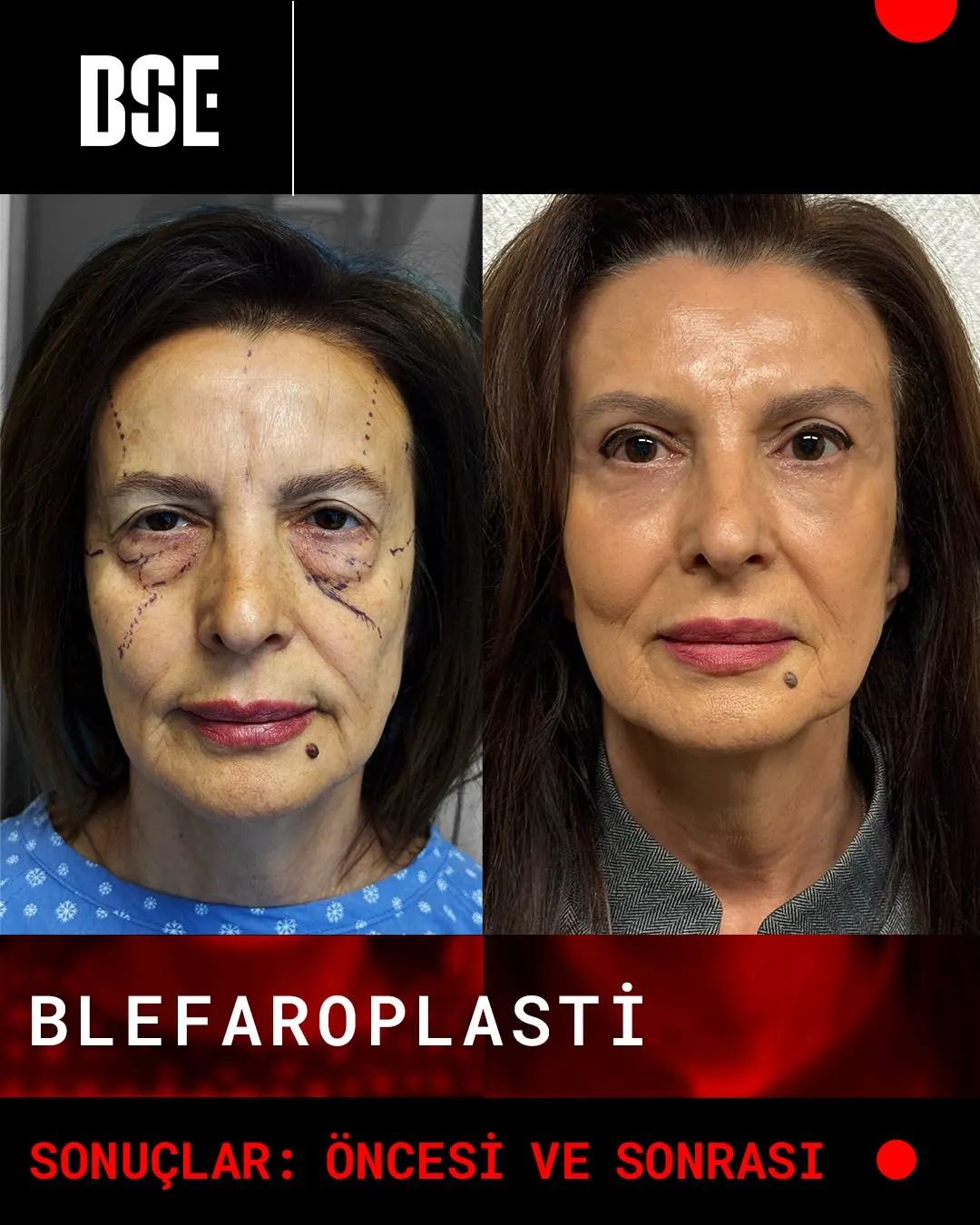
Eyelid surgery before and after
This patient's main concern was eyes that looked tired. The examination found three things working together: skin on the upper lids, bags on the lower lids and a brow that had dropped at the outer end. Eyelid surgery alone would have left the heaviness from the brow in place, so the lids, the brow and the volume of the cheek were treated in one operation.
The aim was a face that looks rested, not one that looks operated on. The eye shape stays her own, and the upper lid keeps some of its natural fullness.
Every case is shown with the patient's written consent. There are more results in the full before and after gallery.
Eyelid or brow: how to tell where the heaviness comes from
This is the most useful thing to understand before a consultation. The eyebrow and the upper eyelid work as one unit. When the brow drops, the lid skin folds down with it, and the eye looks hooded even if the lid itself has barely changed.
Usually the eyelid
Upper blepharoplasty is often enough.
- The brow sits at or above the bony rim above the eye
- Lifting the brow with a fingertip changes little, but pinching the lid skin does
- Eyeshadow creases or smudges onto the fold during the day
- The heaviness is even across the whole lid, not mainly at the outer corner
Usually the brow
Lid surgery alone would not fix it.
- The outer brow sits low, at or below the bony rim
- Lifting the outer brow with a fingertip gives the look you want
- You raise your forehead without noticing to see clearly, and have deep forehead lines from it
- Earlier eyelid surgery helped for a while, then the hooding came back
The mirror test is a fair first guide, not a diagnosis. At the examination the brow position, lid skin, fat, muscle strength and tear film are all checked, because taking too much skin from a lid that is being pulled down by a low brow can make the brow drop further.
A lid that suddenly droops, a change in vision, or swelling on one side only is checked medically first. Those are not cosmetic questions.
Common eyelid concerns, and what each usually needs
Most people arrive with one of these concerns in mind. The table shows what usually lies behind each one and the approach that tends to help, though your own examination decides it.
| Concern | What usually causes it | Usual approach | Downtime |
|---|---|---|---|
| Hooded upper lids | Extra lid skin, a low outer brow, or both | Upper blepharoplasty, brow lift, or the two together | About 1 to 2 weeks |
| Heavy lids that block vision | Marked skin excess resting on the lashes, sometimes with ptosis | Upper blepharoplasty, with ptosis repair if the lid edge is low | About 2 weeks |
| Bags under the eyes | Fat pushing forward under the lower lid | Lower blepharoplasty, usually from inside the lid | About 2 weeks |
| Dark hollows under the eyes | Volume loss along the tear trough, often next to bags | Fat repositioned during lower blepharoplasty, or fat grafting | About 2 weeks |
| Almond or lifted eye shape | The angle of the outer eye corner | Canthoplasty or canthopexy, assessed separately | About 1 to 2 weeks |
The almond eye look is a different operation from blepharoplasty, and it is planned with more caution because it changes the shape of the eye rather than removing tiredness. Our guide to the types of canthoplasty explains the options and their limits.
Not sure whether it is your eyelids or your brows?
Three photographs, straight ahead, eyes closed and from the side, are enough for a first answer. The reply comes from the clinic, usually within about 15 minutes on weekdays.
Who eyelid surgery suits, and when to wait
This is the part of the consultation that matters most. Eyelid surgery is a good answer to excess skin and fat, and a poor one when the eye surface or general health is not ready for it.
Usually a good fit
Where the cause is clear and the eyes are healthy.
- Skin or fat that makes the eyes look tired or heavy, and that has not changed with sleep, diet or eye creams.
- A healthy eye surface. No untreated dry eye, and contact lenses tolerated comfortably.
- Stable general health, with blood pressure and blood sugar under control.
- Smoking stopped well before the date, and blood-thinning medicines reviewed with your doctor.
Better to wait, or start elsewhere
Not a refusal, a question of timing.
- Significant dry eye. It is treated and settled first, because eyelid surgery can make it worse for a while.
- Active thyroid eye disease. Surgery waits until the condition has been stable for some time, and is planned with the endocrinologist.
- Recent laser eye surgery. The eye surface needs several months to recover before the lids are operated on.
- Under 18, or wanting a different eye shape to follow a trend rather than to correct heaviness.
If you have tried sleep, creams and makeup and the heaviness is still there in every photograph, you are the typical patient for this operation. If you are unsure, send your photographs and ask.
Can tired eyes be improved without surgery?
Sometimes. It depends on whether the problem is skin, fat, brow position or volume, and the honest answer differs for each route people try first.
With eye creams
They help the skin's surface and can make fine lines less obvious. They do not remove extra skin or the fat behind a bag.
With filler
Filler can soften a hollow below the eye in well-chosen cases. It does not treat bags, and in the wrong lower lid it can make puffiness look worse.
With a "Botox brow lift"
Small doses of toxin can lift the outer brow by a millimetre or two for a few months. That is enough for mild hooding, and it can show whether a surgical brow lift would help.
With laser and skin tightening
Resurfacing improves fine lines and skin quality on the lower lid. It cannot remove a fold of upper lid skin or a fat bag.
With makeup
Shading along the bony rim makes the lid look deeper and more open. It is useful while you decide, and it does not change the tissue.
If the heaviness is visible in every photograph and nothing above has made a lasting difference, surgery is usually the more reliable answer. For the wider picture of how the eyes age alongside the cheeks and jawline, see the facelift page.
How eyelid surgery is performed
An upper blepharoplasty takes about an hour, and upper and lower lids together take two to three. The order below is the same for most patients, with the balance between the steps set by what your examination found.
- 1.
Marking sitting up
The lids are marked while you sit upright, because that is how the eyes are seen. The amount of skin is measured so that the eyes can still close fully afterwards.
- 2.
Anaesthesia
Local anaesthesia with sedation for the upper lids alone. General anaesthesia when the lower lids, a brow lift or other facial work are combined.
- 3.
Upper lid through the natural crease
Extra skin is removed through an incision in the lid crease, with a thin strip of muscle or a little fat only where it is needed. Some natural fullness under the brow is kept, because a hollow upper lid looks older.
- 4.
Lower lid from inside or below the lashes
Bags are treated from inside the lid when the skin is good, or through a fine line below the lashes when there is loose skin. Fat is usually moved into the hollow below rather than simply removed, and the outer corner is supported where the lid is lax.
- 5.
Closure and cold compresses
Fine sutures close the upper lid. Cold compresses start in the recovery room, and most patients go home the same day.
When a brow lift is part of the plan, it is done first, because raising the brow changes how much lid skin needs to come off. Taking the skin first and lifting the brow afterwards is how lids end up unable to close fully.
Eyelid surgery recovery, week by week
Recovery is shorter than most patients expect, and the part that needs patience is swelling rather than pain.
- First 48 hours
Cold compresses, head raised
The lids feel tight and swollen rather than sharply painful, and ordinary painkillers usually cover it. Cold compresses, sleeping with the head raised and lubricating drops are what help most.
- First week
Review and stitches out
Swelling and bruising peak around day two or three, then fade. The review falls at around day five to seven, when the upper lid stitches come out.
- Weeks two to three
Back to normal days
Most people return to desk work and go out without dark glasses. Makeup can go on once the incisions have healed, and contact lenses usually return at about two weeks.
- Weeks three to six
Exercise and screens
Light exercise is fine from the second week and full training from around the fourth. Eyes may tire more quickly in front of screens for a few weeks, and drops help.
- Two to three months
The result you keep
The last swelling settles, especially in the lower lids. The scar in the upper lid crease keeps fading for several months and is usually hard to see.
What decides how smoothly this goes: cold compresses in the first two days, using the drops you are given, avoiding bending and heavy lifting for the first week, and not smoking. Combining the eyes with a brow lift or a deep plane facelift adds a few days of swelling, not a separate recovery.
What can go wrong, and what reduces it
Eyelid surgery is a common operation, not a minor one. These are the problems that come up in practice, and what is done about each.
Dry, gritty eyes
The most common complaint in the first weeks, especially in people with a sensitive eye surface beforehand.
What reduces it: checking the tear film before surgery, conservative skin removal and lubricating drops while it settles.
Lids that do not close fully
Called lagophthalmos, usually from too much upper lid skin being removed or from swelling in the first days.
What reduces it: measuring the skin sitting up, and lifting a low brow before taking lid skin.
Lower lid pulling down
White showing below the iris, or a lid that turns outward, after lower lid surgery.
What reduces it: testing lid laxity before surgery and supporting the outer corner when it is needed.
A hollow, over-operated look
An upper lid that looks sunken because too much fat was removed.
What reduces it: keeping natural fullness, and moving lower lid fat into the hollow instead of discarding it.
Asymmetry
Lids or creases that settle slightly differently on each side.
What reduces it: marking each side separately and pointing out existing differences beforehand.
Bleeding
Usually minor bruising. Bleeding behind the eye is rare, but it is an emergency.
What reduces it: stopping blood thinners as advised, controlling blood pressure, and calling the clinic at once for severe pain, a hard swollen eye or a change in vision.
Small white spots along the scar and some tearing or light sensitivity are common for a few weeks and usually settle on their own. Anything that appears suddenly, such as severe pain or a change in vision, is reviewed straight away rather than at the next appointment.
See how the surgeon thinks, then ask about your own eyes
Dr. Burak posts cases and short explanations as they come up. This one shows why a higher brow is not automatically a better result, and why keeping some fullness in the upper lid matters. More results are in the before and after gallery.
Send your own photographs and you get a straight answer about what surgery would and would not change for you.
From the clinic on Instagram
@drburaksercanercin
Assoc. Prof. Dr. Burak Sercan Erçin
Plastic, reconstructive and aesthetic surgery
Eyelid surgery is part of the practice's facial rejuvenation work. It is often planned together with a brow lift, fat grafting or a facelift, so that the eyes match the rest of the face instead of looking newer than it.
The reconstructive side of the training shapes how it is done. Years of microsurgery and rebuilding eyelids after trauma, tumours and facial paralysis teach how little tissue the eye can spare, and that a lid has to close and protect the eye before it can look good.
- EBOPRAS board certification
- University faculty post in the specialty
- Peer-reviewed publications in the field
- Consulting in English, operating in Istanbul
Coming to Turkey for eyelid surgery
Most international patients plan around a week in Istanbul, which covers the operation and the stitch removal. Combining the eyes with a brow lift or facelift usually adds a few days.
- 1.
Send photographs and your history
Three photographs without makeup, a line about what bothers you, and any eye conditions, contact lens use, previous eye surgery and medicines.
- 2.
Video consultation
A conversation with the surgeon rather than a coordinator, covering what is realistic, whether the brow is involved, and the likely scars.
- 3.
Dates and preparation
Surgery date, hospital, pre-operative tests, and a written list of what to stop and when. Travel is arranged around the stitch removal.
- 4.
Examination, surgery, first days
In-person examination and marking before surgery, then the operation with same-day discharge in most cases and a quiet first few days.
- 5.
Review, then follow-up from home
Stitches out and review at around day five to seven before you fly, then remote follow-up at the points where something is worth checking.
Flying is confirmed at the review rather than booked in advance, because it depends on how the swelling is settling. To start, send your details through the contact page.
Eyelid surgery questions people ask before booking
These come up in almost every consultation. If yours is not here, it is quicker to ask it directly than to read around it.
How long do the results of eyelid surgery last?
Upper eyelid results usually last many years, and lower eyelid results are often longer-lasting still, because the fat that formed the bags is repositioned or removed. The face keeps ageing, so some skin can return to the upper lid over time, especially if the brow drops.
A small touch-up years later is possible, but most patients never need one.
Will there be visible scars?
The upper lid scar sits in the natural crease and is usually hard to see once it has faded, which takes a few months. Lower lid surgery from inside the lid leaves no visible scar. When loose skin is removed below the lashes, the line sits just under the lash line and fades well.
Is eyelid surgery painful?
Most patients describe tightness and soreness rather than real pain. Ordinary painkillers and cold compresses cover the first two days for most people.
When will I look presentable again?
Most people go out without dark glasses and return to desk work after 7 to 10 days. Some bruising can be covered with makeup once the incisions have healed, at around 10 to 14 days.
Do I need a brow lift instead of eyelid surgery?
If lifting your outer brow with a fingertip gives the look you want, the brow is probably part of the problem. In that case a brow lift, alone or with a conservative upper blepharoplasty, usually gives a better and longer-lasting result than removing more lid skin.
Can upper and lower eyelids be done at the same time?
Yes. Upper and lower blepharoplasty are commonly done together in one operation of two to three hours, and recovery runs in parallel rather than doubling.
Can eyelid surgery be combined with a facelift?
Yes. Eyelid surgery is often combined with a facelift, a brow lift or fat grafting, so the eyes match the rest of the face. Combining adds a few days of swelling, not a separate recovery.
What is the right age for eyelid surgery?
There is no fixed age. Hereditary under-eye bags can appear in the twenties, while upper lid skin excess is more common from the forties onward. What matters is a clear cause, healthy eyes and good general health. Cosmetic eyelid surgery is not performed under 18.
Is eyelid surgery in Turkey safe?
Eyelid surgery in Turkey can be safe when a board-certified plastic surgeon plans and performs it in a properly equipped hospital, with clear aftercare. Check the surgeon's certification, ask to see eyelid results, and make sure follow-up is arranged for after you return home.
If your question is about your own eyes rather than the operation in general, ask the surgeon and include a photograph.
Where to go next
If the eyes are only part of what you want to change, one of these is the next page to read.
Procedures often planned alongside it
Find out whether your eyelids, your brows or both need attention
Send photographs and a short description, and you will get a straight answer about what is causing the heaviness, which operation would help, and what to expect afterwards.
The first consultation is free and your details stay confidential under GDPR.

