
Liposuction in Istanbul
Liposuction removes fat that has settled in one area and stayed there through diet and training. It is not a weight-loss operation, and on its own it does not tighten skin. Most of the liposuction performed here is part of a wider plan, usually a mommy makeover or an abdominoplasty, because after pregnancy or weight change fat is rarely the only thing that has shifted.
- EBOPRAS board certification in plastic surgery
- Reconstructive microsurgery background
- Faculty post in plastic and reconstructive surgery
- Operating in a full-service hospital, Istanbul

Every plan starts with an examination in Kadikoy, where the fat, the skin and the abdominal wall are assessed separately.
Ask before you book anything
Send standing photographs and a short note about what bothers you. You get an answer about whether liposuction is the right operation for you, and what it would cost you in time.
Send photographs on WhatsAppBook a consultationCall +90 533 433 52 50- Weekdays 09:00 to 20:00, Istanbul time
- First consultation is free, and your details stay confidential under GDPR
What liposuction does, and what it does not do
Liposuction removes fat cells from a defined area through small openings in the skin, using a thin cannula and suction. It changes the shape of that area. It does not change what the scale says in any meaningful way, and it is not a treatment for being overweight.
The people it suits best are close to a stable weight and have one or two places where fat has stopped responding: the lower abdomen, the flanks, the inner thighs, under the chin. Skin quality decides much of the result. Where skin has lost its elasticity, taking fat out from underneath can leave the surface looser than before, which is why an examination comes before any plan.
After pregnancy this matters more than anywhere else. Fat, stretched skin and separated abdominal muscles usually arrive together, and liposuction addresses only the first of the three. That is why it is most often performed here as one part of a mommy makeover rather than on its own.
Where liposuction is used
Fat behaves differently depending on where it sits. Some deposits shrink readily with weight loss, others stay almost unchanged whatever you do, and those are the ones worth treating surgically.
Face and neck
- Under the chinThe submental pad that blurs the jawline. Small volumes, and the result depends heavily on how well the skin retracts.
- CheeksRarely treated with suction alone. Facial fullness is often structural rather than fatty, so it is assessed before anything is planned.
- NeckUsually treated together with the submental area to keep the transition from chin to neck smooth.
Torso
- AbdomenThe most requested area and the one most often needing more than suction, particularly after pregnancy.
- Waist and flanksTreating the flanks is what actually creates a waistline. The abdomen alone rarely does it.
- HipsWorked in continuity with the flanks and outer thighs so the contour reads as one line rather than three treated zones.
- BackRolls above and below the bra line. Fibrous tissue here often makes it slower work than the abdomen.
- ChestIn men, fullness is often glandular rather than fatty, and suction alone will not correct it.
Arms and legs
- Upper and inner armsSuits firm skin. Where the skin has already loosened, an arm lift addresses what suction cannot.
- Inner and outer thighsContour here is easy to overtreat, so conservative removal usually reads better than aggressive removal.
- KneesA small deposit above the inner knee that resists exercise and is often treated alongside the thigh.
Whether an area is worth treating has more to do with skin quality and your weight history than with the fat itself. Our guide to body mass index and liposuction covers where that line usually falls.
Who liposuction suits, and who it does not
This is the part of the consultation that matters most. Liposuction is a good operation for a narrow problem, and a poor answer to several problems that look similar from the outside.
Usually a good fit
Where fat is the only thing in the way.
- Localized fat that resists diet and training. A deposit that has stayed put while the rest of you responded is exactly what suction is designed for.
- A weight that has been stable for months. Contouring a body that is still changing gives you a result that changes with it.
- Skin that still springs back. Elastic skin redrapes over the smaller volume, and that is what makes the shape read cleanly.
- General health that allows anaesthesia, with any long-term conditions under control and smoking stopped well before the date.
Better served by something else
Not a refusal, a different operation.
- Loose or hanging skin. Removing what fills it makes it hang further. A tummy tuck removes the skin itself.
- Separated abdominal muscles after pregnancy. The bulge is the abdominal wall rather than fat, and it is repaired inside a mommy makeover.
- Wanting to lose weight overall. Liposuction reshapes; it does not treat obesity, and it will not do the work that a stable routine does.
- Fullness that turns out not to be fat, such as glandular breast tissue in men, or a firm abdomen that is full behind the muscle rather than in front of it.
In practice most people after pregnancy or a significant weight change sit somewhere between the two columns, with fat in some places and loose skin in others. That is the ordinary case rather than the difficult one, and it is what a combined plan is for. If you are not sure which column you are in, send your photographs and ask.
The techniques, and what actually separates them
Clinics market these as though the device decides the outcome. It does not. Every method below removes fat through the same small openings, and the differences show up in how fibrous tissue is handled and how much work the surgeon has to do by hand.
| Technique | How it works | Where it helps | Trade-off |
|---|---|---|---|
| TumescentThe basis of all of the below | A dilute fluid with local anaesthetic and adrenaline is infiltrated first, firming the tissue and reducing bleeding. | Every area. This is the groundwork rather than an alternative to the others. | None in itself. The fluid takes time to work and that time is not optional. |
| Power-assistedPAL | The cannula vibrates rapidly, so it passes through tissue with less force from the surgeon. | Larger areas and fibrous zones such as the back and the male chest. | Speed can tempt over-removal, so the discipline has to come from the surgeon. |
| Ultrasound-assistedOften sold as VASER | Ultrasound energy loosens fat before it is suctioned. | Dense, fibrous tissue, revision cases, and definition work where precision matters. | Energy near the skin needs care, and operating time is longer. |
| Laser-assisted | Laser energy is delivered through a fibre to break down fat and warm the deeper skin layer. | Smaller areas such as under the chin. | The skin-tightening effect is modest and does not substitute for a lift. |
| Fat transferNot a removal method | Fat removed by any of the above is purified and reinjected where volume is wanted. | Restoring contour rather than only reducing it. | A proportion of the transferred fat does not survive, so the plan allows for it. |
Which one is chosen for you follows from the tissue and the area, and it is decided at the examination rather than booked in advance from a price list. Our note on body shaping with liposuction covers how the areas are planned together.
How recovery actually runs
Swelling is the reason liposuction takes months to show its result rather than weeks. Almost everything below is about managing that patiently.
- First 48 hours
Garment on, and moving early
You wake in a compression garment and you keep it on. Expect leakage of the infiltrated fluid from the entry points for the first day, which is normal and stops on its own. Short walks around the room start the same evening, and lying still is the one thing to avoid.
- First week
The worst of the bruising, and the first review
Bruising peaks and then fades, and the treated area feels tight, firm and numb in patches. Sutures usually come out around day seven at your first review, which is also when travel home is discussed if you have come from abroad.
- Weeks two to four
Back to ordinary days
Most people return to desk work in the first week or two, and to a fuller social and working routine around week three. The garment stays on through this period. Lifting and anything that strains the treated area waits.
- Weeks four to eight
Garment comes off, exercise comes back
The garment is worn for four to eight weeks depending on the area and how you are healing. Exercise restarts around the one-month mark, gently at first. The shape at this point is real but still carries swelling.
- Three to six months
The result you keep
Deep swelling resolves slowly and firmness in the tissue softens over the same period. Judging the outcome earlier than three months is judging swelling, and scars from the entry points continue to fade well past six.
What decides how smoothly this goes
Garment compliance, walking early, not smoking, and not chasing the scale in the first month. Those four do more for the result than the choice of device. There is more detail in our guide to recovering well after liposuction.
What can go wrong, and what reduces it
Liposuction is a common operation, not a minor one. These are the things that come up in practice, and what is done about each.
Contour irregularity
Dips, ridges or unevenness where fat was removed unevenly or too superficially. It is the most common reason people seek revision.
What reduces it: removing less than the maximum, working across zones rather than into one spot, and keeping the cannula in the deeper plane.
Seroma
Fluid collecting under the skin, usually in the larger treated areas. It shows as a soft swelling that does not settle with the rest.
What reduces it: consistent compression, and drainage in clinic if a collection does form, which is straightforward when it is caught early.
Prolonged swelling and firmness
The treated tissue can stay firm and swollen for months. This is expected rather than a complication, but it is the thing people are least prepared for.
What reduces it: wearing the garment for the full period and giving the result the three to six months it needs before judging it.
Asymmetry
Sides that settle slightly differently. Some pre-existing asymmetry is present in almost everyone and becomes more visible once volume is reduced.
What reduces it: marking and photographing standing before surgery, and pointing out existing differences at the consultation rather than after.
Skin that does not retract
Where elasticity was already reduced, the skin can look looser after the fat beneath it is gone.
What reduces it: honest assessment beforehand, and recommending a lifting procedure instead when that is the truthful answer.
Anaesthetic and clot risk
As with any operation under general anaesthesia, there is a small risk of clots and of anaesthetic complications, higher in longer combined cases.
What reduces it: pre-operative assessment, walking on the day of surgery, and preventive measures where your risk profile calls for them.
Numbness in the treated area is normal for weeks to months and almost always resolves. Anything that appears suddenly, such as one-sided pain, spreading redness, fever or breathlessness, is not part of the expected course and should be reported the same day.
Before and after, and what to look for in them
Photographs are only useful when they are taken the same way twice. These are shot standing, at the same distance and in the same light, at least three months apart, because anything earlier is a picture of swelling rather than of a result.
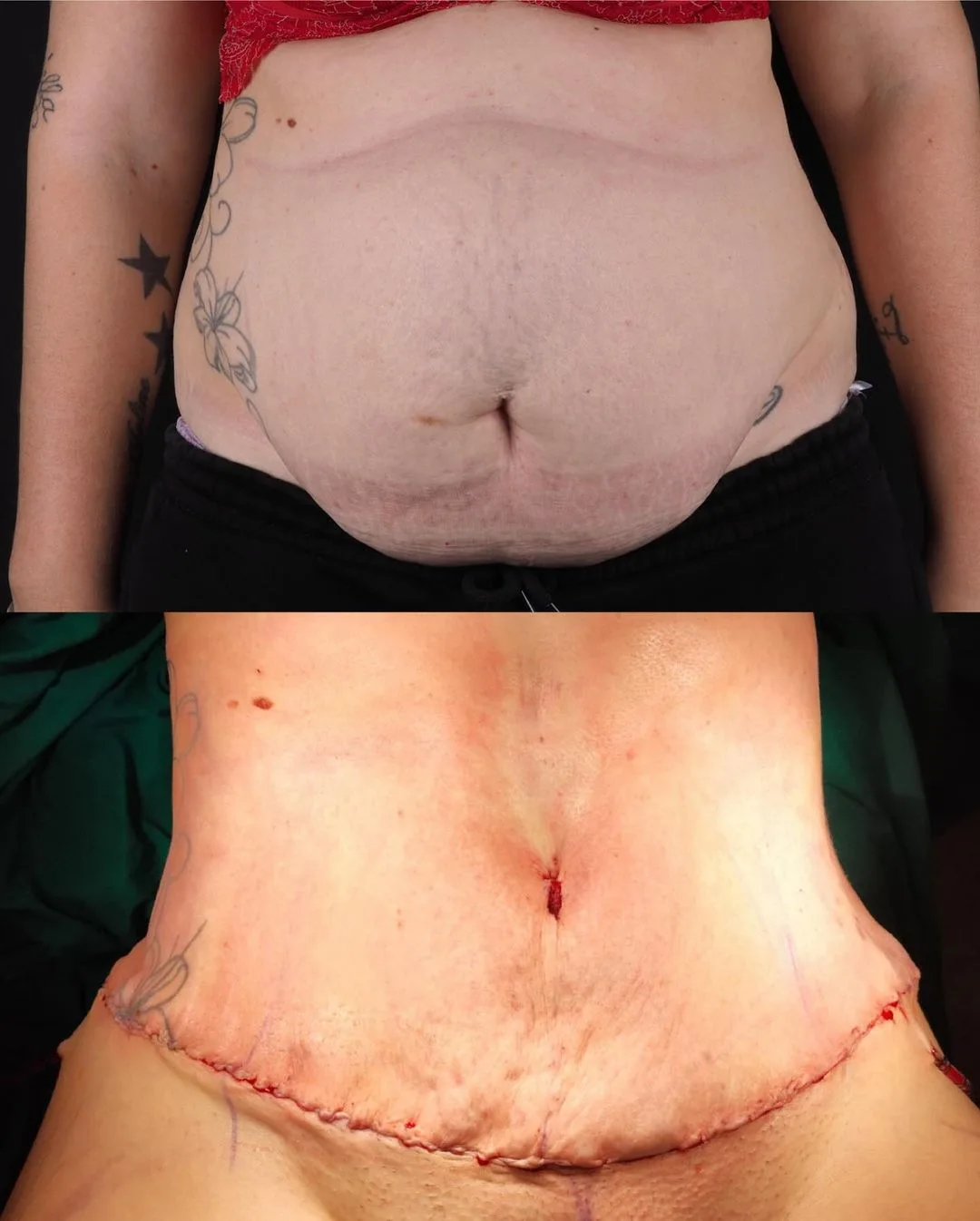
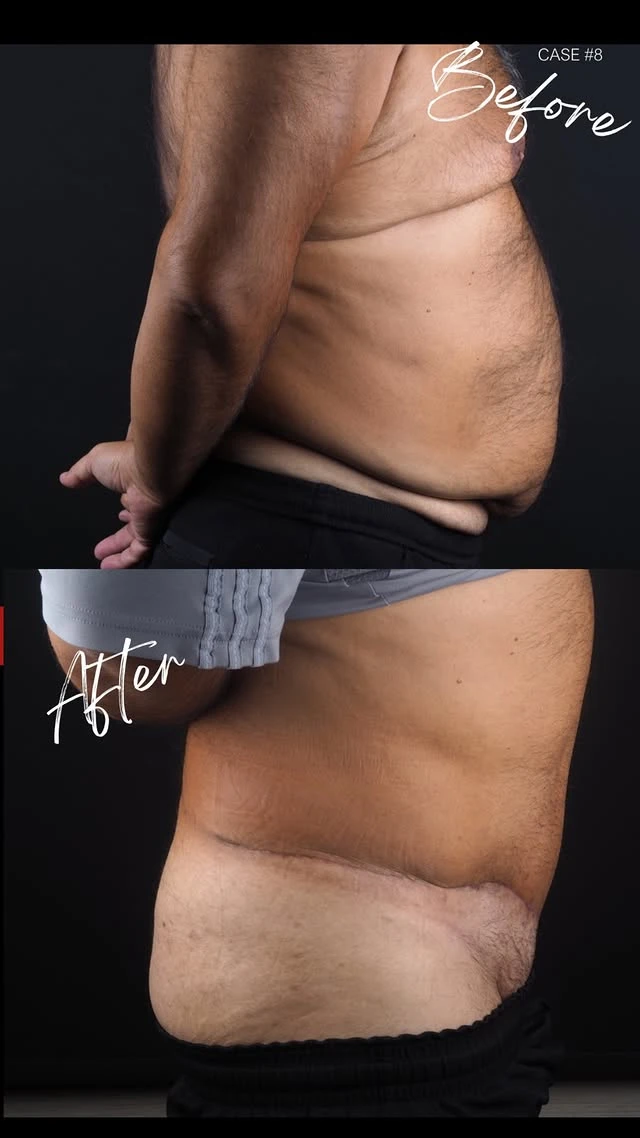
Every case is shown with the patient's written consent, and no image is retouched. Results differ from person to person because skin quality, weight history and healing differ. There are more cases in the full gallery.

Assoc. Prof. Dr. Burak Sercan Erçin
Plastic, reconstructive and aesthetic surgery
Body contouring after pregnancy and weight change is the centre of the practice, and liposuction is one instrument within it rather than a service sold on its own. Cases are planned around what the abdominal wall and the skin need, with fat removal fitted to that plan.
The reconstructive side of the training is what informs it. Time spent on microsurgery and on rebuilding tissue after injury and cancer changes how you think about taking tissue away: how much a plane can tolerate, where blood supply runs, and when an operation should be smaller than the patient expects.
- EBOPRAS board certification
- University faculty post in the specialty
- Peer-reviewed publications in the field
- Consulting and operating in Istanbul
Coming from abroad
Most international patients plan around ten days in Istanbul for a single-area case. A combined operation usually means longer, and that is agreed before you book anything.
- 1.
Send photographs and your history
Standing photographs of the area, your weight history, past operations and any medication. Enough to say whether liposuction is the right operation for you at all.
- 2.
Video consultation
A conversation with the surgeon rather than a coordinator, covering what is realistic, what is not, and whether a combined plan makes more sense.
- 3.
Dates and preparation
Surgery date, hospital, pre-operative tests, and a written list of what to stop and when. Travel is arranged around the date, not the other way round.
- 4.
Examination, surgery, first days
In-person examination and marking the day before or the morning of surgery, then the operation and either same-day discharge or one night in hospital.
- 5.
Review, then follow-up from home
Review at around a week before you travel back, then remote follow-up at the points where something is worth checking rather than on a fixed schedule.
Flying is discussed at the review rather than booked in advance, because it depends on how you are healing and on the length of the flight. If you would rather start with a written answer than a call, send your details through the contact page and you will get a reply from the clinic.
See a case like yours, then ask about your own
Cases are posted as they settle, which is the easiest way to see how a contour changes between the first month and the sixth. Send your own photographs and you get a straight answer about what liposuction would and would not do for you.
- Reply within about 15 minutes on weekdays
- First consultation free, confidential under GDPR
Questions people ask before booking
These come up in almost every consultation. If yours is not here, it is worth asking directly rather than reading around it.
Will liposuction help me lose weight?
Not in any way that matters. The change on the scale after liposuction is small, and it is not the point of the operation.
What changes is shape. Fat is removed from a specific area so that the outline of that area is different, which is a separate goal from weighing less. If losing weight is the aim, that work comes first and liposuction comes afterwards, if it is still needed.
How much fat can be removed in one operation?
There is no single figure, and any clinic quoting one before examining you is quoting a sales number rather than a surgical one.
The volume that is safe depends on your size, your health, how many areas are being treated and whether anything else is being done at the same time. Larger removals shift the operation into a setting with closer monitoring, which is a decision made on medical grounds.
Will the fat come back?
The fat cells removed from the treated area do not return. The cells left behind, and those everywhere else, still respond to weight gain by getting larger.
So the result holds at a stable weight and changes if your weight climbs, sometimes distributing differently than it used to, because the treated area now has fewer cells to fill. This is the main reason the operation is offered to people whose weight has settled.
Can it tighten loose skin after pregnancy?
No. Skin retracts on its own where elasticity remains, and where it does not, removing the fat underneath tends to make looseness more obvious.
After pregnancy the abdominal skin has usually been stretched and the muscles beneath it often separated. Those are addressed by a tummy tuck or within a mommy makeover, with liposuction used alongside them to refine the contour.
Can liposuction be combined with other operations?
Yes, and here it usually is. Combining is what makes a post-pregnancy plan work, because fat, skin and muscle rarely need attention in isolation.
Combining lengthens the operation and the recovery, so it is planned around your health rather than around convenience. Where the combined case would be too long to be safe, it is staged instead.
What anaesthesia is used?
General anaesthesia for most cases, and sedation with local anaesthesia for small single areas such as under the chin.
Which one applies to you is decided with the anaesthetist after your pre-operative assessment, taking the number of areas and your medical history into account.
How long do I wear the compression garment?
Four to eight weeks, depending on the area and how you are healing. It goes on in theatre and stays on nearly all the time in the first weeks.
It is not optional comfort wear. Consistent compression is one of the few things that visibly changes how evenly the area settles, and it is the instruction people most often relax too early.
When can I fly home?
Usually after the review at around a week, once the surgeon has seen how you are healing. It is a clinical decision rather than a fixed rule.
Long flights soon after surgery carry a clot risk, so the timing takes the flight length into account, along with moving regularly and staying hydrated on the day you travel.
Will there be visible scars?
The entry points are a few millimetres across and are placed in creases and shadows where possible. They stay pink for some months and then fade considerably.
Scars never disappear entirely, and how yours mature depends partly on your skin. In a combined operation the longer incision belongs to the lift rather than to the liposuction.
When will I see the final result?
Three to six months for most people. You will see a change much earlier, but you will be looking at a shape that still holds swelling.
Revision, if it is ever needed, is not considered until the tissue has fully settled, because operating on swollen tissue produces an unreliable answer.
If your question is about your own case rather than the operation in general, it is quicker to ask it directly.
Ask the surgeonWhere to go next
If liposuction turned out not to be the operation you were looking for, one of these probably is.
Procedures often planned alongside it
Mommy makeover
Abdominal skin, muscle separation and contour treated together after pregnancy. The plan liposuction most often belongs to.
Tummy tuck
Removes stretched abdominal skin and repairs the muscle wall, which is the answer when the problem is not fat.
Male body contouring
Chest and torso work in men, where fullness is often glandular rather than fatty and needs a different approach.
Worth reading first
Body mass index and liposuction
Where the line usually falls between contouring and weight loss, and why it is asked about at the first consultation.
Body shaping with liposuction
How areas are planned in relation to each other so the outline reads as one line rather than several treated zones.
Recovering well afterwards
The habits in the first six weeks that make the largest difference to how evenly the area settles.
Find out whether this is your operation
Send photographs and a short description of what bothers you, and you will get a straight answer about whether liposuction addresses it, whether something else does, or whether the two work better together. That answer comes from the surgeon.
- Reply within about 15 minutes on weekdays
- No price quoted before an examination
- English-speaking contact throughout
The first consultation is free and your details stay confidential under GDPR.

