This article was written by Assoc. Prof. Dr. Burak Sercan Erçin and is based on clinical experience. A specialist in Plastic, Reconstructive and Aesthetic Surgery; prepared in accordance with current medical literature and personal surgical data. A consultation is recommended before making any medical decisions.

If you’ve been researching ways to achieve a sharper, more defined eye shape and have come across the term “hunter eyes,” you are far from alone. Across consultations in Istanbul, this is one of the most searched and most misunderstood aesthetic topics we encounter today. Patients arrive with questions that go well beyond the surface: What does the procedure actually involve? Is it surgical or non-surgical? Am I a realistic candidate? And perhaps most importantly — will the result look natural?
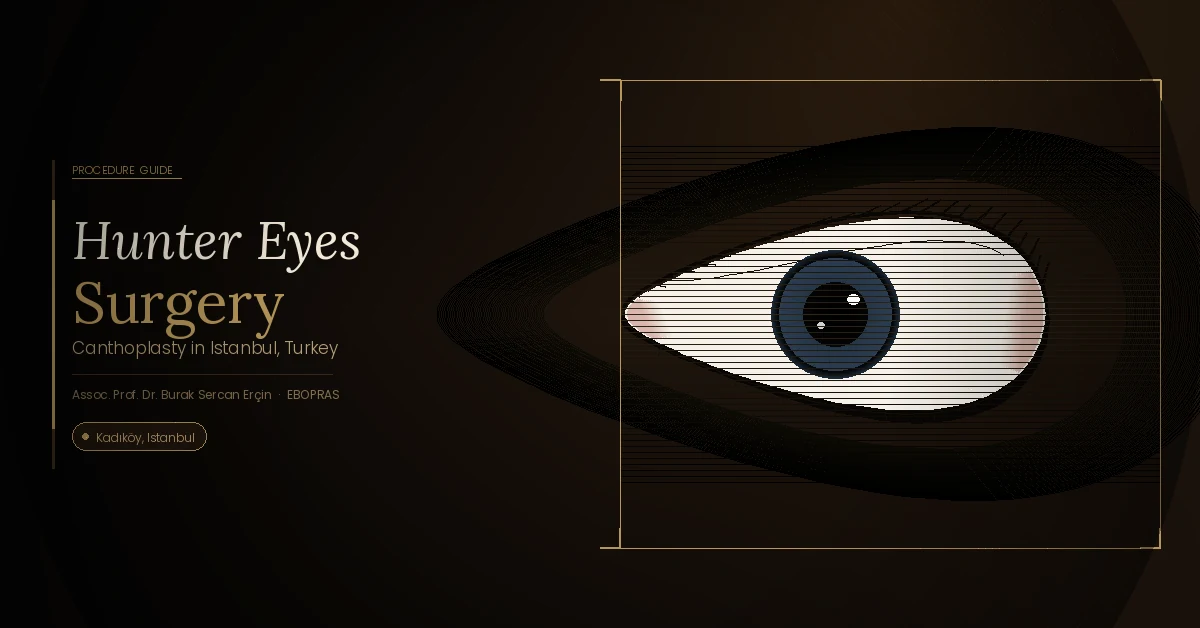
Hunter eyes, in aesthetic medicine, refer to a specific configuration of the eye area characterised by a lateral canthal position that sits level with or slightly above the medial canthus (the inner corner of the eye), a forward orbital rim, and a relatively deep-set appearance under a well-defined brow. The result is an almond-shaped, horizontally elongated eye that many patients associate with a defined, alert, and structured facial appearance. Achieving this through surgery involves a group of procedures, most commonly canthoplasty or canthopexy, and sometimes lateral orbital fat repositioning or brow-related interventions.
This guide is written to help you understand the full picture: the anatomy involved, the surgical and non-surgical options available, who tends to benefit from each, and what recovery in Istanbul typically looks like for international patients.
What Are “Hunter Eyes” — And Why Does the Eye Shape Matter?
The term “hunter eyes” is a colloquial description that has migrated from social media into clinical consultations. While it is not a formal medical term, the anatomical features it describes are well-defined and surgically addressable. Understanding the anatomy is the first step toward understanding what can — and cannot — be achieved.
The key structural elements involved are:
- The lateral canthus: The outer corner where the upper and lower eyelids meet. In a typical aesthetic configuration, this sits at roughly the same horizontal level as the medial canthus. When it droops below the medial canthus, the eye takes on a downward, tired appearance.
- The orbital rim: The bony framework around the eye. A forward or prominent orbital rim creates the characteristic “deep-set” shadow that many associate with a hunter eye appearance.
- The canthal tilt: The angle between the inner and outer corners of the eye. A slightly positive canthal tilt — where the lateral canthus sits higher than the medial — is the defining feature of the look most patients are pursuing.
- Periorbital fat distribution: The volume and positioning of fat pads around the orbit influence how the eye sits within the face and how shadows and highlights fall.
Not all of these features can be surgically altered with equal precision, and not all are appropriate targets for intervention in every patient. This is why an in-person anatomical assessment is essential before any plan is formed.
What Procedures Are Used to Create a Hunter Eye Appearance?
Several surgical and non-surgical techniques can be used, either alone or in combination, depending on the patient’s starting anatomy. Below is a structured overview.
Canthoplasty and Canthopexy: The Foundation of Hunter Eyes Surgery
Canthoplasty (reconstruction or repositioning of the lateral canthal tendon) and canthopexy (suspension of the existing tendon without detachment) are the primary surgical tools used to alter canthal position and tilt.
Canthopexy is generally considered a less invasive approach: the lateral canthal tendon is elevated and secured without being detached, making it suitable for patients with mild to moderate laxity. Canthoplasty involves detaching and repositioning the tendon, allowing more significant adjustment of the outer corner’s vertical position. Both procedures address canthal tilt and can produce the upward, elongated eye shape associated with the hunter eye aesthetic.
The distinction between these two procedures matters clinically. Patients often research one term and arrive expecting the other. In practice, the right choice depends on your specific anatomy — not on the name you’ve read online.
Lateral Canthoplasty for Almond Eye Reshaping
A specific application of canthoplasty involves not only elevating the lateral canthus but also horizontally elongating the palpebral fissure (the visible opening of the eye). This procedure, sometimes called almond eye surgery or Fox eye surgery, extends the outer corner of the eye laterally to create a more elongated appearance. It requires careful attention to the integrity of the canthal tendon and surrounding periorbital structures.
Non-Surgical Approaches: Thread Techniques and Toxin Injections
For patients who are not ready for surgery or who present with mild anatomical changes only, non-surgical options exist. Botulinum toxin (commonly known as Botox) injected at the lateral orbicularis muscle can create a mild upward rotation of the outer corner by relaxing the depressor action of the muscle. The effect is temporary, lasting typically three to four months, and is modest in magnitude.
Thread-based canthoplasty uses absorbable suture material to suspend and elevate the lateral canthus without open surgery. Results are generally shorter-lived than surgical canthoplasty and are more variable, depending heavily on the technique and the individual’s tissue characteristics.
Neither non-surgical option produces results equivalent to surgical canthoplasty in patients with significant laxity or structural asymmetry. They can, however, be appropriate for the right candidate and serve as a useful preview of the aesthetic direction before committing to surgery.
Who Is a Suitable Candidate for Hunter Eyes Surgery?
Candidacy for any periorbital surgery requires a detailed anatomical and medical assessment. Generally speaking, patients who may benefit from canthoplasty or canthopexy include those with:
- A flat or negative canthal tilt (outer corner sitting below the inner corner)
- Visible lower eyelid laxity contributing to a tired or sagging appearance
- Mild to moderate horizontal palpebral fissure shortening
- Realistic expectations and a clear understanding of what surgery can achieve
- Good overall health with no active ocular conditions
Patients who are generally not suitable candidates include those with:
- Active thyroid eye disease or other orbital conditions
- Significant dry eye syndrome or corneal sensitivity
- A history of previous periorbital surgery that has altered the canthal anatomy significantly
- Unrealistic expectations regarding the degree of change achievable
- Any condition affecting wound healing or clotting
Age is also a clinical consideration. Periorbital anatomy changes significantly over time, and the procedure plan for a patient in their late twenties may differ substantially from that appropriate for a patient in their fifties. Gravity, skin laxity, and soft tissue descent all influence what surgical approach is most suitable.
Dr. Erçin’s Note
“In consultations, I often meet patients who have arrived with a very specific reference image — usually from a celebrity or social media figure. The first conversation I always have is about anatomy: your bone structure, orbital depth, and eyelid tension are unique to you, and the most successful outcomes I see are always those tailored to the individual’s face rather than a template. Naturalness is not a compromise — it is the goal.”
The Surgical Process: What Happens During Canthoplasty in Istanbul?
Understanding the procedural process helps patients arrive at their consultation better prepared and with more specific questions.
Consultation and planning: The process begins with a detailed face-to-face assessment. Photographs are taken in standardised positions, and canthal position, tilt, lid laxity, and orbital anatomy are evaluated. The procedure plan is discussed, alternative approaches are considered, and pre-operative instructions are provided.
Anaesthesia: Canthoplasty and canthopexy are generally performed under local anaesthesia with sedation, though some cases may require general anaesthesia depending on the scope of the procedure and patient preference.
The procedure itself: Depending on the approach, incisions are made at or near the lateral canthus, typically within the natural crease or lid margin to minimise visible scarring. The canthal tendon is then elevated, repositioned, and secured. Procedure time is generally between 45 minutes and two hours depending on complexity.
Closure and immediate post-operative care: Fine sutures are placed and the area is cleaned. Patients are observed for a short recovery period before being discharged, usually the same day. Detailed written aftercare instructions are provided.
Recovery After Hunter Eyes Surgery: A Realistic Timeline
Recovery from canthoplasty varies between individuals, and the following should be understood as a general guide rather than a fixed timeline.
Days 1–3: Swelling and bruising around the eye area are expected and typically peak within the first 48 hours. Some patients experience mild tightness at the outer corner. Cold compresses and elevation of the head are recommended.
Days 4–7: Swelling begins to subside. Sutures are typically removed at the one-week mark (where non-absorbable sutures are used). Most patients feel comfortable being seen in public by day 7–10 with minimal visible bruising.
Weeks 2–4: The majority of visible swelling resolves. The final canthal position begins to become apparent, though tissue settling continues.
Months 1–3: Full resolution of residual firmness or minor asymmetry related to healing. The final aesthetic result can generally be assessed at approximately three months post-procedure.
International patients should plan for a minimum stay of seven to ten days in Istanbul to allow for the initial post-operative check and suture removal before flying home. Travel after periorbital surgery carries certain considerations — particularly regarding cabin pressure, dry air, and the practicalities of aftercare away from the clinic. These factors are discussed in detail during pre-operative planning.
Hunter Eyes Surgery vs. Non-Surgical Alternatives: A Comparison
| Metric / Surgery Type | Surgical Canthoplasty / Canthopexy | Botulinum Toxin (Lateral Brow/Orbicularis) | Thread Canthoplasty |
|---|---|---|---|
| Duration of results | Long-lasting (years) | 3–4 months | 6–18 months (variable) |
| Degree of change | Moderate to significant | Mild | Mild to moderate |
| Downtime | 7–14 days | Minimal | 3–5 days |
| Anaesthesia required | Local + sedation | None | Local |
| Suitable for significant laxity | Yes | No | Partial |
| Risk profile | Surgical risks apply | Low | Moderate |
This comparison is illustrative only. The appropriate option for a given patient depends entirely on individual anatomy and goals.
Why Do Patients Choose Istanbul for Hunter Eyes Surgery?
Istanbul has grown into one of the most established destinations for aesthetic surgery in Europe and the wider region, and there are several reasons why international patients, particularly from the UK, Europe, and the Middle East, choose to travel here specifically.
Turkey has a well-developed infrastructure for medical tourism, with internationally accredited hospitals and clinics offering procedures at a cost structure that differs significantly from Western European and UK pricing. This cost difference does not, in itself, indicate a difference in quality — but it does mean that patients can access highly trained surgeons with extensive periorbital surgery experience at more accessible price points.
Istanbul specifically offers the practical advantage of being a well-connected hub: direct flights from most major European cities, a city that accommodates recovery comfortably, and a growing number of clinics with experience in managing international patients through the full care pathway, including aftercare communication and remote follow-up.
The Kadıköy district, where our clinic is located, offers a quieter alternative to central Istanbul while remaining accessible for patients staying across the city. Many patients use their recovery period to experience Istanbul at a gentle pace — which, for the first post-operative week, aligns naturally with the rest requirements following periorbital surgery.
Clinical Note
“Patients travelling specifically for periorbital surgery often ask me whether the timeline is manageable. In the majority of cases, a stay of seven to ten days allows for the initial post-operative period, suture removal where applicable, and a clear handover of aftercare instructions before the return journey. I always recommend that patients remain in Istanbul until I am clinically satisfied with their early recovery. Remote follow-up via video consultation is available thereafter for international patients.”
What Results Can Be Realistically Expected?
This is the question that deserves the most honest answer. Surgical canthoplasty, when appropriately planned and performed, can achieve a meaningful shift in canthal tilt and produce a more structured, almond-shaped eye appearance. Patients with a measurable negative canthal tilt and adequate tissue quality generally see the most clearly defined results.
However, several factors influence outcomes in ways that no surgeon can fully control in advance: individual healing patterns, tissue elasticity, the degree of anatomical change that was achievable, and the natural asymmetry that exists in every face. Results differ between individuals, and the outcome visible at six weeks will continue to refine over the following months as tissue settles fully.
The goal at every stage of this process is a result that looks like a natural part of your face — not a surgical intervention. That principle guides both the technical planning and the degree of change targeted.
Assessing Your Candidacy: What the In-Person Evaluation Involves
There is a point in every patient’s research journey where online information reaches its limit. The candidacy question — “Is this right for me?” — genuinely cannot be answered without an in-person assessment. What that assessment involves:
- Clinical evaluation of canthal position, tilt, and lid laxity
- Assessment of orbital anatomy and any asymmetry
- Discussion of realistic surgical goals and alternatives
- Review of relevant medical history, ocular history, and any medications
- Photographic documentation for surgical planning
- A clear explanation of the proposed procedure, its limitations, and the recovery process
No reputable surgeon will recommend a procedure before completing this evaluation. If you encounter a consultation process that skips this step, that is worth noting.
Frequently Asked Questions About Hunter Eyes Surgery
Is hunter eyes surgery painful? The procedure itself is performed under anaesthesia, so patients do not experience pain during surgery. The post-operative period involves some discomfort, tightness, and sensitivity around the outer corners of the eyes for the first several days. Most patients describe this as manageable with prescribed pain relief. Individual experience varies, and your surgeon will discuss what to expect specifically based on your procedure.
Will there be visible scarring after canthoplasty? Incisions in canthoplasty and canthopexy are placed within or very close to the natural eyelid crease and lid margin, which generally allows for discreet healing. In most cases, scarring is not visible once healing is complete. As with all surgical procedures, individual healing patterns vary, and some patients may experience more prolonged redness or firmness along the incision line.
How long should I plan to stay in Istanbul for this procedure? A minimum stay of seven to ten days is generally recommended for international patients undergoing canthoplasty. This allows for the initial recovery period, post-operative check, and suture removal before returning home. Your surgeon will advise on the appropriate timeline based on the specifics of your procedure.
Are the results of hunter eyes surgery permanent? Surgical canthoplasty and canthopexy produce long-lasting results, but it would not be accurate to describe them as permanent in an absolute sense. The canthal tendon and surrounding tissues continue to age naturally after surgery. The degree of longevity depends on surgical technique, the individual’s tissue quality, and how the area ages over time. Non-surgical alternatives such as botulinum toxin have a much shorter effect duration of three to four months.
Who is not a suitable candidate for this surgery? Patients with active ocular conditions such as thyroid eye disease, significant dry eye syndrome, or previous periorbital surgery that has substantially altered the anatomy may not be suitable candidates. Patients with unrealistic expectations regarding the degree of change achievable are also generally not considered appropriate candidates. A thorough pre-operative assessment is the only way to determine individual suitability.
Is it safe to combine hunter eyes surgery with other facial procedures? Combining procedures is sometimes appropriate and is discussed on a case-by-case basis during consultation. Whether combination surgery is suitable depends on the specific procedures involved, the patient’s overall health, and the additional time under anaesthesia that would be required. No blanket answer can be given; it is a decision reached through individualised surgical planning.
Can I have a consultation remotely before travelling to Istanbul? Yes. An initial video consultation can be arranged for international patients to discuss goals, share photographs, and receive a preliminary assessment before committing to travel. A formal surgical plan, however, is completed only after the in-person evaluation, which remains an essential step in the process.
Before You Decide: The Most Important Questions to Weigh
The research phase of any surgical decision is valuable precisely because it gives you time to form the right questions before you walk into a consultation. From the information covered in this guide, three considerations stand out as most important for prospective patients:
First, the outcome you are seeking must be anatomically achievable. Not all patients present with the structural features that canthoplasty can meaningfully address, and an honest surgeon will tell you this in assessment rather than proceed with a plan that does not serve your goals.
Second, recovery requires realistic planning, particularly for international patients. The one-to-two-week stay requirement is not negotiable from a clinical safety standpoint, and the aftercare period following return home requires access to a physician who can manage any questions that arise.
Third, the surgeon’s experience in periorbital surgery specifically matters considerably. The orbital region is anatomically complex and functionally significant. Surgical planning in this area requires both aesthetic judgement and a thorough understanding of ocular and lid anatomy.
Dr. Erçin’s Approach
Assoc. Prof. Dr. Burak Sercan Erçin brings over fifteen years of clinical experience in plastic, reconstructive and aesthetic surgery to every periorbital consultation. His training in complex reconstructive procedures — including time spent alongside internationally recognised microsurgeons — has shaped an approach that prioritises anatomical understanding over templated technique. In the periorbital region, where the margin between a refined result and an operated appearance is narrow, this foundation matters.
Dr. Erçin holds EBOPRAS certification from the European Board of Plastic Reconstructive and Aesthetic Surgery and holds an academic faculty position at Bahçeşehir University. His clinical practice in Kadıköy, Istanbul sees a significant proportion of international patients, and the consultation and post-operative communication process has been developed with the specific needs of travelling patients in mind.
The core principle underlying every procedure planned in this clinic is a commitment to naturalness. In the context of canthoplasty and hunter eyes surgery, this means that the degree of change targeted is determined by what the patient’s anatomy can accommodate gracefully — not by how dramatic a result appears in a photograph. A result that enhances the face without announcing itself as surgical is, in this practice, the only result worth pursuing.
For international patients considering this procedure, the clinic offers both in-person consultation at the Kadıköy location and initial remote consultation by video for those in the planning phase of their journey. Every patient leaves the assessment process with a clear, realistic understanding of what is possible for their specific anatomy.
This content was written by Assoc. Prof. Dr. Burak Sercan Erçin in line with clinical experience and current medical literature. It is intended for general informational purposes only and does not constitute medical advice. A personal consultation with Dr. Erçin is recommended for individual assessment.
Faculty Member · Bahçeşehir University
Graduate of Ege University Faculty of Medicine, Assoc. Prof. Dr. Erçin completed advanced fellowships at Tampa General Hospital (USA) under Dr. Deniz Dayıcıoğlu in breast reconstruction and burn surgery, and at the clinic of Dr. Pedro Cavadas in Valencia, Spain in reconstructive microsurgery. After passing the EBOPRAS examination in 2018, he joined Bahçeşehir University as a faculty member and continues his private practice on Bağdat Avenue, Istanbul, specialising in face, breast and body aesthetics alongside complex reconstructive surgery.