This article was written by Assoc. Prof. Dr. Burak Sercan Erçin and is based on clinical experience. A specialist in Plastic, Reconstructive and Aesthetic Surgery; prepared in accordance with current medical literature and personal surgical data. A consultation is recommended before making any medical decisions.

If you have spent time on looksmaxxing forums or facial aesthetics TikTok, you have encountered the midface ratio. It has become one of the most analysed measurements in the community: a single number that supposedly determines whether a face looks compact, attractive, and youthful or long, flat, and aged. Like most ideas in the looksmaxxing space, the underlying observation is not baseless. Midface proportions genuinely matter in facial aesthetics. But the way the concept is discussed online, and the conclusions drawn from it, often diverge sharply from what a plastic surgeon in Istanbul or anywhere else would tell you in a clinical setting.
What follows is an honest look at what the midface ratio actually measures, what surgical science says about its role in facial attractiveness, and which procedures can realistically influence midface proportions for patients considering surgery in Turkey.
What Is the Midface Ratio? The Measurement Explained
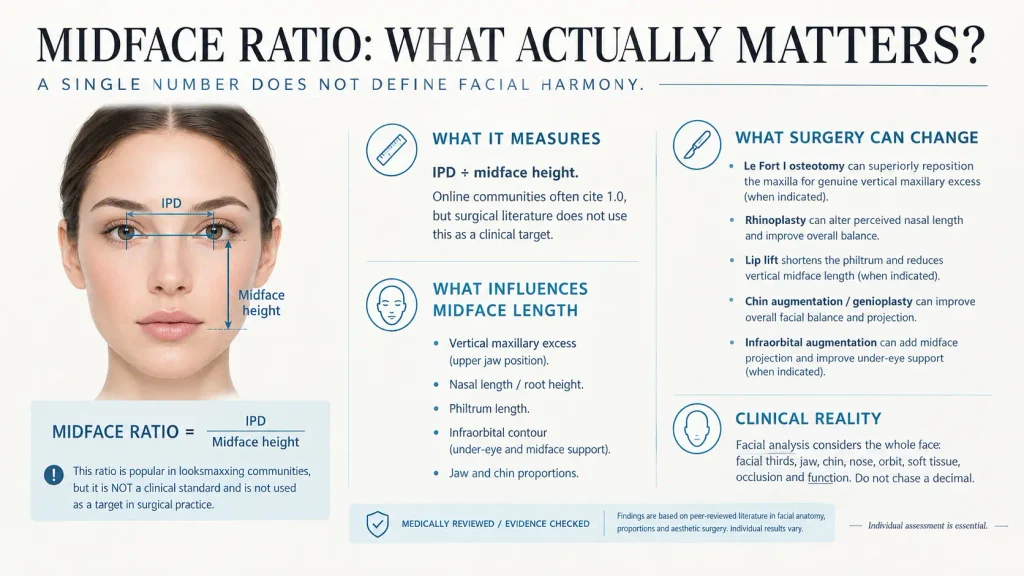
The midface ratio, as defined in the looksmaxxing community, is the relationship between the width of the midface (typically measured as the interpupillary distance, or IPD, the span between the centres of the two pupils) and the height of the midface (measured from the centre of the pupils to the upper lip line). The ratio is expressed as IPD divided by midface height. A result close to 1.0 is considered ideal. Below 1.0, the midface is seen as vertically long relative to its width. Above 1.0, it is seen as compact.
The concept borrows from established principles in facial analysis. Classical facial proportions, documented in surgical literature since at least the 1980s, divide the face into horizontal thirds (forehead to brow, brow to nasal base, nasal base to chin) and vertical fifths. The midface ratio is not one of these classical measurements, but it captures a related idea: that the vertical and horizontal dimensions of the central face need to be in balance for the face to read as harmonious.
Where the forum analysis starts to diverge from clinical practice is in the weight it places on this single measurement. Looksmaxxing communities treat the midface ratio as one of the most important determinants of facial attractiveness, sometimes ranking it above jaw definition, eye shape, or skin quality. Surgeons do not. In clinical facial analysis, midface proportions are one variable among many, and they are always evaluated in context, never in isolation.
Does Midface Ratio Actually Matter? What Surgical Literature Says
The honest answer is: yes, midface proportions influence perceived attractiveness, but not in the reductive way forums suggest. A vertically long midface can make the face appear flat, elongated, and older. A very short midface can make features appear crowded. Both extremes are less harmonious than a proportionate middle ground.
Published facial morphometric studies confirm that faces perceived as attractive tend to have balanced vertical proportions across all three facial thirds, not specifically a midface ratio of exactly 1.0. A 2020 study in Aesthetic Plastic Surgery found that patient satisfaction after mandibular contouring correlated with the ratio of midface width to lower face width approaching 4:3, and that patients with more compact midface proportions reported higher morphological satisfaction. But the same literature makes clear that isolated midface measurements predict very little about overall facial attractiveness. The nose, chin, jaw, orbital structure, and soft tissue all interact to create the composite impression.
The clinical takeaway is straightforward. A disproportionately long midface is a real finding that can be addressed surgically, and doing so can meaningfully improve facial balance. But obsessing over a decimal point on a single ratio, which is what the forums encourage, is not how experienced surgeons evaluate a face.
| 🩺 Dr. Burak’s Clinical Note: ===================================== “Midface proportions are part of every facial analysis I perform, but they are never the whole story. A patient can have what the online community would call a ‘long midface’ and still have a highly attractive, balanced face because the jaw, chin, and orbital structure compensate. What matters clinically is the relationship between all the facial zones, not one ratio measured with a ruler on a selfie.” ===================================== |
What Actually Determines Midface Length?
Midface height, the vertical dimension the looksmaxxing community focuses on, is determined by a combination of skeletal, dental, nasal, and soft tissue factors. Understanding these is essential because the right surgical approach depends entirely on which structure is driving the elongation.
Skeletal Structure: The Maxilla
The maxilla (upper jaw) is the primary bone of the midface. Its vertical height sets the foundational distance between the orbital floor and the upper teeth. A vertically excessive maxilla is the single most significant skeletal cause of a long midface, and it is addressed through orthognathic surgery, specifically Le Fort I osteotomy, which repositions the entire upper jaw upward to shorten the midface. This is a well-established procedure with decades of published outcomes.
Nasal Length and Root Height
The nose sits at the centre of the midface, and its length contributes directly to midface height perception. A long nose, particularly with a high nasal root (the bridge at its uppermost point between the eyes), visually extends the midface. Rhinoplasty that addresses dorsal height and tip position can reduce the perceived vertical length of the midface without touching bone. The relationship between the nasal root and the brow is explored in more detail in Dr. Burak’s rhinoplasty page.
Philtrum Length
The philtrum (the vertical groove between the nose base and the upper lip) is another contributor to perceived midface height. A long philtrum, particularly one that elongates with age, extends the distance from the nasal base to the lip line. A lip lift, which shortens the philtrum by removing a small amount of skin beneath the nose, directly reduces midface height. Dr. Burak’s scarless lip lift in Turkey page covers the procedure in detail.
Infraorbital Region
The bone and soft tissue beneath the eye (the infraorbital rim and cheek area) also affects midface proportions. A flat or recessed infraorbital rim creates hollowing under the eyes and adds to the visual impression of midface length by reducing the apparent transition between the upper and middle face. Infraorbital rim implants address this by adding forward projection that shortens the perceived vertical gap. Details are covered in the infraorbital rim implants guide.
Interpupillary Distance (Width)
Forum discussions focus heavily on IPD, the width side of the ratio. A narrow IPD relative to midface height produces a higher (worse, per forum logic) ratio. In reality, IPD is largely determined by orbital anatomy and is not meaningfully changeable through surgery. Orbital box osteotomy, a complex craniofacial procedure that repositions the orbital walls, can adjust IPD, but it is a major operation performed for functional or congenital indications, not for aesthetic proportion adjustments. The site’s orbital box osteotomy page explains the procedure and its genuine indications.
Procedures That Can Influence Midface Proportions
Several procedures realistically improve midface balance. They are rarely performed in isolation for this purpose; instead, they are combined within a comprehensive facial plan based on individual assessment. The right combination depends on which anatomical factor is driving the concern.
- Le Fort I osteotomy (maxillary impaction): Repositions the upper jaw upward, directly shortening the skeletal midface. The most powerful procedure for genuine vertical midface excess, typically performed alongside orthodontic treatment.
- Rhinoplasty: Reduces nasal length, nasal root height, and tip projection. A shorter nose visually compresses the midface without skeletal change.
- Lip lift: Shortens the philtrum, reducing the distance from the nasal base to the lip line. Produces a meaningful reduction in perceived midface height with a relatively minor procedure.
- Infraorbital rim implants: Add forward projection beneath the eyes, reducing hollowing and the visual impression of vertical midface elongation.
- Chin augmentation or genioplasty: While these act on the lower third rather than the midface itself, adding chin projection improves the proportional relationship between the middle and lower face, which is often the real issue when a midface ‘looks long.’
| 🩺 Dr. Burak’s Clinical Note “The most common finding when a patient comes to me concerned about a ‘long midface’ is that their midface is actually within normal range, but their chin or jaw is recessed, making the middle face appear elongated by comparison. In those cases, a genioplasty or chin implant achieves the proportional improvement they are looking for without touching the midface at all. This is precisely why a proper facial analysis matters more than a self-measured ratio.” |
Why Istanbul for Facial Proportion Surgery?
Facial proportion surgery, whether orthognathic, rhinoplasty, or implant-based, demands a surgeon who understands how the entire face integrates as a structural unit. Istanbul has become one of the world’s leading cities for this kind of work, combining deep surgical expertise with JCI-accredited hospital infrastructure and a genuine value proposition for international patients.
The credential to look for when choosing a surgeon in Turkey is EBOPRAS certification, the diploma of the European Board of Plastic, Reconstructive and Aesthetic Surgery. It confirms training assessed against Europe’s highest formal standard. ISAPS consistently ranks Turkey among the top countries globally for the volume of aesthetic and reconstructive procedures performed each year. Assoc. Prof. Dr. Burak Sercan Erçin holds both Turkish Board and EBOPRAS certification, and his dual background in reconstructive microsurgery and aesthetic facial surgery gives him a structural understanding of facial anatomy that is particularly relevant to proportion-based procedures.
A Word on Measurement, Realism, and Perspective
The looksmaxxing community’s focus on precise numerical ratios creates a specific psychological risk: the belief that a face can be optimised to a target number. Faces are three-dimensional, asymmetric, living structures that move, age, and express emotion. They do not reduce to a single ratio, and no surgeon can or should promise a specific numerical outcome.
What surgery can do is identify genuine proportion gaps, the cases where one facial zone is meaningfully out of balance with the rest, and address them in a way that produces visible, natural improvement. The patients who benefit most from proportion-focused facial surgery are those who arrive with a clear concern, an open mind about which procedure actually addresses it, and realistic expectations about what constitutes a good result. If thoughts about facial proportions are causing significant distress, that is worth discussing with a qualified professional, not just a surgeon.
Frequently Asked Questions
What is the ideal midface ratio?
Looksmaxxing forums typically cite a ratio of 1.0 (interpupillary distance equal to midface height) as ideal. Surgical literature does not use this specific measurement as a clinical standard. Academic facial analysis relies on the classical facial thirds and fifths system, which evaluates vertical and horizontal balance across the whole face. A proportionate midface contributes to facial harmony, but no single number defines attractiveness.
Can you surgically shorten a long midface?
Yes. The most effective procedure for genuine skeletal midface shortening is Le Fort I osteotomy, which repositions the upper jaw upward. Rhinoplasty, lip lift, and infraorbital rim implants can also reduce perceived midface length by adjusting the nose, philtrum, and under-eye area respectively. In many cases, chin or jaw surgery addresses the proportional imbalance more effectively than midface intervention.
Is midface ratio the most important facial measurement?
No. Midface proportions are one factor among many in facial attractiveness. Jaw and chin definition, eye shape and position, nasal harmony, skin quality, and the relationship between all three facial thirds contribute to the overall impression. Surgeons evaluate the face as an integrated system, not through isolated ratios.
Can you change interpupillary distance (IPD)?
IPD is determined by orbital bone anatomy and is not meaningfully adjustable through standard aesthetic surgery. Orbital box osteotomy can alter IPD but is a major craniofacial procedure performed for functional or congenital reasons, not aesthetic ratio correction. The focus in clinical practice is on the factors that can be safely and effectively changed: nasal length, philtrum height, infraorbital projection, and jaw and chin proportions.
Does Dr. Burak offer online consultations for international patients?
Yes. Assoc. Prof. Dr. Burak Sercan Erçin offers WhatsApp and video consultations for international patients before travel. Initial facial assessment and surgical direction can be discussed remotely, with full in-person planning confirmed on arrival in Istanbul. Visit the contact page or reach out via WhatsApp to begin.
Your Face Is More Than a Number
The midface ratio captures something real: the vertical and horizontal balance of the central face matters to how the whole face reads. But reducing that insight to a decimal and treating it as the primary metric of attractiveness is where the online conversation leaves clinical reality behind. The most balanced, natural, and attractive surgical results come from evaluating the face as a whole, identifying the genuine proportion gaps, and selecting the procedures that address them with precision and restraint.
For international patients considering facial proportion surgery in Istanbul, the right starting point is a conversation with a surgeon whose background spans both reconstructive and aesthetic facial work, someone who understands the skeletal, nasal, and soft tissue anatomy of the midface at a structural level and will tell you honestly what your face needs.
Why Assoc. Prof. Dr. Burak Sercan Erçin
Dr. Burak Sercan Erçin is an Istanbul-based Plastic, Reconstructive and Aesthetic surgeon with more than 15 years of experience and over 6,000 operations. He trained alongside Dr. Pedro Cavadas, one of the world’s leading reconstructive microsurgeons, and holds both the Turkish Board and EBOPRAS diplomas. He serves as academic faculty at Bahçeşehir University and practices at Pendik Medical Park, Istanbul. His reconstructive background in craniofacial and facial trauma surgery provides the structural depth that proportion-focused facial procedures specifically demand. To discuss your case, book an online consultation or reach out via WhatsApp.
This content was written by Assoc. Prof. Dr. Burak Sercan Erçin in line with clinical experience and current medical literature. It is intended for general informational purposes only and does not constitute medical advice. A personal consultation with Dr. Erçin is recommended for individual assessment.
Faculty Member · Bahçeşehir University
Graduate of Ege University Faculty of Medicine, Assoc. Prof. Dr. Erçin completed advanced fellowships at Tampa General Hospital (USA) under Dr. Deniz Dayıcıoğlu in breast reconstruction and burn surgery, and at the clinic of Dr. Pedro Cavadas in Valencia, Spain in reconstructive microsurgery. After passing the EBOPRAS examination in 2018, he joined Bahçeşehir University as a faculty member and continues his private practice on Bağdat Avenue, Istanbul, specialising in face, breast and body aesthetics alongside complex reconstructive surgery.