This article was written by Assoc. Prof. Dr. Burak Sercan Erçin and is based on clinical experience. A specialist in Plastic, Reconstructive and Aesthetic Surgery; prepared in accordance with current medical literature and personal surgical data. A consultation is recommended before making any medical decisions.

A facelift is not a small decision, and the number one question in nearly every consultation is the same: what will the scars look like? The concern has never been more visible than in 2026. Recent high-profile facelift stories in the international press, viral YouTube videos with hundreds of thousands of views documenting patient regret, and open forum discussions about visible scarring have all raised the question in the mind of every patient considering the procedure. A well-performed facelift in Turkey should leave scars that are essentially imperceptible in normal social distance. A poorly-performed one can leave marks that are visible for life. The difference is not luck. It is technique, judgement, and closure, and it can be evaluated before you book.
This guide, written from the perspective of Assoc. Prof. Dr. Burak Sercan Erçin, an EBOPRAS-certified plastic and reconstructive surgeon in Istanbul, covers exactly where facelift incisions are placed, what a well-planned scar looks like at every healing stage, what causes visible scars when they occur, and what patients should specifically ask a surgeon about before committing to surgery.
Where Facelift Incisions Are Actually Placed
The reason most facelift scars are barely visible is that they are placed along natural anatomical boundaries where the eye already expects a transition: the hairline, the fold in front of the ear, the natural curve where the earlobe meets the face, and the crease behind the ear. A well-designed incision uses these existing lines as camouflage. When healing is complete and the scar has matured, the transition simply reads as the boundary between two skin textures, not as a surgical mark.
A standard facelift incision has four connected segments:
- Temporal (hairline) segment: Begins in the temple hair or along the hairline. Placed inside the hair when possible so the scar is hidden by the hair itself. Sits along the hairline in patients where a hairline-preserving approach is preferred.
- Pre-auricular (in front of the ear) segment: Follows the natural crease immediately in front of the ear. In female patients, this is often designed to run inside the tragus (the small cartilage flap at the ear canal) so the scar disappears into the ear’s natural shadow. In male patients, the incision typically sits just in front of the tragus to avoid pulling hair-bearing skin into the ear.
- Infra-auricular (under the earlobe) segment: Curves under the earlobe. This is one of the most technically important sections. A properly closed incision here preserves the natural attachment of the earlobe to the face. A poorly closed one can produce the visible ‘pixie ear’ deformity, where the earlobe is pulled downward and appears elongated.
- Post-auricular (behind the ear) segment: Runs up the crease behind the ear and, for a full facelift with neck lift, continues into the hairline at the nape of the neck.
For a submental (chin) neck lift, a small additional incision is placed in the crease beneath the chin, roughly one to two centimetres long. This scar sits in a natural shadow and is essentially invisible once healed.

The specific incision plan varies with technique. A deep plane facelift and a mini facelift use different lengths of incision, and a starter facelift for a younger patient is typically shorter than a full traditional lift. The principle is constant: the scar goes where the eye is already trained to see a transition.
| 🩺 Dr. Burak’s Clinical Note “The three most technically demanding moments in facelift closure are the tragal edge, the earlobe attachment, and the temporal hairline. Get all three right and the scar disappears into the anatomy. Get any one wrong and the patient will carry a visible reminder of the surgery. I plan those three points before the first incision is made. Closure is not the end of the operation. It is one of the most important parts of it.” |
What a Facelift Scar Looks Like at Every Stage of Healing
Understanding the healing timeline is essential because a scar that looks alarming at three weeks may look completely acceptable at three months. Patients who judge the result too early often experience unnecessary anxiety about scars that would have resolved naturally.
Weeks 1 to 3: Red and Raised
Fresh facelift scars are red or pink and slightly raised. This is completely normal. The redness reflects the increased blood supply to the healing tissue, and the mild elevation reflects the initial deposit of collagen. Sutures are typically removed between day five and day seven, at which point the wound is fully closed but still actively healing. Most patients cover this stage with hair, sunglasses, and, from about week two, with makeup on the visible edges of the scar.
Months 1 to 3: The Transition Phase
Between one and three months, the scar begins to flatten and the intense redness fades to pink and then to a lighter tone. This is the period when patients often become concerned because the scar has not yet matured but is now visible in normal light. Reassurance during this phase matters. The scar is following an expected biological process, and most of the redness resolves during month three.
Months 3 to 12: Fading to Invisibility
Between three and twelve months, the scar continues to fade toward the surrounding skin tone. In most patients, by six months the scar is difficult to see even at conversational distance. By twelve months, it has typically matured into a fine, pale line that reads as an anatomical boundary rather than a surgical mark. Sun protection during this entire period is essential, because UV exposure during the maturation phase can permanently darken a scar and prevent it from fully fading.
Year One and Beyond
A fully matured facelift scar in a patient who healed well is essentially undetectable in normal social contexts. Patients often need to point out where the incisions were placed for anyone to see them. This is the standard against which any facelift result should be measured.
What Causes Visible Facelift Scars? The Four Real Reasons
Visible facelift scars are not random. They result from identifiable causes, and understanding them is how patients evaluate surgeon quality before booking. Some causes are patient-related and some are surgeon-related, and the honest surgeon will discuss both openly.
1. Excessive Tension on the Skin Closure
This is the single most common cause of a bad facelift scar and the most important indicator of surgical technique. A well-designed facelift lifts and holds the underlying tissue, particularly the SMAS layer, so that the skin closure is essentially tension-free. When the skin itself is used to hold the lift, the wound edges are pulled apart with each movement of the face, and the resulting scar widens, thickens, and remains visible for years.
This is one of the defining differences between an experienced facelift surgeon and a less experienced one. The lift should be held by the deep structural work. The skin closure should simply approximate the wound edges without pulling on them.
2. Poorly Planned Incision Placement
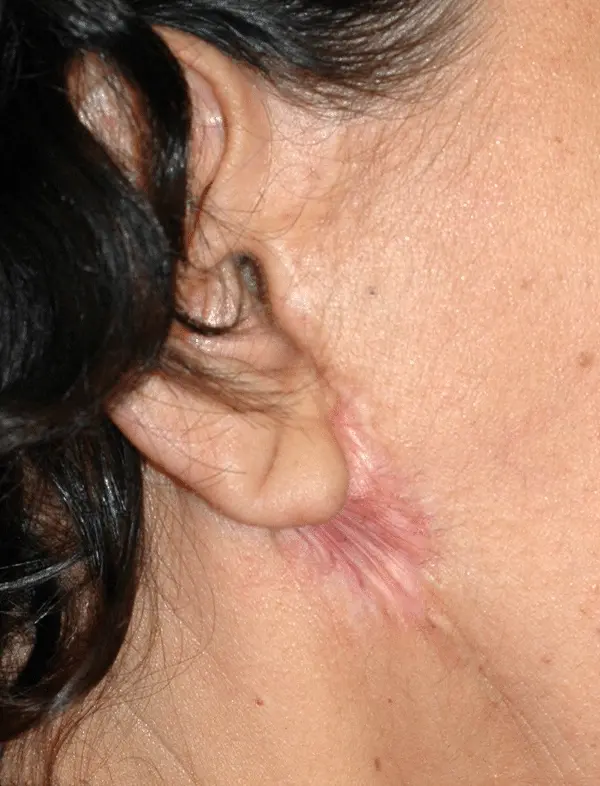
An incision that sits slightly forward of the tragus rather than inside it, or that cuts across the hair-bearing skin at the temple rather than following the hairline, will remain visible even if it heals perfectly. Planning is a distinct skill from execution, and it is decided before the operation begins. Reviewing the planned incision diagram at consultation is a reasonable request, and any surgeon should be willing to demonstrate it.
3. Poor Closure Technique
The wound must be closed in multiple layers, with the deep dermal layer taking the majority of the tension and the surface layer approximated precisely. A wound closed in a single layer, or closed with uneven tension distribution, produces a wider, more visible scar. This is invisible on the day of surgery but shows up clearly by month three.
4. Patient Factors and Aftercare
Some patients scar more visibly than others due to skin type (darker skin types are more prone to hyperpigmentation, and some ethnicities are more prone to keloid or hypertrophic scarring), genetics, and sun exposure. Smoking is one of the most damaging patient factors, because nicotine constricts the blood vessels that supply the healing wound and can produce wound margin necrosis and permanent scarring. Poor sun protection during the first year, aggressive activity too soon after surgery, and neglecting scar care are all patient-controllable factors that affect the final result.
| 🩺 Dr. Burak’s Clinical Note “When I see a patient in my clinic with a visible facelift scar from a previous procedure elsewhere, I can usually tell within seconds which of the four causes produced it. Widened scars almost always mean skin-tension closure. Scars in the wrong anatomical line mean planning failure. Pigmented scars often mean poor sun protection during healing. These are not mysteries. They are consequences of specific decisions, most of which were made before or during the operation.” |
How Dr. Burak’s Practice Manages Facelift Scars
Scar quality is not an accident. It is engineered from the consultation through to the twelve-month review. The specific measures applied to every facelift patient include:
- Detailed incision planning at consultation, adjusted for the patient’s hairline, skin type, ear anatomy, and gender-specific considerations.
- Deep-plane or SMAS-level structural work that holds the lift, so the skin closure is tension-free.
- Multi-layered closure with careful attention to the tragal edge, earlobe attachment, and temporal hairline.
- Post-operative silicone-based scar therapy, initiated from the point of suture removal and continued for a minimum of three months.
- Strict sun protection guidance for the first twelve months, including SPF 50+ on all scar lines and hair or hat coverage for direct sun exposure.
- Individual scar review at one, three, six, and twelve months, with WhatsApp-based photograph review for international patients between in-person appointments.
Patients recovering from more complex reconstructive procedures, including those involving scar management after trauma or surgery, benefit from the same underlying principles. Dr. Burak’s approach to scar management draws on his reconstructive background, which is covered in more depth in the burn scar treatment guide and the facial burn scars guide.
What to Ask Any Surgeon Before Booking a Facelift Abroad
The value of a checklist at consultation cannot be overstated. Patients travelling to Turkey, or to any international destination, should be prepared to ask direct questions about the surgeon’s approach to closure and scarring. A responsible surgeon will welcome the questions and answer them clearly:
- Can you show me where the incisions will be placed on my face specifically?
- Is the lift held by the SMAS or by the skin? (The answer should be the SMAS or a deeper structural layer.)
- How do you close the tragal edge for a female patient?
- How do you plan to prevent pixie-ear deformity?
- What scar care protocol do I follow after suture removal?
- What is your revision rate for visible scarring?
- Can I see photographs of matured scars, not just early post-operative results?
Any surgeon who cannot or will not answer these questions clearly is not the right surgeon. This is not aggressive questioning. It is due diligence for a procedure that will affect your face for the rest of your life.
Why the Right Surgeon Choice Matters More Than the Country
Turkey is one of the world’s leading destinations for facial surgery, with JCI-accredited hospitals, ISAPS-ranked surgical volume, and deep expertise concentrated in Istanbul. But the country’s reputation is only as good as the individual surgeon a patient chooses. A facelift performed by an EBOPRAS-certified surgeon at an accredited hospital in Istanbul is held to the same technical and safety standard as one performed in London, New York, or Sydney. A facelift performed by an under-qualified operator anywhere, including in the UK or US, can produce the visible-scar outcomes patients most fear.
The credential to look for in Turkey is EBOPRAS certification, the European Board diploma held by Assoc. Prof. Dr. Burak Sercan Erçin alongside his Turkish Board certification. His practice at Pendik Medical Park operates to JCI-accredited hospital standards, and his reconstructive background means that closure technique and scar management are treated with the same precision as any reconstructive case. To see how mature scars actually settle in his patients, the facelift before-and-after gallery provides visual reference.
Frequently Asked Questions
How visible are facelift scars after full healing?
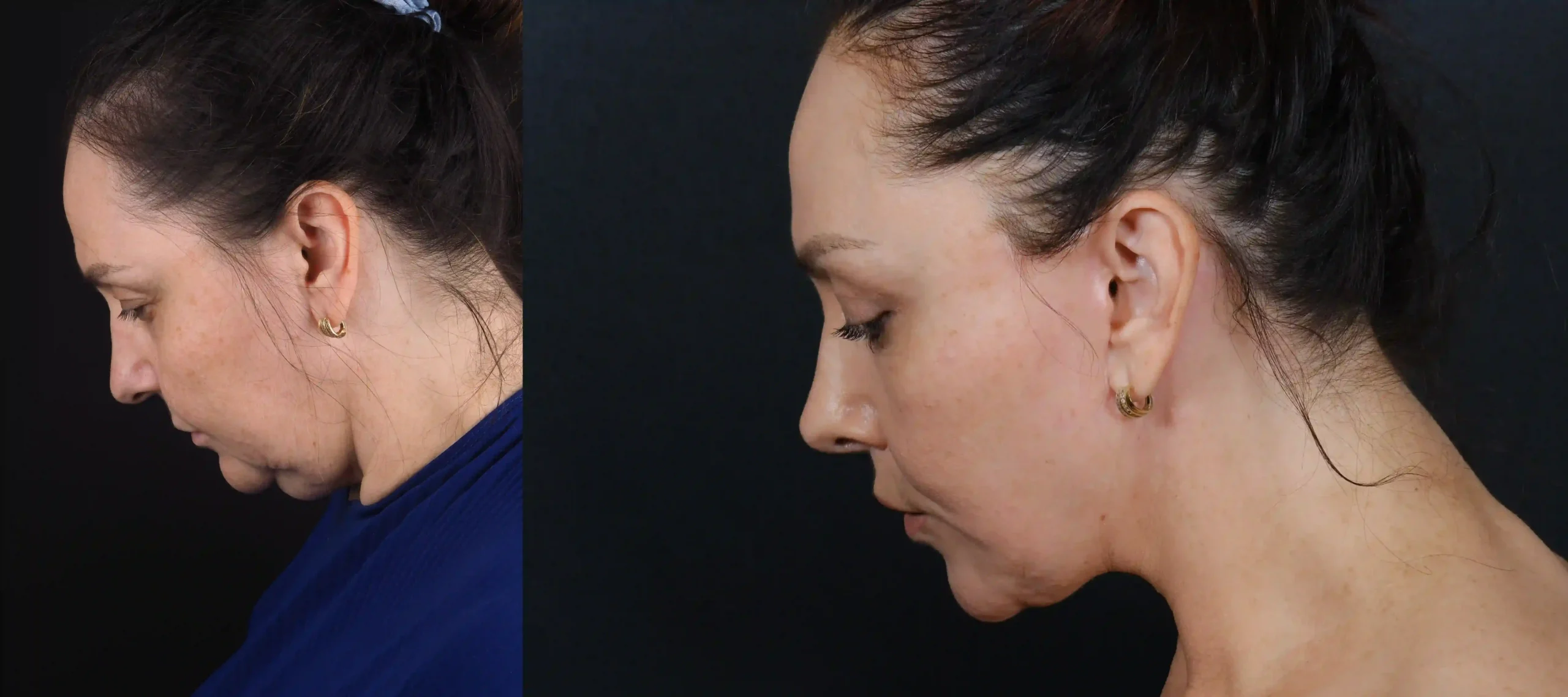
In a well-performed facelift with tension-free closure, mature scars are essentially undetectable at normal social distance by twelve months post-operatively. Patients typically need to point out where the incisions were placed for them to be noticed. This is the standard against which any facelift result should be measured, and it is achievable with proper technique.
Where are facelift scars usually placed?
Facelift incisions follow four connected segments: along the temporal hairline, in the crease in front of the ear (often hidden inside the tragus in female patients), around the earlobe attachment, and behind the ear into the nape hairline. A submental neck lift adds a small hidden incision beneath the chin. The design uses natural anatomical boundaries to camouflage the scar.
What causes visible facelift scars?
The four main causes are excessive tension on the skin closure (the biggest single factor), poorly planned incision placement, poor multi-layered closure technique, and patient factors including smoking, poor sun protection, and skin type. Most causes are surgeon-related and can be evaluated before booking through direct questioning and review of matured before-and-after photographs.
How long do facelift scars take to fade?
Scars are red and raised for the first three weeks, transition through pink over months one to three, and continue fading toward the surrounding skin tone through months three to twelve. Full maturation occurs at approximately twelve months. Sun protection with SPF 50+ during the entire first year is essential to allow full fading.
Can you remove or improve a bad facelift scar?
Yes, in most cases. Revision options range from non-surgical treatments such as steroid injection, silicone therapy, laser resurfacing, and dermabrasion for thickened or discoloured scars, to surgical scar revision for widened or poorly placed incisions. The right approach depends on the specific type of scar and the underlying cause. A consultation with an experienced revision surgeon is the necessary starting point.
Does Dr. Burak show patients where the incisions will be placed at consultation?
Yes. Incision planning is discussed openly at every facelift consultation, adjusted for hairline, ear anatomy, skin type, and patient-specific considerations. International patients receive this discussion during their online consultation via WhatsApp or video call before travelling to Istanbul, and it is confirmed at the in-person review. Visit the contact page or reach out via WhatsApp.
An Invisible Scar Is a Choice Made Before the First Incision
The image of a visible facelift scar is the fear that keeps many patients from a procedure that would genuinely benefit them. What the recent news cycle should teach patients is not to avoid facelifts, but to select surgeons more carefully. A well-planned, tension-free, precisely closed facelift produces scars that essentially disappear. A poorly-planned or hastily-executed one produces scars that a patient carries for life. The difference is decided during the consultation, not on the operating table.
For international patients considering a facelift in Istanbul, the right first step is a surgeon who will show you exactly where the incisions will sit, explain how the lift is held, and answer every question about closure and scar care openly. If the answers are clear, specific, and grounded in surgical anatomy, you are in the right consultation. If they are vague or dismissive, you are not, and the country is not the problem.
Why Assoc. Prof. Dr. Burak Sercan Erçin
Dr. Burak Sercan Erçin is an Istanbul-based Plastic, Reconstructive and Aesthetic surgeon with more than 15 years of experience and over 6,000 operations. He holds both Turkish Board and EBOPRAS certifications, trained alongside reconstructive microsurgeon Dr. Pedro Cavadas, and serves as academic faculty at Bahçeşehir University. He practices at Pendik Medical Park, Istanbul. His reconstructive background is particularly relevant to facelift scar quality, because the surgeons who repair complex facial scars understand what makes an invisible one from the point of the first incision. To discuss your case, book an online consultation or reach out via WhatsApp.
This content was written by Assoc. Prof. Dr. Burak Sercan Erçin in line with clinical experience and current medical literature. It is intended for general informational purposes only and does not constitute medical advice. A personal consultation with Dr. Erçin is recommended for individual assessment.
Faculty Member · Bahçeşehir University
Graduate of Ege University Faculty of Medicine, Assoc. Prof. Dr. Erçin completed advanced fellowships at Tampa General Hospital (USA) under Dr. Deniz Dayıcıoğlu in breast reconstruction and burn surgery, and at the clinic of Dr. Pedro Cavadas in Valencia, Spain in reconstructive microsurgery. After passing the EBOPRAS examination in 2018, he joined Bahçeşehir University as a faculty member and continues his private practice on Bağdat Avenue, Istanbul, specialising in face, breast and body aesthetics alongside complex reconstructive surgery.