This article was written by Assoc. Prof. Dr. Burak Sercan Erçin and is based on clinical experience. A specialist in Plastic, Reconstructive and Aesthetic Surgery; prepared in accordance with current medical literature and personal surgical data. A consultation is recommended before making any medical decisions.

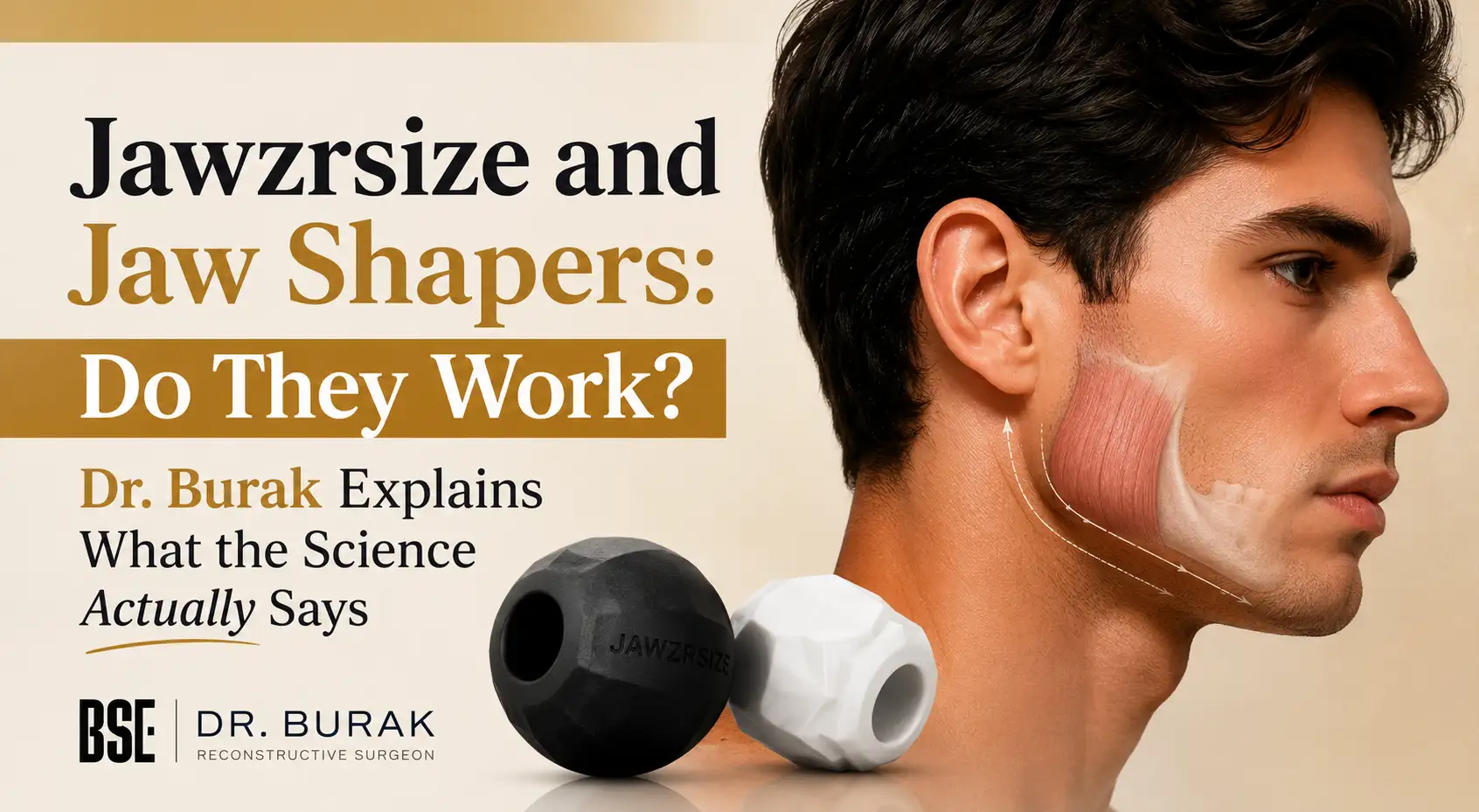
Chew this silicone ball for ten minutes a day and get a chiselled jawline in three months. That is the promise sold across TikTok, Instagram, and Amazon by a category of products including Jawzrsize, Jawline Trainer, Jaw Exerciser Pro, Rockjaw, and dozens of others. The devices are cheap, non-surgical, and marketed with dramatic before-and-after photos that make them look like a shortcut to the sharp lower face of every leading man in Hollywood. The science, however, tells a very different story. Peer-reviewed research has documented that repeated use of these devices places significant stress on the temporomandibular joint (TMJ), can trigger tooth shifting, and, in the outcome that is most inconvenient for the marketing, tends to make the face look wider rather than narrower.
This guide, written from the perspective of Assoc. Prof. Dr. Burak Sercan Erçin, an EBOPRAS-certified plastic and reconstructive surgeon in Istanbul, covers exactly what jaw exercisers do biologically, what the published research warns about them, what actually creates a defined jawline, and when the honest answer is that a properly selected surgical or non-surgical treatment will achieve what a rubber ball never will.
What Are Jaw Exercisers and What Do They Claim to Do?
Jaw exercisers are silicone or thermoplastic resistance devices designed to be placed between the upper and lower teeth. Users bite down repeatedly against the device’s resistance, typically 20 to 50 pounds of force per bite, for sessions ranging from 60 seconds to 10 minutes at a time. Jawzrsize, the best-known brand, and the many competitors it inspired all market the same core promise: that biting against resistance will exercise the masseter and surrounding facial muscles, tighten the jawline, reduce a double chin, and produce a sharper, more masculine lower face.
The category exploded through social media over the past five years. Amazon listings for jaw exercisers now number in the thousands, prices range from around ten pounds to over fifty, and the products are marketed to audiences that skew heavily toward men aged 18 to 35 chasing the alpha-male or looksmax aesthetic covered in Dr. Burak’s looksmaxxing guide and the broader softmax vs hardmax discussion.
The physiological premise is not entirely baseless. Repetitive resistance training does grow the muscle being trained, which is why the masseter, the large chewing muscle that runs along the side of the face from cheekbone to jaw angle, does hypertrophy with sustained use of these devices. The problem is what that hypertrophy actually looks like on a face, and what other structures get damaged along the way.
What Peer-Reviewed Research Actually Says
Multiple published sources, including a research paper widely cited in dental and orthodontic literature, have warned about specific harms associated with jaw exerciser use. The findings are consistent enough that professional dental education platforms have issued formal warnings. The main documented concerns are the following.
TMJ Damage and Articular Disc Wear
Researchers examining the stress patterns produced by resistance-based jaw devices concluded that repeated use “will result in far more stresses on the TMJ and cause significant wear on the articular disc,” potentially triggering symptoms of temporomandibular disorder (TMD) ranging from clicking and crepitus (a grating noise) to complete joint dislocation. The stress patterns produced were compared to those seen in bruxism (chronic teeth grinding), a well-documented cause of TMJ dysfunction. Dr. Burak’s guide to the 20 things that make TMJ worse covers the broader picture of what damages the joint over time.
Tooth Shifting and Malocclusion
Because the axial force applied to the teeth by these devices is not the direction the teeth are designed to bear load, dentists have documented tooth shifting in patients who use jaw exercisers regularly. The front teeth are particularly vulnerable, and patients with early periodontal disease (mild gum recession or bone loss) can experience significant shifting even with moderate device use. The clinical consequence can be a new alignment problem requiring orthodontic treatment, and in severe cases, difficulty eating or long-term bone loss around affected teeth.
The Masseter Hypertrophy Trap
The devices do successfully hypertrophy the masseter muscle. This is precisely the outcome the marketing implies is desirable, and it is precisely the outcome that most often produces the opposite of the intended aesthetic result. A hypertrophied masseter makes the lower face look wider, not sharper. Patients who use jaw exercisers consistently often find that their jawline appears more square and their overall face reads as heavier through the lower third. The paradox is remarkable: the treatment promoted as a shortcut to a sharper jawline can, over months of use, produce exactly the kind of overdeveloped chewing-muscle appearance that plastic surgeons treat with masseter Botox to slim.
“The consultation for a patient who has been using a jaw exerciser is usually the same conversation. We work out what they were trying to achieve. We identify why the device could not achieve it. We map that goal onto the actual anatomical variable driving their concern. Half the time, the answer is dietary and lifestyle. A quarter of the time, it is masseter Botox to undo the muscle bulk the device created. The remainder is genuinely skeletal, and that is where surgical planning begins. There is no version of the conversation where the answer is to buy a different rubber ball.”
What Actually Creates a Defined Jawline?
The reason jaw exercisers do not produce the marketed result is that jawline definition is not a muscular phenomenon. It is a composite of three separable variables, none of which is meaningfully improved by biting a rubber ball.
Body Fat Percentage
The single most important variable in visible jawline definition is the amount of subcutaneous fat sitting between the skin and the bone. A patient at 12 percent body fat will show a naturally sharper jaw and chin regardless of their skeletal anatomy than the same patient at 25 percent body fat. This is why physique athletes and professional models look chiselled around the jawline in the run-up to a shoot: they have deliberately reduced body fat to the level where the underlying skeletal structure becomes visible. Diet, cardiovascular exercise, and sustainable weight management do more for jawline definition than any device on the market.
Skeletal Structure of the Jaw and Chin
The bony framework of the mandible (lower jaw) and chin sets the ceiling for what jawline definition is achievable. A patient with a strong mandibular angle and a well-projected chin has a genetic head start. A patient with a weak or recessed chin, or an underdeveloped jaw angle, will struggle to achieve a defined jawline through non-surgical means alone because the underlying structure is not there. This is where surgical options such as mandibular angle implants, sliding genioplasty, or chin augmentation implants become relevant, because they change the skeleton itself rather than the muscle covering it.
Skin Quality and Neck Contour
The transition from the jawline to the neck determines how sharply the jaw reads visually. A crisp jaw-to-neck angle produces the definition patients recognise as attractive. Loose skin, submental (under-chin) fat, or an overdeveloped platysma muscle can blur that transition, softening even a strong bony jaw. Non-surgical options such as masseter Botox for a wide lower face, submental liposuction for under-chin fat, or a well-planned starter facelift address this variable directly.
If Not Jaw Exercisers, Then What Actually Works?
Body Fat Reduction (the free option)
Sustainable weight management remains the most cost-effective jawline treatment ever devised. For patients who are carrying meaningful excess fat, dropping body fat to a healthy sustainable level will produce more jawline definition than any device, and it will do so without damaging the TMJ or the teeth. This is not glamorous advice, but it is the honest one, and every plastic surgeon who is asked about jaw exercisers gives it. Patients who have lost significant weight through GLP-1 medication or bariatric surgery face a different problem, addressed in Dr. Burak’s Ozempic face guide.
Masseter Botox for a Wide Lower Face
For patients whose lower face is wide because of an overdeveloped masseter muscle (whether from genetics, teeth grinding, or, ironically, from months of jaw exerciser use), botulinum toxin injected into the masseter causes gradual muscle reduction over two to three months. The result is a slimmer, more tapered lower face, achieved by shrinking the same muscle that jaw exercisers grow. Masseter Botox is the closest thing to a true non-surgical jawline treatment currently available, and it does the opposite of what jaw exercisers do.
Surgical Definition for Skeletal Cases
For patients whose limitation is skeletal, no muscle-based treatment will produce meaningful change. Mandibular angle implants add definition at the rear angle of the jaw, sliding genioplasty or chin implants add forward projection to a recessed chin, and combined procedures can address both simultaneously. These are permanent structural changes that address the actual anatomical variable driving the concern. Dr. Burak’s jawline contouring for women guide and the looksmaxxing surgery overview cover the surgical options for female and male patients respectively.
Neck and Jawline Rejuvenation for Older Patients
For patients whose jawline has softened with age rather than never having been defined in the first place, the appropriate solution is skin and tissue repositioning through a lift procedure, not muscle exercise. A deep plane facelift, a starter facelift, or a targeted neck lift addresses the descended tissue that is blurring the jawline. Muscle exercisers do nothing for this pattern.
Why Consider Istanbul for a Proper Jawline Assessment
Istanbul has become one of the world’s leading destinations for facial and jaw surgery. Turkey ranks consistently in the top tier globally for aesthetic surgical volume per ISAPS data, and the concentration of experienced facial surgeons in Istanbul is among the highest in the world. Leading hospitals, including Pendik Medical Park where Dr. Burak operates, are JCI-accredited and operate to the standards patients expect in the UK, the US, or Australia. For international patients researching the honest answer to their jawline goals, the value of a consultation with an EBOPRAS-certified surgeon is not just the surgery itself but the possibility of finding out that the answer is not surgery at all.
The credential to look for remains EBOPRAS certification, the European Board diploma held by Assoc. Prof. Dr. Burak Sercan Erçin alongside his Turkish Board certification. His reconstructive and craniofacial background provides the depth of skeletal understanding that jawline consultations specifically demand.
Frequently Asked Questions
Does Jawzrsize actually give you a sharper jawline?
No, not in the way the marketing suggests. Jaw exercisers such as Jawzrsize do hypertrophy the masseter muscle, but a larger masseter makes the lower face look wider rather than sharper. Jawline definition is created primarily by low body fat percentage combined with the underlying skeletal structure, neither of which is improved by biting a resistance device. Many patients who use these devices consistently for months find their face looks squarer and heavier through the lower third.
Can jaw exercisers damage your teeth or jaw?
Yes. Published research has warned of significant stresses placed on the temporomandibular joint (TMJ), potentially causing wear of the articular disc, clicking, popping, and in some cases dislocation. Dentists have also documented tooth shifting caused by the non-axial force applied to the teeth, particularly the front teeth. Patients with braces, crowns, fillings, or early gum disease are at particularly elevated risk. TMD (temporomandibular disorder) is a real, documented risk of regular jaw exerciser use.
Why does my face look wider after using a jaw exerciser?
Because the device successfully grew your masseter muscle. The masseter is the large chewing muscle that runs from the cheekbone to the angle of the jaw. When it hypertrophies, the lower face becomes wider and squarer. This is the opposite of the effect most users intended. The solution, for patients who have already produced this outcome, is typically masseter Botox, which gradually reduces the muscle over two to three months.
What actually gives you a defined jawline?
Three variables. Low body fat percentage is the largest single factor and can be addressed through sustainable diet and exercise at no cost. The underlying skeletal structure of the jaw and chin sets the ceiling of what is achievable, and this can be modified with mandibular angle implants, chin augmentation, or sliding genioplasty when appropriate. Skin quality and the jaw-to-neck transition determine visual definition and can be addressed with masseter Botox, submental liposuction, or facelift procedures depending on the individual case.
Are there any legitimate uses for jaw exercisers?
Physical therapy-guided jaw exercises can play a role in TMJ disorder rehabilitation, but these are typically low-resistance, therapist-guided exercises used within a broader treatment plan, not the high-resistance consumer devices sold on social media. Resistance-based commercial products are not endorsed by mainstream dental or plastic surgery organisations for either therapeutic or aesthetic purposes.
Does Dr. Burak treat jawline concerns in international patients?
Yes. Dr. Burak’s practice covers the full spectrum of jawline treatment from non-surgical assessment and masseter Botox planning through to surgical options including mandibular angle implants, chin augmentation, sliding genioplasty, and facelift procedures. Every consultation begins with an honest anatomical assessment to determine which variable is actually driving the concern. Visit the contact page or reach out via WhatsApp.
A Rubber Ball Cannot Reshape a Face
Jaw exercisers are the archetype of a category of aesthetic products that sell simplicity where none exists. The face is a composite of bone, muscle, fat, skin, and the way these interact under gravity and time. Reshaping any of these variables requires an intervention that actually addresses that variable. Biting silicone for ten minutes a day addresses only the masseter muscle, in a direction that most users would not choose if they understood what would happen. The peer-reviewed research warns of TMJ damage. Dentists warn of tooth shifting. Plastic surgeons see, month after month, the patients whose faces look wider than they were before they started using the device.
For international patients considering a proper jawline consultation in Istanbul, the value is not just in the possibility of surgery. It is in the possibility of a conversation that starts with what your face actually needs, not what a marketing campaign is selling you. Sometimes the honest answer is dietary. Sometimes it is masseter Botox. Sometimes it is a surgical structural change. It is never, in Dr. Burak’s practice, a rubber ball.
Why Assoc. Prof. Dr. Burak Sercan Erçin
Dr. Burak Sercan Erçin is an Istanbul-based Plastic, Reconstructive and Aesthetic surgeon with more than 15 years of experience and over 6,000 operations. He holds both Turkish Board and EBOPRAS certifications, trained alongside reconstructive microsurgeon Dr. Pedro Cavadas, and serves as academic faculty at Bahçeşehir University. He practices at Pendik Medical Park, Istanbul. His reconstructive and craniofacial background, which includes deep expertise in the anatomy of the mandible, TMJ, and lower face, is directly relevant to any honest jawline consultation. To discuss your case, book an online consultation or reach out via WhatsApp.
This content was written by Assoc. Prof. Dr. Burak Sercan Erçin in line with clinical experience and current medical literature. It is intended for general informational purposes only and does not constitute medical advice. A personal consultation with Dr. Erçin is recommended for individual assessment.
Faculty Member · Bahçeşehir University
Graduate of Ege University Faculty of Medicine, Assoc. Prof. Dr. Erçin completed advanced fellowships at Tampa General Hospital (USA) under Dr. Deniz Dayıcıoğlu in breast reconstruction and burn surgery, and at the clinic of Dr. Pedro Cavadas in Valencia, Spain in reconstructive microsurgery. After passing the EBOPRAS examination in 2018, he joined Bahçeşehir University as a faculty member and continues his private practice on Bağdat Avenue, Istanbul, specialising in face, breast and body aesthetics alongside complex reconstructive surgery.