This article was written by Assoc. Prof. Dr. Burak Sercan Erçin and is based on clinical experience. A specialist in Plastic, Reconstructive and Aesthetic Surgery; prepared in accordance with current medical literature and personal surgical data. A consultation is recommended before making any medical decisions.

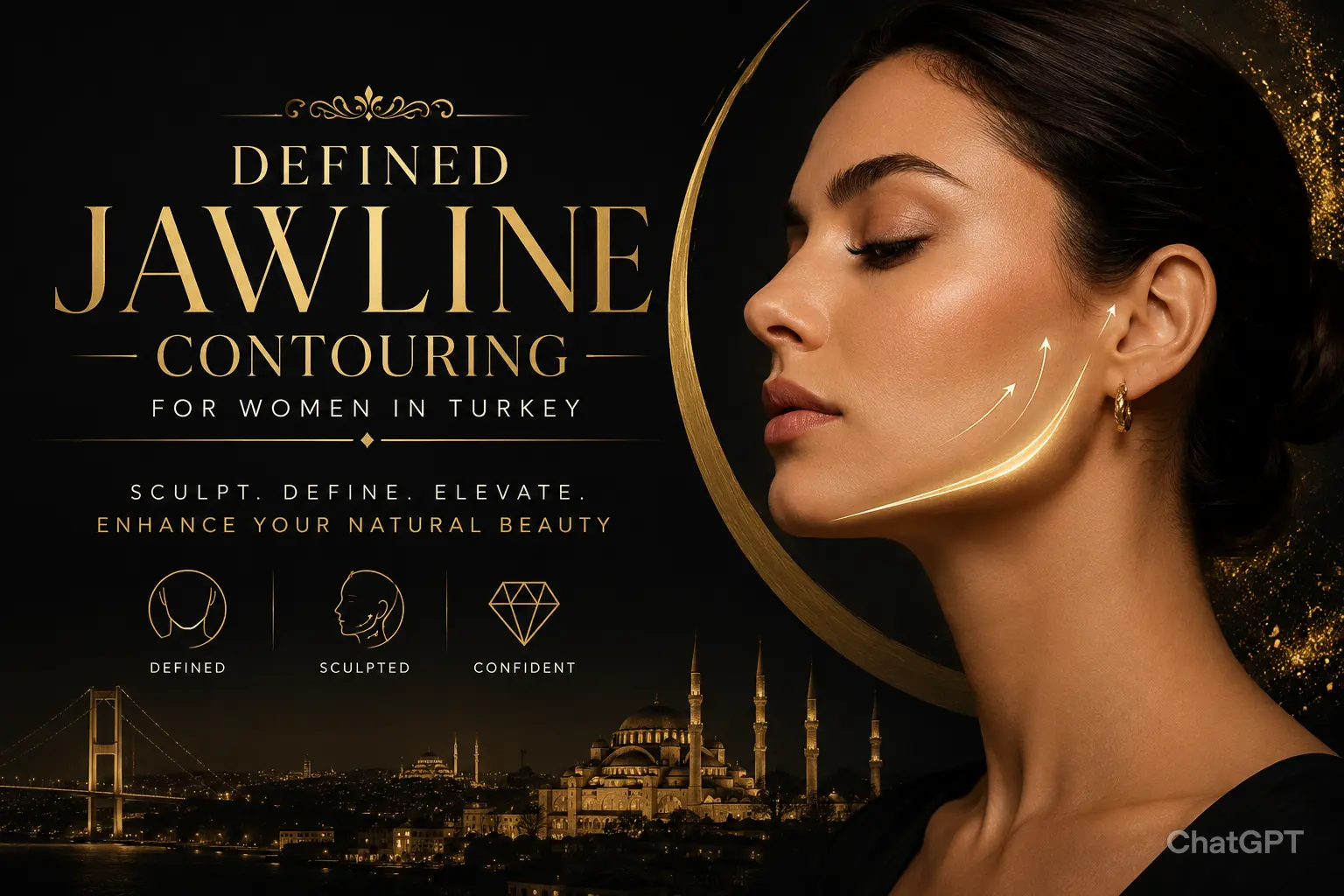
For decades, a strong, angular jawline was treated as an exclusively masculine trait. Women seeking facial surgery were typically steered toward softening, reducing, and rounding, as though definition itself were something to be corrected. That assumption has shifted significantly, and jawline contouring for women in Turkey is now among the fastest-growing categories of facial aesthetic surgery. The real question international patients are asking is no longer “should my jaw be smaller?” but rather “how does my jaw fit into my face as a whole?”
Istanbul has become one of the world’s leading destinations for this kind of nuanced, proportion-focused facial surgery. Women travelling from the UK, the US, Australia, and the Gulf region are arriving not to erase features but to refine and define them, and to work with surgeons who understand that beauty is not about having everything small. It is about having the right proportions in the right places.
Why a Defined Jawline Is One of the Most Feminine Features a Face Can Have
Facial attractiveness research consistently points to balance and proportion as the foundation of beauty across all genders. A well-defined jawline creates a clear transition between the face and the neck, anchors the lower third of the face, and gives the cheekbones and eyes a structural counterpoint. Without sufficient jaw definition, even well-balanced upper features can read as undefined and heavy from the front and profile.
The oval or slightly heart-shaped face, long considered the classical feminine ideal, is actually characterised by a moderately defined jaw with a slightly tapered chin. It is definition within proportion, not absence of structure, that creates this shape. Consensus guidance from the International Society of Aesthetic Plastic Surgery (ISAPS) identifies a well-defined jawline as a core marker of facial attractiveness in women across multiple cultural contexts, including Middle Eastern, European, and Asian aesthetic standards.
The goal of jawline contouring for women is therefore not to create a sharp, angular jaw in the male sense. It is to establish the right frame for the individual face: a jaw that is visible, structured, and in harmony with the chin, cheeks, and neck.
The Shift in Aesthetic Standards: What Women Are Now Asking For
The global conversation around beauty and the female face has evolved. Women are increasingly seeking to enhance, not erase, structure. The faces that consistently appear at the top of aesthetic wish lists belong to women with well-defined lower thirds: clear jaw angles, visible transitions from cheek to neck, and chins that anchor the profile. Social media has made facial structure more studied than at any previous time, and patients arrive at consultations with a sophisticated understanding of what they want and why.
ISAPS data shows that chin and jaw procedures have grown consistently among female patients globally over the past five years. What is driving this is not a shift toward masculinity, but a growing recognition that definition and femininity are not opposites. Proportion, harmony, and the relationship between individual facial thirds determine whether a jawline reads as elegant or harsh, not its size alone.
Procedures like genioplasty, mandibular angle implants, V-line surgery, and masseter reduction are increasingly being combined and personalised for female patients specifically, with implant designs and surgical targets calibrated to feminine anatomy rather than adapted from male-centric protocols.
| If you are considering jawline enhancement in Istanbul and want to understand which procedure suits your anatomy, Dr. Burak offers personalised online consultations via WhatsApp and video call before you travel. You can begin the assessment process from wherever you are in the world. |
Jawline Contouring Options for Women in Istanbul
Jawline surgery for women is not a single procedure. The right approach depends on the patient’s underlying anatomy, the proportion gap being addressed, and the aesthetic goal. Four primary options are available, and they are frequently combined within the same surgical session to achieve cohesive, balanced results.
Mandibular Angle Implants
Mandibular angle implants add structure and definition at the rear corners of the jawline, where the jaw curves from vertical to horizontal. For women, the goal is not the sharply squared male jaw angle, but a softer, more sculpted corner that creates a visible transition from the cheek to the neck. Implants are placed through small incisions inside the mouth, leaving no external scarring. When the angle, size, and projection are chosen for the patient’s specific face rather than a standard template, the result is a more defined and framed appearance that reads as entirely natural.
Female mandibular angle implants are anatomically distinct from those used in male jaw enhancement. The dimensions, curve, and degree of lateral projection differ substantially, and a surgeon experienced in female facial anatomy will select accordingly. For a more detailed overview of the procedure, Dr. Burak’s jaw implants guide covers anatomy, candidacy, and surgical approach in full.
Chin Augmentation for Women
The chin is the anchor of the lower face and has a disproportionately large effect on how the jawline reads overall. A chin that sits too far back relative to the lips and nose makes the jaw appear softer and less defined than it actually is, and creates a profile that lacks a clean finishing point. Chin augmentation using implants (also referred to as chin genioplasty) addresses this by adding forward projection, adjusting chin width, or both.
Female chin implants are designed to add subtle forward and vertical projection with a slightly tapered, pointed tip rather than the broader, flatter male chin shape. The result is the feminine heart-shaped lower face: clearly defined, but unmistakably soft. The procedure involves a short recovery and, in the right candidate, has a striking effect on overall facial balance. Further detail on the procedure is available at Dr. Burak’s chin augmentation in Istanbul page.
V-Line Surgery and Jaw Reduction
For women with a naturally broad or square mandible, V-line surgery involves contouring the jawbone itself to create a softer, more tapered lower face. The term V-line refers to the triangular lower-face shape that results when the jaw angle and chin are brought into proper harmony. Bone reduction at the mandibular angle creates a smoother jaw curve, and when performed correctly, the outcome is a narrower, more refined lower face that retains natural structure.
This is among the more technically demanding of the jawline procedures. It requires a surgeon with genuine craniofacial and bone-contouring experience, an understanding of how the jaw integrates with the overlying muscle and soft tissue, and a long-term view of how facial ageing will interact with a reduced bony frame. It is also a procedure where the difference between an aesthetic result and an over-reduced one is measured in millimetres.
Non-Surgical Options: Dermal Fillers and Masseter Botox
Not all jawline refinement requires surgery, and two non-surgical routes address different problems effectively. Dermal fillers, typically hyaluronic acid-based, can be placed along the jaw angle and chin to add definition and improve the jaw-to-neck transition, with results lasting approximately 12 to 18 months. For patients with an overdeveloped masseter muscle (the large chewing muscle that contributes to a wide, square lower face), botulinum toxin injected into the masseter causes gradual muscle reduction, effectively slimming the lower jaw over two to three months.
Both treatments are reversible, involve no meaningful downtime, and can function as standalone options for mild cases or as a way of exploring the direction of surgical enhancement before committing to a permanent procedure.
| 🩺 Dr. Burak’s Clinical Note “In my practice, I rarely evaluate the jaw in isolation. The jaw angle, chin projection, and the jawline-to-neck transition function as a single aesthetic unit. A patient may arrive asking to narrow her jaw, when the real gap in balance is a retruded chin. Adding chin projection alone can create the definition she was looking for, with a considerably simpler procedure and a much shorter recovery. Getting that assessment right before surgery is where the result is actually determined.” |
What Makes a Jawline Look Feminine? The Anatomy of Proportion
The female jaw is anatomically distinct from the male jaw in several measurable ways. The gonial angle (where the jaw transitions from vertical to horizontal) is typically wider and softer in women, creating a more curved rather than angular jaw outline. The chin is usually narrower, with more vertical height and a slightly tapered tip rather than the broader, flatter male chin form. The overall jaw width is generally more proportionate to the narrower female facial skeleton.
Understanding these differences is the foundation of every good jawline consultation. The question in female jaw surgery is never simply how to make the jaw smaller. It is where to add or reduce structure to move the patient’s face toward the most harmonious version of itself. A jaw that reads as too wide may benefit from bone contouring or masseter reduction. A jaw that reads as undefined may need implants at the angle or chin augmentation to add frame. In many cases, the issue is not the jaw itself at all, but its relationship to the surrounding structures.
For international patients, this anatomical assessment is most accurately conducted in person with imaging, including CBCT scanning for patients considering surgical bone work. Digital consultations establish the direction of treatment; the full surgical plan is confirmed at in-person review on arrival in Istanbul.
| To review your case with one of Istanbul’s most experienced reconstructive and aesthetic surgeons, book a no-obligation consultation with Dr. Burak today. Jaw and chin assessment cases are frequently managed through an online first step, followed by in-person planning on arrival. |
Is Jawline Surgery Safe for Women in Turkey?
Turkey has become one of the primary destinations for facial surgery globally, and the quality tier at the top of the market is genuine. The country’s leading hospitals are JCI (Joint Commission International) accredited, operating to the same international standards patients expect in the UK, US, and Australia. Surgical training among board-certified Turkish plastic surgeons includes both formal local postgraduate programmes and, in many cases, extended fellowships with leading international surgeons.
ISAPS consistently ranks Turkey among the top five countries globally for the volume of plastic and reconstructive procedures performed annually. The benchmark international patients should look for when selecting a surgeon in Turkey is EBOPRAS certification, the diploma of the European Board of Plastic, Reconstructive and Aesthetic Surgery. This credential confirms that the surgeon has been assessed against the highest formal standard of plastic surgery training and practice in Europe, and is not a designation every Turkish surgeon holds.
Pre-surgical planning for jaw and chin procedures at this level includes clinical photography, facial analysis, and for bone contouring cases, three-dimensional imaging. International patients are advised to ensure their chosen surgeon works within a formally accredited hospital environment rather than a standalone clinic, and that post-operative follow-up arrangements are explicit before travel is booked.
Why the Surgeon’s Aesthetic Eye Matters More Than the Procedure Itself
Jaw and chin surgery produces results that are visible every day of a patient’s life. The difference between a result that looks natural and one that looks operated-upon lies almost entirely in the surgical judgment applied before any incision is made: choosing the right implant dimensions, the correct jaw angle, the appropriate chin projection and shape for a specific face. These decisions require thousands of cases, a trained eye for proportion, and a philosophy of restraint.
Assoc. Prof. Dr. Burak Sercan Erçin brings a combination of formal academic credentialing and genuine surgical range to this area of practice. His training with Dr. Pedro Cavadas, one of the world’s most respected microsurgeons and craniofacial reconstructive specialists, grounded his technical precision in a context where anatomy and outcome must be understood at the highest possible level of detail. His EBOPRAS certification confirms that precision against the European standard, and his faculty position at Bahçeşehir University places him within the academic peer review process in plastic surgery.
Across more than 6,000 procedures and 15 years of practice, Dr. Burak’s guiding principle has remained consistent: results should belong to the patient. The goal is never an imposed look or a trend-driven outcome, but the most refined, harmonious, and individually appropriate version of what the patient already has. His before-and-after results page reflects this philosophy across a broad range of cases.
| 🩺 Dr. Burak’s Clinical Note “The patients who leave my practice most satisfied are not those who arrived with the biggest goals. They are those who trusted the process of proportion assessment. Some of the most elegant jaw results I have delivered have been single-implant cases where the change is subtle, structural, and reads immediately as natural to everyone who knows the patient. That is the target: results that look like the best version of you, not like a surgery.” |
Recovery and Planning Your Istanbul Journey
Recovery timelines vary by procedure. Masseter Botox and filler treatments involve no meaningful downtime. Chin augmentation typically allows patients to be comfortable for international travel within five to seven days. Mandibular angle implants generally require seven to ten days before long-haul travel is advisable. V-line jaw reduction, being the most involved of the four options, typically requires ten to fourteen days of recovery in Istanbul before flying.
Swelling at the jaw and chin can persist for several weeks following surgical procedures, with final definition becoming visible at three to six months post-operatively. Patients are advised to plan for a soft-food diet during the first two weeks and to avoid contact sports or high-impact activity for four to six weeks. All timelines and restrictions are confirmed individually at consultation based on the specific procedure plan.
Dr. Burak’s team accommodates international patients with English-language care coordination and WhatsApp communication throughout the pre-operative and post-operative process. For more information about the face and jaw surgery offering in Istanbul, visit the face and jaw surgery page.
Frequently Asked Questions
Who is a good candidate for jawline contouring for women?
Good candidates are women in good general health with a stable jaw structure and a specific proportion concern they want to address, whether that is an undefined jaw angle, a retruded chin, a naturally wide mandible, or early loss of jaw definition due to ageing. Facial growth should be complete, which typically occurs by the late teens. Candidacy for specific procedures is confirmed at consultation following facial analysis and, where required, imaging.
Is jaw implant surgery for women different from jaw surgery for men?
Yes, significantly. Female mandibular angle implants are designed to add definition and frame without squaring the jaw. Implant dimensions, projection, and positioning differ substantially from male jaw enhancement protocols. A surgeon experienced in female facial anatomy will select implant designs calibrated for feminine outcomes rather than adapting male-centric components. The same principle applies to chin augmentation: female implants differ in shape, width, and projection profile from those used in male surgery.
How long do I need to stay in Istanbul after jawline surgery?
This depends on the procedure. Non-surgical treatments (fillers, masseter Botox) require no recovery stay. Chin augmentation typically requires five to seven days before travel is comfortable. Mandibular angle implants, seven to ten days. V-line bone contouring surgery, ten to fourteen days. All travel timelines are discussed and confirmed at consultation before any commitment is made to book flights or accommodation.
Is Dr. Burak EBOPRAS certified?
Yes. Assoc. Prof. Dr. Burak Sercan Erçin holds the EBOPRAS diploma, the certification of the European Board of Plastic, Reconstructive and Aesthetic Surgery. This is the highest formal credentialing standard available to plastic surgeons practicing in Europe and Turkey, and it is the benchmark international patients are advised to use when assessing surgeon qualifications in this region.
Can non-surgical jawline treatment produce results comparable to surgery?
Non-surgical options, particularly fillers and masseter Botox, can produce meaningful improvement for patients with mild to moderate proportion gaps and no requirement for structural change. However, they are temporary and cannot replicate the permanent structural changes that implants or bone contouring surgery achieve. Many patients use non-surgical treatments to explore the direction of enhancement before committing to a surgical result.
Does Dr. Burak offer online consultations for international patients?
Yes. Dr. Burak’s team accommodates international patients with WhatsApp and video consultations before travel. This allows the surgical direction to be discussed and initial candidacy assessed remotely, so that when the patient arrives in Istanbul, the in-person review and surgical planning can move efficiently. The contact page provides full details for booking a consultation.
Your Jawline Is Already Beautiful — It May Just Need the Right Frame
The case for a defined jawline is ultimately a case for proportion. A face that lacks jaw definition tends to show the imbalance across all its features: the lower face merges softly into the neck, the chin fails to anchor the profile, the cheekbones appear to float without structural grounding below them. Addressing that structural gap, through implants, bone contouring, or chin enhancement, does not impose a new look. It brings the face’s existing features into proper focus.
For women considering this journey from the UK, the US, the UAE, Australia, or Europe, Istanbul offers a genuine combination of surgical expertise, European-standard credentials, JCI-accredited hospital care, and a value proposition that makes a well-planned surgical trip worthwhile. The key is a surgeon who brings both technical precision and an aesthetic philosophy built around natural, proportionate results.
Dr. Burak’s approach to the female jawline is grounded in that philosophy: not smaller, not sharper, not operated-upon, but balanced, defined, and entirely yours. To take the first step, reach out via WhatsApp or through the contact page for a personalised online consultation.
Why Assoc. Prof. Dr. Burak Sercan Erçin
Dr. Burak Sercan Erçin is an Istanbul-based Plastic, Reconstructive and Aesthetic surgeon with more than 15 years of experience and over 6,000 operations across both reconstructive and aesthetic disciplines. He trained alongside Dr. Pedro Cavadas, one of the world’s leading microsurgical and craniofacial reconstructive surgeons, and holds the EBOPRAS diploma, the European certification standard for plastic surgery. He serves as academic faculty at Bahçeşehir University and practices at Pendik Medical Park, Istanbul.
His humanitarian surgical work with the Turkish Ministry of Health reflects a commitment to surgical excellence that extends beyond the aesthetic sphere. For international patients seeking jawline enhancement, Dr. Burak’s dual background in reconstructive precision and aesthetic refinement provides a particularly strong foundation for results that look natural, last, and make structural sense for the individual face. To discuss your case, book an online consultation or reach out via WhatsApp.
This content was written by Assoc. Prof. Dr. Burak Sercan Erçin in line with clinical experience and current medical literature. It is intended for general informational purposes only and does not constitute medical advice. A personal consultation with Dr. Erçin is recommended for individual assessment.
Faculty Member · Bahçeşehir University
Graduate of Ege University Faculty of Medicine, Assoc. Prof. Dr. Erçin completed advanced fellowships at Tampa General Hospital (USA) under Dr. Deniz Dayıcıoğlu in breast reconstruction and burn surgery, and at the clinic of Dr. Pedro Cavadas in Valencia, Spain in reconstructive microsurgery. After passing the EBOPRAS examination in 2018, he joined Bahçeşehir University as a faculty member and continues his private practice on Bağdat Avenue, Istanbul, specialising in face, breast and body aesthetics alongside complex reconstructive surgery.