This article was written by Assoc. Prof. Dr. Burak Sercan Erçin and is based on clinical experience. A specialist in Plastic, Reconstructive and Aesthetic Surgery; prepared in accordance with current medical literature and personal surgical data. A consultation is recommended before making any medical decisions.

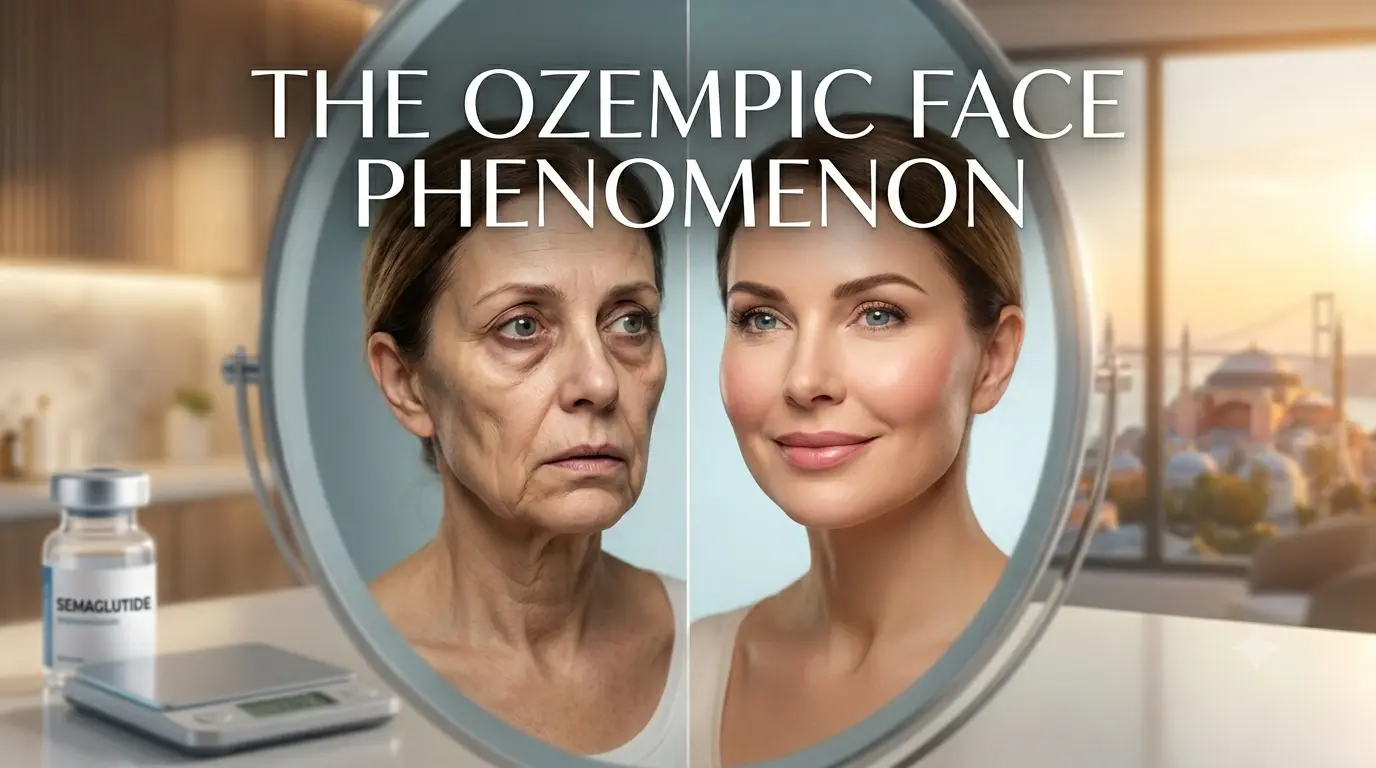
You lost the weight. The number on the scale moved in the direction you wanted for the first time in years, and GLP-1 medications like semaglutide or tirzepatide made it possible. Then you looked in the mirror and noticed something nobody warned you about: your face looks older. The cheeks are hollower. The temples are sunken. The jawline that was once softened by fullness is now sagging rather than defined. The phenomenon has a name now, Ozempic face, and it has become one of the most discussed topics in facial aesthetics worldwide. Plastic surgeons in Istanbul, Turkey, are seeing a growing number of international patients arriving with exactly this concern.
Ozempic face is not a side effect of the medication itself. It is a consequence of rapid, significant fat loss from the face, which is one of the first places the body draws from. Understanding why it happens, what it actually involves anatomically, and which procedures restore balance is the difference between feeling betrayed by a weight-loss success and finding a path to looking as good as you feel.
What Is Ozempic Face? The Anatomy of Facial Volume Loss After Weight Loss
Ozempic face describes the facial ageing that occurs when rapid weight loss depletes fat from the cheeks, temples, under-eye area, and jawline. The superficial fat pads that give the face its youthful contours, particularly the malar (cheek) fat pad and the buccal fat pad, shrink significantly as the body metabolises stored fat. Research published in peer-reviewed journals estimates that patients lose approximately 7% of midfacial volume for every 10 kilograms of total weight loss, with the effect concentrated in the areas that contribute most to a youthful appearance.
The result is a cluster of visible changes that, taken together, can age the face by five years or more:
- Hollowed cheeks and temples, creating a gaunt or skeletal appearance.
- Deeper nasolabial folds (nose-to-mouth lines) as the cheek pad descends.
- Pronounced tear troughs and under-eye hollowing.
- Sagging along the jawline and jowling, as skin that once sat over a fuller face now lacks structural support.
- Loss of lip fullness and increased visibility of fine lines around the mouth.
These changes are not unique to semaglutide or tirzepatide. Any rapid, significant weight loss, whether from GLP-1 medications, bariatric surgery, or aggressive dieting, can produce identical effects. The GLP-1 medications simply made the phenomenon more visible because so many patients are losing large amounts of weight on a compressed timeline. For a broader look at how the face changes structurally with age and weight fluctuation, the facial changes after ageing guide provides additional context.
| 🩺 Dr. Burak’s Clinical Note “What makes Ozempic face so frustrating for patients is the mismatch between how they feel and how they look. They have achieved something genuinely significant with their weight loss, and they expected to look healthier, not older. The good news is that the facial changes are well understood anatomically and highly treatable. The important step is to wait until weight has stabilised before planning any surgical restoration.” |
Why Dermal Filler Alone Is Rarely the Right Answer
The instinct for many patients is to reach for filler. Hyaluronic acid injections can replace lost volume quickly, and for mild cases, they can offer a meaningful improvement. But for patients who have lost significant weight, filler has structural limitations that become apparent over time.
The first issue is volume. Replacing the amount of facial fat lost after 20, 30, or 40 kilograms of weight reduction would require quantities of filler that risk looking and feeling unnatural, and the cost of maintaining that volume every 12 to 18 months becomes substantial. The second issue is skin quality. Filler adds volume beneath the skin, but it does not address the skin laxity, sagging, and loss of elasticity that accompany the volume loss. A face with hollowed cheeks and loose skin needs both structural support and tissue repositioning, and filler alone provides only one of those.
The third, and increasingly discussed, issue is filler fatigue. Patients who layer filler over years can experience product migration, facial distortion, and a characteristic heaviness that moves the face further from natural balance rather than toward it. For patients who have already dissolved old filler or want to avoid an injectable-dependent future, the conversation turns to surgical and semi-permanent solutions. For those exploring a transitional option between filler and surgery, Dr. Burak’s guide to Algeness bio-stimulatory filler covers a newer non-synthetic alternative.
| If you have experienced facial volume loss following GLP-1 medication or significant weight loss, Dr. Burak offers online consultations via WhatsApp and video call. An initial assessment can establish whether your weight is stable enough to plan restoration and which approach suits your anatomy. |
How a Surgeon Restores What Ozempic Face Takes Away
Facial restoration after significant weight loss typically involves addressing two distinct problems simultaneously: replacing lost volume and repositioning descended tissue. The procedures that achieve this can be performed individually, but they are most effective in combination, tailored to the patient’s specific anatomy and degree of change.

Facial Fat Grafting (Autologous Fat Transfer)
Fat grafting is the single most relevant procedure for Ozempic face patients. The surgeon harvests fat from an area of the body where it remains available (typically the abdomen, flanks, or thighs), processes it, and reinjects it into the face at the areas of volume depletion: cheeks, temples, tear troughs, jawline, and lips. Because the transferred tissue is the patient’s own, it integrates with the existing facial fat and ages naturally. Published data shows that 60 to 70% of transferred fat survives at six months, with most patients experiencing lasting volume improvement for five years or longer.
For Ozempic face patients specifically, fat grafting has an additional advantage. Adipose-derived stem cells within the transferred fat have been shown to improve skin quality, texture, and elasticity in the recipient area, a regenerative benefit that filler cannot provide. The procedure does require that the patient has sufficient donor fat available, which is typically not an issue for patients who have lost significant weight but retain some body fat stores.
Facelift and Neck Lift
When the facial changes extend beyond volume loss into visible skin laxity, jowling, and neck banding, a facelift becomes the structural solution. A well-timed facelift repositions the descended SMAS layer and skin, restoring the jawline definition and neck-to-jaw transition that weight loss has softened. For GLP-1 patients in their forties or fifties, a deep plane facelift is often the most effective approach, as it lifts the midface, lower face, and neck as a single composite unit. For patients with milder descent, a mini facelift or targeted SMAS lift may be sufficient; the mini facelift guide covers when the lighter approach is appropriate.
Combining a facelift with fat grafting in a single surgical session is increasingly common for Ozempic face patients. The lift addresses skin laxity and tissue descent while fat grafting restores volume simultaneously, producing a comprehensive result that neither procedure achieves alone.
Eyelid Surgery (Blepharoplasty)
Weight loss often accelerates the hollowing of the under-eye area and can contribute to increased upper eyelid exposure, making the eyes look tired, sunken, or aged. Blepharoplasty, which addresses excess skin and repositions fat around the eyelids, is frequently performed alongside fat grafting or facelift surgery for Ozempic face patients. Dr. Burak’s eyelid aesthetics page covers the procedure in full.
Neck Contouring
Rapid weight loss can leave loose, banded skin beneath the chin and along the neck. For patients whose primary concern is neck laxity rather than overall facial descent, a standalone neck lift or neck contouring with liposuction may be appropriate. In many cases, this is combined with chin augmentation to restore the jaw-to-neck angle that weight loss has blurred. The facelift and neck lift guide provides a full overview of the combined approach.
| 🩺 Dr. Burak’s Clinical Note “The critical rule for Ozempic face surgery is timing. I do not operate until the patient’s weight has been stable for a minimum of three to six months. If weight loss is still ongoing, the facial fat pads will continue to change, and surgical results can be compromised. I would rather a patient wait three extra months and achieve a result that holds than rush into a procedure that may need early revision.” |
Why International Patients Are Choosing Istanbul for Post-Weight-Loss Facial Surgery
Istanbul has become a leading global destination for facial surgery, and the post-GLP-1 patient cohort is a growing part of that trend. Turkey’s top hospitals are JCI-accredited, surgical training standards are rigorous, and the concentration of experienced facial surgeons is among the highest in the world. ISAPS data consistently ranks Turkey in the top tier for the volume of aesthetic and reconstructive surgery performed annually.
For Ozempic face patients, Istanbul offers a particularly compelling proposition. Combination procedures (facelift plus fat grafting, or fat grafting plus blepharoplasty) are performed routinely by experienced surgeons, and the cost of a comprehensive facial restoration is typically a fraction of equivalent procedures in the UK, the US, or Australia. The credential to look for remains EBOPRAS certification. Assoc. Prof. Dr. Burak Sercan Erçin holds both Turkish Board and EBOPRAS diplomas, practices at JCI-accredited Pendik Medical Park, and brings a dual reconstructive and aesthetic background to every facial case.
When Is the Right Time to Address Ozempic Face?
Timing is the single most important variable in post-weight-loss facial surgery. The face needs time to settle after significant fat loss, and operating too early risks a result that changes as the body continues to redistribute tissue. The general guidance is clear:
- Weight must be stable for a minimum of three to six months before surgical planning.
- If still on GLP-1 medication, discuss with your prescribing physician whether weight loss has plateaued.
- Non-surgical options (filler, bio-stimulators) can be used to manage appearance during the waiting period.
- The skin’s elasticity, which determines how well it redrapes after restoration, is better addressed sooner rather than later. Waiting years after weight stabilisation may mean the skin has lost additional elasticity, requiring more extensive surgery.
Dr. Burak’s team can advise on timing during an initial online consultation and help determine whether the face is ready for surgical planning or whether a waiting period is recommended.
Frequently Asked Questions
Is Ozempic face permanent?
The facial volume loss caused by significant weight loss is permanent in the sense that the lost fat does not return on its own, even if weight is regained (the body typically restores fat in different distribution patterns). However, the changes are highly treatable. Fat grafting, facelift surgery, filler, and blepharoplasty can all restore facial balance to a natural and lasting degree.
Can I prevent Ozempic face while still taking GLP-1 medication?
You cannot fully prevent facial fat loss if the body is losing fat systemically. However, maintaining adequate nutrition, protein intake, hydration, and a consistent skincare routine with collagen-supporting ingredients (retinol, vitamin C, peptides) can support skin quality during the weight-loss phase. The goal is to preserve skin elasticity so that restoration procedures are more effective when the time comes.
Is fat grafting or filler better for Ozempic face?
For mild cases, filler can provide a meaningful and immediate improvement. For moderate to significant volume loss, fat grafting is generally superior because it provides a larger, more natural volume of restoration, lasts longer (five years or more versus 12 to 18 months for filler), and delivers regenerative skin-quality benefits that filler cannot. Many patients benefit from filler during the weight-loss phase and fat grafting once weight has stabilised.
How long do I need to stay in Istanbul after facial fat grafting?
Most patients are comfortable for international travel within five to seven days after standalone fat grafting. If fat grafting is combined with a facelift, the recovery window extends to ten to fourteen days. All travel timelines are confirmed individually at consultation.
Does Dr. Burak offer online consultations for Ozempic face patients?
Yes. Assoc. Prof. Dr. Burak Sercan Erçin offers WhatsApp and video consultations for international patients before travel. Facial assessment, timing guidance, and procedure planning can all be discussed remotely, with in-person confirmation on arrival in Istanbul. Visit the contact page or reach out directly via WhatsApp.
You Earned the Weight Loss. Now Let Your Face Reflect It.
Ozempic face is an unintended consequence of a genuinely positive health achievement. The facial changes it produces, hollowed cheeks, sunken temples, sagging jawlines, deeper folds, are anatomically predictable and surgically reversible. The path to restoration runs through honest assessment, proper timing, and the right combination of volume replacement and tissue repositioning, performed by a surgeon who understands the face at a structural level.
For international patients considering facial restoration in Istanbul, the starting point is a conversation. Dr. Burak’s consultations begin with an assessment of whether the timing is right, which procedures match the anatomy, and what result is realistically achievable. The goal is always the same: a face that reflects how you feel, not just what the scale says.
Why Assoc. Prof. Dr. Burak Sercan Erçin
Dr. Burak Sercan Erçin is an Istanbul-based Plastic, Reconstructive and Aesthetic surgeon with more than 15 years of experience and over 6,000 operations. He holds both Turkish Board and EBOPRAS certifications, trained alongside Dr. Pedro Cavadas, one of the world’s most respected reconstructive microsurgeons, and serves as academic faculty at Bahçeşehir University. He practices at Pendik Medical Park, Istanbul. His dual background in reconstructive and aesthetic surgery is particularly relevant for post-weight-loss facial restoration, where the interplay between skeletal structure, fat distribution, and skin quality demands the deepest understanding of facial anatomy. To discuss your case, book an online consultation or reach out via WhatsApp.
This content was written by Assoc. Prof. Dr. Burak Sercan Erçin in line with clinical experience and current medical literature. It is intended for general informational purposes only and does not constitute medical advice. A personal consultation with Dr. Erçin is recommended for individual assessment.
Faculty Member · Bahçeşehir University
Graduate of Ege University Faculty of Medicine, Assoc. Prof. Dr. Erçin completed advanced fellowships at Tampa General Hospital (USA) under Dr. Deniz Dayıcıoğlu in breast reconstruction and burn surgery, and at the clinic of Dr. Pedro Cavadas in Valencia, Spain in reconstructive microsurgery. After passing the EBOPRAS examination in 2018, he joined Bahçeşehir University as a faculty member and continues his private practice on Bağdat Avenue, Istanbul, specialising in face, breast and body aesthetics alongside complex reconstructive surgery.