This article was written by Assoc. Prof. Dr. Burak Sercan Erçin and is based on clinical experience. A specialist in Plastic, Reconstructive and Aesthetic Surgery; prepared in accordance with current medical literature and personal surgical data. A consultation is recommended before making any medical decisions.

Many people spend years feeling that their eyes betray an emotion they do not feel. A downward slant at the outer corners of the eyes can project tiredness, sadness, or even irritability, regardless of how the person actually feels. If you have researched your eye shape and discovered the term negative canthal tilt, you are already asking the right question, and negative canthal tilt surgery in Turkey is increasingly the answer that international patients find when they look for a surgeon with the precision and experience to address it.
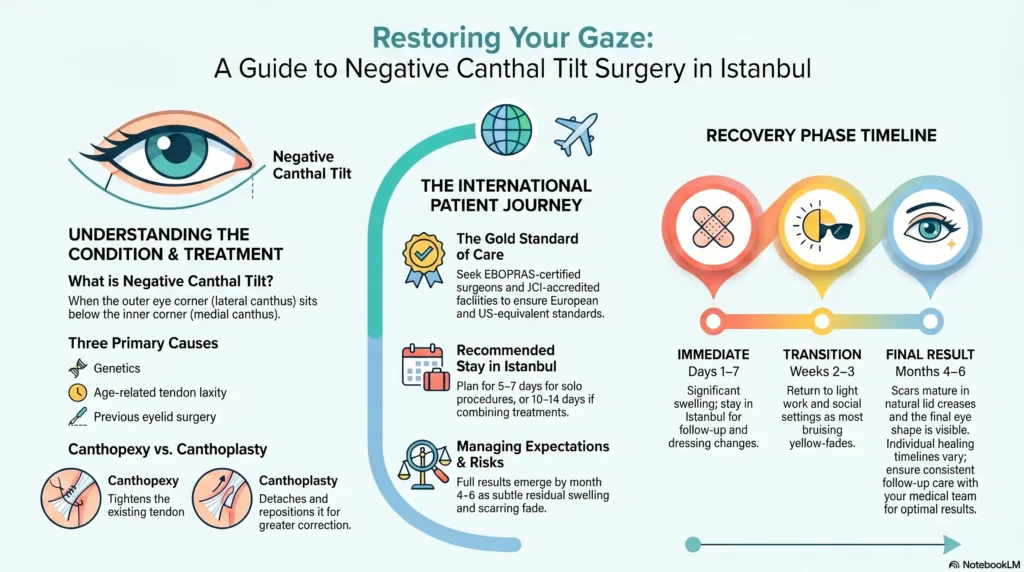
The lateral canthus, the outer corner where the upper and lower eyelids meet, typically sits at the same horizontal level as the medial canthus (the inner corner) or very slightly higher. When the outer corner descends below the inner corner, this is referred to as a negative canthal tilt, sometimes described as a downward or reverse canthal tilt. The structural imbalance is subtle in anatomy but significant in perception, and correcting it requires a surgeon who works at the intersection of oculoplastic technique and aesthetic refinement.
Istanbul has established itself as one of the leading global destinations for plastic and reconstructive surgery, combining internationally accredited facilities, credentialed surgeons, and a straightforward patient journey for visitors travelling from the UK, Europe, North America, and the Gulf region. For a procedure as technically demanding as canthal tilt correction, choosing the right surgeon matters more than geography. This guide covers everything an international patient needs to know.
What Is a Negative Canthal Tilt?
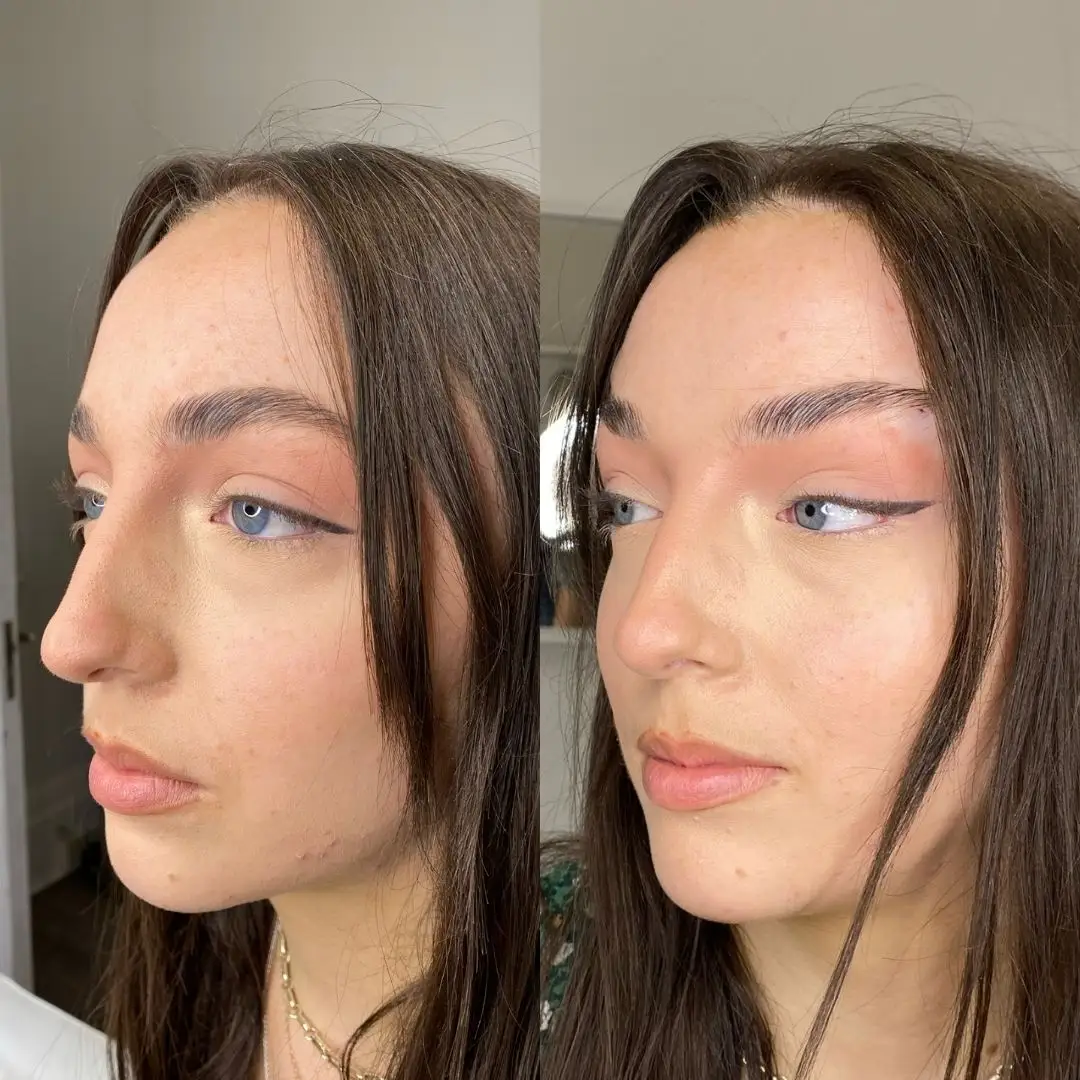
The canthal tilt describes the angular relationship between the inner and outer corners of the eye. In a neutral or positive canthal tilt, the outer corner (lateral canthus) sits at the same level as or slightly above the inner corner (medial canthus), giving the eye an alert, uplifted appearance. A negative canthal tilt occurs when the outer corner descends below the inner corner, creating a downward slope across the palpebral fissure, which is the visible opening between the eyelids.
Even a descent of just a few millimetres can meaningfully alter facial expression. The eyes are the first feature most people register when they look at a face, and a downward tilt at the outer corners is consistently associated in perception studies with expressions of fatigue, melancholy, or resignation. For patients who are conscious of this, the impact on confidence and social comfort can be considerable.
The condition can be purely anatomical, present from birth as a natural feature of the orbital structure, or it can develop over time as the lateral canthal tendon, which anchors the outer corner of the eye to the orbital rim, gradually loosens with age. In some cases, previous eyelid surgery that did not account for canthal position has contributed to the appearance. Understanding the underlying cause is the first step in selecting the most appropriate surgical approach.

What Causes a Negative Canthal Tilt?
The causes of negative canthal tilt fall into three broad categories, and a thorough pre-operative assessment will identify which applies to a given patient:
- Anatomical (congenital): Some individuals are born with a natural downward outer canthal position. The bony orbital structure, the relative tension of the canthal tendons, and the shape of the tarsal plates all contribute. In these patients, the tilt is a structural feature rather than a change over time.
- Age-related canthal laxity: The lateral canthal tendon is a fibrous structure that, like many connective tissues, loses elasticity with age. As it stretches and descends, the outer corner of the eye follows. This is often accompanied by lower eyelid laxity and can occur alongside other signs of periorbital ageing.
- Post-surgical changes: Eyelid surgery that has altered the position of the lower lid without adequately supporting the canthal angle can result in a downward shift. Revision canthal surgery in these cases requires particular attention to both function and aesthetics.
- Orbital or facial bone structure: In some patients, the underlying bony orbital rim contributes to the appearance of a negative tilt. In complex cases, this may be addressed in combination with other facial procedures.
Negative Canthal Tilt Surgery: Techniques and What the Procedure Involves
Correcting a negative canthal tilt is an oculoplastic procedure that repositions the lateral canthus to a higher, more anatomically neutral position. Depending on the degree of correction needed, the underlying cause, and whether the procedure is being performed alongside other work such as blepharoplasty (eyelid surgery) or a face lift, different surgical techniques may be used.
Lateral Canthopexy
Lateral canthopexy is a less invasive approach that tightens and re-suspends the lateral canthal tendon without fully detaching it. The tendon is reinforced and repositioned by securing it to the periosteum (the connective tissue overlying the orbital rim) at a higher point. Canthopexy is generally suited to patients with mild to moderate laxity and is often performed in conjunction with lower blepharoplasty.
Lateral Canthoplasty
Canthoplasty is a more definitive technique in which the lateral canthal tendon is detached, the eyelid margin is shortened if necessary, and the tendon is re-attached at a precisely planned position on the orbital rim. Lateral canthoplasty provides a greater degree of correction and is preferred when the tilt is more pronounced or when structural support of the lower lid is needed. The incisions are placed within the natural skin creases or existing wrinkle lines to minimise visible scarring.
Combined Approaches
Canthal tilt correction is frequently performed alongside complementary procedures. Lower blepharoplasty (lower eyelid surgery) addresses excess skin, muscle, or fat in the lower lid at the same time. In patients seeking broader periorbital rejuvenation, upper blepharoplasty or a midface lift may be incorporated. When combined procedures are planned, a detailed discussion with your surgeon is essential to understand sequencing and recovery.
| Dr. Burak’s Clinical Note In my practice, one of the most important decisions in canthal tilt correction is precisely where to fix the canthal tendon on the orbital rim. Too high produces an unnatural, wide-eyed appearance; too lateral creates tension and distortion. The ideal position respects the individual’s orbital anatomy and aims for a result that looks refreshed and natural, never operated. I spend considerable time in pre-operative planning mapping the exact vector of correction before any incision is made. |
Am I a Good Candidate for Negative Canthal Tilt Correction?
Most patients who seek canthal tilt surgery are adults who have noticed a persistent downward slant at the outer corners of their eyes, whether a lifelong anatomical feature or a change they have observed over time. The following criteria generally describe suitable candidates, though a personal consultation is the only way to assess individual suitability:
- You have a measurable downward slant at the outer canthal angle that bothers you aesthetically
- The appearance is causing self-consciousness or affecting your confidence in social or professional settings
- You are in good general health with no active eye conditions that would increase surgical risk
- You do not smoke, or are prepared to stop for the required period before and after surgery
- You have realistic expectations and understand that results, while typically excellent, cannot be guaranteed
- You have had a thorough eye examination to rule out dry eye syndrome or other conditions that may influence candidacy
| Considering negative canthal tilt surgery in Istanbul? Dr. Burak offers online consultations via WhatsApp and video call before you travel. You can share photographs and receive a preliminary assessment from Istanbul before committing to any plan. Reach out via buraksercanercin.co/contact/ or WhatsApp +90 533 433 5250. |
Is Negative Canthal Tilt Surgery Safe in Turkey? What to Know Before You Travel
The question every international patient asks when considering surgery abroad is entirely reasonable: how does the standard of care compare? Turkey’s position in global medical tourism has grown substantially over the past two decades, and for good reason. According to data from the International Society of Aesthetic Plastic Surgery (ISAPS), Turkey consistently ranks among the top five countries worldwide for aesthetic surgical procedures, with infrastructure and surgeon training that meets or exceeds European standards in accredited centres.
The Turkish Ministry of Health has invested significantly in international patient services, and hospitals operating at the level where procedures like canthal tilt surgery are performed are subject to both national accreditation and, in many cases, Joint Commission International (JCI) certification, the same standard applied to leading hospitals in the United States and the United Kingdom. Istanbul specifically concentrates a high density of internationally trained plastic surgeons, many of whom hold European board qualifications.
The European Board of Plastic, Reconstructive and Aesthetic Surgery, known as EBOPRAS, is the highest recognised qualification in plastic surgery within the European framework. Surgeons who hold the EBOPRAS diploma have passed rigorous written and practical examinations and met documented standards in clinical training, volume of procedures, and outcomes. For an international patient selecting a surgeon in Turkey, EBOPRAS certification is one of the most reliable indicators of equivalent European-standard training.
| Factor | Istanbul, Turkey | Typical Home-Country Private Care |
| Surgical expertise | EBOPRAS-certified specialists; academic faculty surgeons | Variable by country and provider |
| Waiting times | Typically days to weeks from enquiry | Often several months in public healthcare |
| Facility standards | JCI-accredited hospitals; international patient services | Varies; often excellent in private sector |
| Surgeon access | Direct, personal; surgeon performs and reviews | Depends on practice model |
| International support | Multilingual coordinators; travel and stay assistance | Generally not provided |
None of this is to suggest that choosing surgery abroad is without considerations. Surgical outcomes depend on many factors: the surgeon’s expertise, the facility’s standards, the patient’s own health, and the quality of the aftercare. The appropriate response to these considerations is thorough research and direct consultation, not avoidance. Patients who invest time in understanding their surgeon’s credentials and asking detailed questions are consistently better prepared, and better outcomes tend to follow.
Why Choose Dr. Burak Sercan Ercin for Canthal Tilt Surgery in Istanbul?
The periorbital area, the zone of the face surrounding the eyes, is surgically demanding. The tissues are delicate, the anatomical relationships are precise, and the margin between a result that looks natural and one that does not is narrow. Canthal tilt correction in particular requires a surgeon who understands not just the mechanical correction of position but the aesthetic impact of every millimetre of change.
Assoc. Prof. Dr. Burak Sercan Ercin is a plastic, reconstructive, and aesthetic surgeon based in Istanbul with over 15 years of clinical experience and more than 6,000 operations across the full spectrum of plastic surgery. He holds the EBOPRAS diploma, is a faculty member at Bahcesehir University, and practises at Pendik Medical Park, Istanbul. His academic position means he remains actively engaged with the evolving evidence base in plastic surgery, and his breadth of reconstructive experience, which includes microsurgery training alongside world-renowned reconstructive surgeon Dr. Pedro Cavadas, informs a surgical precision that purely cosmetic practices rarely develop.
For procedures involving the eye area, this dual background matters. Canthal repositioning requires understanding of the functional anatomy of the eyelid and orbit, not just its aesthetic appearance. A surgeon trained extensively in reconstructive oculoplastic work, and who also has refined aesthetic judgment, is well placed to achieve a result that is both structurally sound and visually natural. You can learn more about Dr. Burak’s background and training at buraksercanercin.co/md-burak-sercan-ercin/.
For patients considering eyelid procedures alongside canthal correction, Dr. Burak’s eyelid aesthetics page at buraksercanercin.co/eyelid-aesthetics/ details the full scope of periorbital work available. Patients seeking broader facial rejuvenation may also find it useful to explore his facelift and facial surgery services.
| Surgeon’s Perspective In my experience, patients who travel to Istanbul for canthal tilt surgery are often those who have been told at home that the procedure is too niche, or that the risk of an unnatural result is too high. I understand that caution. The outer canthal area is unforgiving territory. My approach is always to plan conservatively, correct precisely, and prioritise a result the patient will still be pleased with in ten years. I never aim for dramatic; I aim for right. |
| Ready to review your case with one of Istanbul’s most experienced reconstructive and aesthetic surgeons? Book a no-obligation consultation with Dr. Burak today. International patients are warmly welcomed, and the entire consultation process can begin online. Visit buraksercanercin.co/contact/ or message directly on WhatsApp. |
Recovery After Negative Canthal Tilt Surgery: What to Expect
Understanding the recovery timeline is particularly important for international patients who need to plan their stay in Istanbul and their return journey. The following overview reflects the typical experience; individual recovery varies based on surgical technique, whether additional procedures were performed, and the patient’s general health.
| Timeframe | What to Expect | Downtime Level |
| Days 1–3 | Swelling, bruising, mild tightness around the outer eye. Cold compresses recommended. Rest at home. | Significant |
| Days 4–7 | Bruising begins to yellow and fade. Most patients comfortable indoors. No strenuous activity. | Moderate |
| Weeks 2–3 | Most visible swelling resolves. Patients typically feel confident returning to light work and social settings. | Mild |
| Month 1–3 | Subtle residual swelling dissipates. Final eye shape begins to emerge. | Minimal |
| Month 4–6+ | Full results visible. Scars mature and fade within the natural lid crease. | None |
Activity and Return to Work
Most patients find that light desk work is comfortable from around the second week onwards. Strenuous physical activity, heavy lifting, and exercise should be avoided for four to six weeks. Sun exposure to the eye area should be minimised during healing, and any sunglasses or protective eyewear should be worn when outdoors.
What to Expect Specifically Around the Eyes
Some temporary dryness or a sensation of tightness at the outer corner of the eye is common in the first few weeks and resolves as the tissues settle. Eye drops to keep the surface of the eye lubricated are frequently recommended during this period. Patients should not wear contact lenses until cleared by Dr. Burak at their follow-up review.
Planning Your Negative Canthal Tilt Surgery Trip to Istanbul: A Practical Guide
Istanbul is exceptionally well-connected for international visitors, served by Istanbul Airport, one of the highest-capacity airports in Europe, with direct flights from London, Dubai, Sydney, New York, and most major cities. Transit into the city is straightforward, and the range of accommodation options, from boutique hotels to fully serviced apartments, suits recovery well.
Recommended Stay Duration
For canthal tilt surgery alone, most international patients are advised to remain in Istanbul for a minimum of five to seven days after the procedure. The day-one post-operative review and the first dressing change take place at the clinic, and the surgeon will assess progress before clearing the patient to travel. A follow-up appointment, typically at the five-to-seven-day mark, is standard. Where canthal correction is combined with additional procedures, a longer stay of ten to fourteen days may be more appropriate.
Before You Travel
- A comprehensive online consultation with Dr. Burak should take place well in advance of travel, during which photographs are reviewed, medical history discussed, and suitability confirmed
- Pre-operative blood tests and any necessary eye examinations should be arranged and results shared with the clinic before arrival
- Travel insurance that specifically covers elective surgical procedures abroad is strongly recommended
- Arrange for a companion to assist during the first forty-eight hours post-surgery if possible
- Plan your return flight for a date that respects the advised recovery window rather than the earliest possible day
Surgical Risks and How They Are Managed
Honest discussion of surgical risk is not a reason to avoid a procedure; it is a sign of a responsible surgeon and an informed patient. Negative canthal tilt surgery, like all surgical procedures, carries a defined set of risks that patients should understand:
- Asymmetry: Minor differences between the two sides are common in the early healing period; significant asymmetry requiring revision is uncommon with precise surgical planning
- Temporary dry eye or eye surface irritation: The eye’s tear film can be temporarily disrupted; this usually resolves with lubricant drops
- Scarring: Incisions are placed in concealed locations, but all surgery produces scarring; in most cases this fades to near-imperceptibility within six to twelve months
- Overcorrection or undercorrection: Precise planning minimises this risk; a conservative approach reduces the likelihood of an unnatural result
- Infection or haematoma: Uncommon in clean surgical environments; managed with prophylactic measures and follow-up monitoring
Dr. Burak will discuss all relevant risks in detail during your consultation, taking into account your individual anatomy, health history, and any additional procedures planned. The goal is always a well-informed patient who enters surgery with realistic expectations and clear post-operative guidance.
Frequently Asked Questions: Negative Canthal Tilt Surgery in Turkey
What is negative canthal tilt surgery, and how does it work?
Negative canthal tilt surgery corrects a downward slant at the outer corners of the eyes by repositioning the lateral canthus to a higher, more anatomically neutral position. The procedure uses either canthopexy (tightening the existing tendon) or canthoplasty (detaching and re-fixing the tendon at a higher point), depending on the degree of correction needed and the individual’s anatomy. Results are typically long-lasting, and for most patients the change is noticeable without appearing surgical.
Is Dr. Burak Sercan Ercin EBOPRAS certified?
Yes. Assoc. Prof. Dr. Burak Sercan Ercin holds the diploma of the European Board of Plastic, Reconstructive and Aesthetic Surgery (EBOPRAS), the highest recognised qualification in plastic surgery within the European framework. He is also an academic faculty member at Bahcesehir University in Istanbul and has clinical experience spanning more than 6,000 operations over 15 years. Full details of his credentials are available at buraksercanercin.co/md-burak-sercan-ercin/.
How long do I need to stay in Istanbul after negative canthal tilt surgery?
A minimum of five to seven days in Istanbul after the procedure is recommended for international patients. This allows for a post-operative review at day one, a dressing assessment, and a follow-up appointment before you are cleared to fly. If canthal correction is combined with blepharoplasty or other facial procedures, a stay of ten to fourteen days is typically more appropriate. Dr. Burak’s team will advise on the exact timeline based on your specific surgical plan.
Can I fly after canthal tilt surgery in Turkey?
Most patients are cleared to fly approximately five to seven days after surgery, following their post-operative review and provided recovery is progressing normally. Long-haul flights during the early healing period carry a marginally elevated risk of swelling and discomfort, so it is advisable to prioritise adequate recovery time over the earliest possible return date. Your surgeon will confirm your individual clearance to travel at your pre-departure follow-up.
Does Dr. Burak offer online consultations for international patients?
Yes. International patients are encouraged to begin the consultation process remotely, before travelling. Dr. Burak and his team can review photographs, discuss your concerns, assess preliminary suitability, and answer detailed questions via WhatsApp or video call. This allows patients to make a well-considered decision without an unnecessary trip. Contact the clinic via buraksercanercin.co/contact/ or WhatsApp +90 533 433 5250 to arrange your online consultation.
Is Turkey a safe destination for eye area surgery?
Turkey is consistently ranked among the top five countries globally for aesthetic surgical procedures by the International Society of Aesthetic Plastic Surgery (ISAPS). Accredited facilities in Istanbul operate to JCI standards, and surgeons with EBOPRAS certification have met the same examination requirements as their European counterparts. As with any surgical decision, the most important factor is the individual surgeon’s qualifications, experience, and clinical judgment, not geography alone.
Can negative canthal tilt be corrected at the same time as eyelid surgery?
Yes, and in many cases a combined approach is both clinically appropriate and practically advantageous. Canthal tilt correction and lower blepharoplasty (lower eyelid surgery) are frequently performed together, as they address adjacent anatomy and the recovery periods overlap. Upper blepharoplasty can also be included where indicated. During your consultation, Dr. Burak will assess whether a combined or staged approach best serves your goals and anatomy.
Reshaping Your Eye Contour in Istanbul: Precision, Naturalness, and the Right Surgeon
A downward canthal tilt is one of the most undertreated causes of an ageing or fatigued appearance, partly because it is subtle enough that many patients cannot initially name what they are seeing in the mirror, and partly because the surgery to correct it demands a level of periorbital precision that not all surgeons offer routinely. Finding a surgeon who combines oculoplastic technical competence with a refined aesthetic eye is the most important decision in this process.
Three things are worth keeping in mind as you consider your next steps. First, the cause matters: whether your tilt is anatomical, age-related, or the result of previous surgery, the appropriate technique and the extent of correction required are different, and both must be assessed in person. Second, the surgeon’s background matters more than the destination: EBOPRAS certification and reconstructive training are meaningful indicators of competence; geography is secondary. Third, results in this area should always look natural. An eye that has been overcorrected into a wide, artificial position is as problematic as one that was not corrected at all.
For international patients considering negative canthal tilt surgery in Turkey, Istanbul offers a compelling combination of internationally credentialed surgeons, modern accredited facilities, and a straightforward patient journey from first enquiry to post-operative follow-up. For patients who value surgical depth alongside aesthetic judgment, Dr. Burak’s profile, which combines reconstructive microsurgery training with 6,000+ aesthetic procedures, represents a rare breadth of expertise applied to delicate periorbital work. View his published before and after results at buraksercanercin.co/before-after-results/ to form your own assessment.
Why Assoc. Prof. Dr. Burak Sercan Ercin
Assoc. Prof. Dr. Burak Sercan Ercin is an Istanbul-based plastic, reconstructive, and aesthetic surgeon with over 15 years of clinical experience and more than 6,000 operations. He holds the EBOPRAS diploma, serves as academic faculty at Bahcesehir University, and practises at Pendik Medical Park. His reconstructive training, which includes microsurgery practice alongside Dr. Pedro Cavadas, one of the world’s most respected reconstructive surgeons, gives him a precision and anatomical depth that is uncommon in aesthetic surgery.
Dr. Burak has completed international humanitarian surgery missions with the Turkish Ministry of Health and has been featured in major media including Anadolu Agency. His surgical philosophy centres on natural results: outcomes that harmonise with the patient’s own anatomy rather than imposing a standardised aesthetic. For periorbital procedures, this philosophy translates directly into results that look refreshed, alert, and genuinely like the patient at their best.
This content was written by Assoc. Prof. Dr. Burak Sercan Erçin in line with clinical experience and current medical literature. It is intended for general informational purposes only and does not constitute medical advice. A personal consultation with Dr. Erçin is recommended for individual assessment.
Faculty Member · Bahçeşehir University
Graduate of Ege University Faculty of Medicine, Assoc. Prof. Dr. Erçin completed advanced fellowships at Tampa General Hospital (USA) under Dr. Deniz Dayıcıoğlu in breast reconstruction and burn surgery, and at the clinic of Dr. Pedro Cavadas in Valencia, Spain in reconstructive microsurgery. After passing the EBOPRAS examination in 2018, he joined Bahçeşehir University as a faculty member and continues his private practice on Bağdat Avenue, Istanbul, specialising in face, breast and body aesthetics alongside complex reconstructive surgery.