This article was written by Assoc. Prof. Dr. Burak Sercan Erçin and is based on clinical experience. A specialist in Plastic, Reconstructive and Aesthetic Surgery; prepared in accordance with current medical literature and personal surgical data. A consultation is recommended before making any medical decisions.

A single TikTok video showing a 21-year-old German man growing from 5 foot 6 to 6 foot 3 has been watched more than 22 million times. Turkish orthopaedic surgeon Prof. Dr. Yuksel Yurttas posts patient transformations reaching 20cm of height gain to hundreds of thousands of followers per video. Hashtags related to limb lengthening surgery now aggregate several billion views across TikTok and Instagram. And unlike most social-media procedure trends, heightmaxxing is no longer confined to niche looksmax forums or Reddit corners. Mainstream press coverage from CTV, Ynetnews, PlacidWay, and Fox affiliate stations has moved the phenomenon into public conversation, and Turkey has emerged as one of the two or three global capitals of the procedure alongside South Korea and the United States.
This guide, written from the perspective of Assoc. Prof. Dr. Burak Sercan Erçin, an EBOPRAS-certified plastic and reconstructive surgeon in Istanbul, covers what heightmaxxing actually is, what limb lengthening surgery involves at a real technical level, why Turkey has become the destination country for international patients, and what the honest surgical assessment looks like for a man considering the procedure. It also covers what most articles on this subject do not: the substantial number of readers arriving via heightmaxxing content who are, on realistic assessment, better served by other procedures entirely.
What Heightmaxxing Actually Means
Heightmaxxing sits inside the broader looksmaxxing vocabulary already familiar to the site’s readers from the looksmaxxing and alpha male surgery guide and the softmax versus hardmax discussion. Where jawmaxxing targets the lower face and canthopexy or hunter-eye surgery targets the eye area, heightmaxxing targets vertical stature. The term functions as an umbrella covering everything from posture correction and elevator shoes at the softmax end through to limb lengthening surgery at the hardmax end.
The specific behaviours the term covers, arranged from least to most invasive:
- Posture correction and postural exercises that recover 1-3 cm of lost vertical stature caused by slouching, spinal compression, or muscle imbalance.
- Footwear choices such as elevator shoes, hidden lifts, and thicker soled trainers that add 2-8 cm of apparent height.
- Styling techniques including monochrome outfits, vertical lines, and tailoring choices that create a taller visual silhouette.
- Growth-hormone therapy for adolescents with a diagnosed growth deficiency, which is a legitimate medical treatment and not a cosmetic intervention.
- Off-label supplements and unregulated hormonal products marketed as height boosters, which are largely unsupported by clinical evidence and can carry meaningful health risks.
- Limb lengthening surgery, the only intervention that produces permanent bone-based height gain in an adult with fused growth plates. This is the intervention driving the current viral cycle.
Everything up to and including footwear is essentially cost-free and low-risk. Everything below the line into supplements and surgery involves real trade-offs that any patient should understand before committing. The rest of this guide focuses on the surgical option, because that is what has made heightmaxxing a 2026 media phenomenon and what most search-driven readers arriving on this page are actually here to learn about.
Limb Lengthening Surgery: How the Procedure Actually Works
Limb lengthening is the only known method of achieving permanent height gain in an adult after skeletal maturity. The procedure has existed for over 70 years in the reconstructive orthopaedic world, where it is used to correct congenital limb-length discrepancies, correct deformities, and treat the aftermath of trauma. Its use as a purely cosmetic procedure for people without a medical indication is relatively newer and considerably more controversial within mainstream medicine, but it is now offered by a small number of specialist centres worldwide, with Turkey, South Korea, the United States, and Spain hosting the highest volumes.
The underlying biological principle: distraction osteogenesis
The procedure exploits a natural biological phenomenon called distraction osteogenesis. When a bone is surgically cut and then very slowly pulled apart at a rate of roughly 1 mm per day, the body responds by generating new bone tissue to fill the widening gap. Over weeks and months, this new bone consolidates into fully mineralised, load-bearing skeleton. The technique was pioneered by Russian orthopaedic surgeon Gavriil Ilizarov in the 1950s and has been refined continuously since. The modern cosmetic variant uses the same core biological principle with substantially more advanced hardware and instrumentation.
The three main modern techniques
Cosmetic limb lengthening today is performed via one of three primary methods, distinguished by the hardware used to control the gradual bone lengthening:
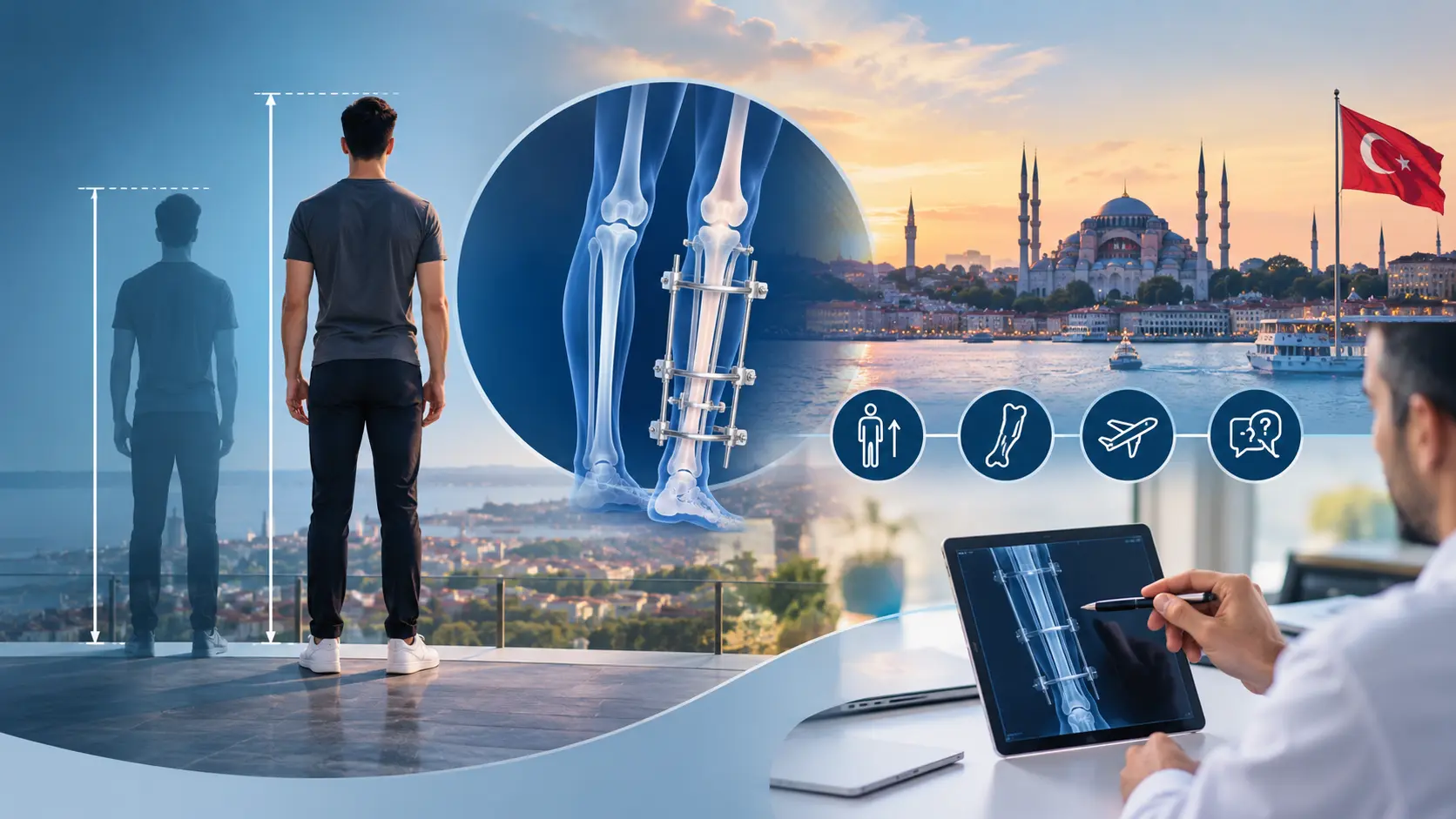
- Precice 2 (internal magnetic nail): a titanium nail is inserted inside the marrow cavity of the bone after surgical osteotomy. Lengthening is achieved by an external magnetic controller that the patient uses at home to gradually turn the internal nail 1 mm per day. No external frame is worn, and there is no external hardware protruding through the skin. This is the technique most heavily featured in viral 2026 TikTok content and is the technique most commonly performed in Turkey.
- LON (Lengthening Over Nails): a hybrid technique combining an external frame worn on the outside of the leg with an internal nail. The external frame does the lengthening, and once the desired length is reached, the frame is removed and the internal nail holds the bone in position while it consolidates. Recovery is faster than a pure external frame approach because the frame is removed earlier.
- Classic Ilizarov (external frame only): the original technique, in which a metal external frame is fixed to the bone through pins passing through the skin. The frame performs both the lengthening and the fixation until the bone consolidates fully. Rarely used for cosmetic purposes now because of the visible external hardware and longer recovery, but still standard in reconstructive orthopaedic practice.
Which bone is lengthened, and by how much
Cosmetic patients most commonly lengthen the femur (thigh bone) because it preserves better proportion between the upper and lower leg and produces a more natural final appearance. Tibial (shin bone) lengthening is available and can be combined with femoral lengthening across staged procedures to achieve greater total height gain. Typical single-procedure gains are 5-8 cm from femur lengthening or 5-7 cm from tibial lengthening. Patients seeking greater total gains typically undergo staged procedures over several years, with total gains occasionally reaching 15-20 cm across three or four surgical episodes. These extreme totals are uncommon and carry proportionately elevated risk.
Recovery timeline
The overall recovery from cosmetic limb lengthening is substantial and should not be underestimated. Standard timelines run as follows:
- Surgery day: outpatient or overnight hospital stay, wheelchair mobilisation begins.
- Weeks 1-2: initial healing, wheelchair mobility, learning to use the magnetic controller (Precice) or manage the frame (LON).
- Weeks 3-12 (lengthening phase): the bone is gradually pulled apart 1 mm per day using the controller or frame. Physiotherapy is intensive and non-negotiable. Walking with support becomes possible late in this phase.
- Months 3-9 (consolidation phase): the new bone gradually mineralises into full load-bearing skeleton. Weight-bearing progresses from partial to full. Running, jumping, and sport remain restricted.
- Months 9-18: return to full activity including sport, though many patients report continued gains in strength and confidence into the second year.
Reasonable estimates for time off normal life are 3-6 months of significant limitation, followed by 6-12 months of progressive return to unrestricted activity.
🩺 Dr. Burak’s Clinical Note
“Limb lengthening is not a plastic surgery procedure. It is a highly specialised orthopaedic operation that I do not perform personally. I include this section in the article because a substantial number of men considering the procedure arrive at aesthetic consultations first, and they deserve a complete picture from a surgeon who has no commercial reason to sell them the operation. What I can tell them honestly is which orthopaedic centres in Turkey are internationally credentialled, what the procedure genuinely involves, and whether an alternative approach might serve their actual goal better.”
Dr. Burak Sercan
Why Turkey Has Become a Global Destination for Limb Lengthening
Turkey, and specifically Istanbul, Izmir, and Ankara, has emerged as one of the three or four highest-volume destinations globally for cosmetic limb lengthening. The reasons are consistent with the country’s broader medical tourism dynamic across aesthetic and orthopaedic surgery.
- Cost: the total cost of Precice 2 femoral lengthening in Turkey typically falls in the range of 25,000 to 45,000 USD, compared with 80,000 to 90,000 USD or more for the equivalent procedure in the United States. Total-package pricing including hospital stay, hardware, physiotherapy, and accommodation is significantly lower than any comparable Western market.
- Surgical volume: leading Turkish limb lengthening surgeons perform hundreds of cosmetic cases per year, which produces measurable outcome advantages over lower-volume centres.
- Hospital infrastructure: JCI-accredited hospitals across the major Turkish cities operate to the same standards patients expect in the UK, the US, or Australia. Anaesthesia protocols, sterile technique, and post-operative care meet international benchmarks.
- Rehabilitation packages: specialist Turkish clinics offer comprehensive rehabilitation programmes covering the full 3-6 month intensive recovery period, often at accommodation options coordinated with the clinic.
The specific credential to verify when selecting a limb lengthening surgeon in Turkey is board certification in orthopaedic surgery combined with a documented sub-specialty focus on limb reconstruction or lengthening. Not every orthopaedic surgeon performs cosmetic lengthening, and among those who do, published volume, patient outcome tracking, and follow-up protocols vary significantly. This is not a procedure to book on price alone.
What a Plastic Surgeon Wants You to Know Before You Book
This section is Dr. Burak’s honest surgeon commentary on the trend, drawing on 15 years of experience with male patients pursuing the -maxxing pathway. It is not an attempt to talk anyone out of a procedure they have carefully considered. It is an attempt to give the same information to a reader searching online at 2am that the reader would receive in a proper consultation.
Who genuinely benefits from limb lengthening
A small subset of the men considering this procedure are excellent candidates and are likely to report high long-term satisfaction. These patients tend to share several characteristics. They have carried a lifelong, well-formulated wish for greater height that predates their exposure to looksmax content. They understand the recovery timeline realistically. They have the financial resources to fund the procedure without hardship. They have secure work and living arrangements that can absorb 3-6 months of significant limitation. They have psychological stability and are not pursuing surgery as a solution to depression, anxiety, or a broader dissatisfaction with life. They have specific and modest gain goals, typically 5-8 cm from a single procedure. For these patients, the operation, performed at a credentialled centre, can be genuinely life-changing in a positive direction.
The larger group who should think twice
A much larger group of men considering the procedure show one or more of the following patterns, and typically benefit from slowing down before booking. Recent immersion in looksmax content combined with a sudden urgency to book surgery. A history of dysmorphic-style focus on a single aesthetic feature that has previously moved from one body part to another. Financial strain in funding the procedure, or borrowing to fund it. Unstable work or living arrangements that will make the 3-6 month recovery genuinely difficult. Underlying depression, anxiety, or social-relational difficulties that the patient believes height gain will solve. Ambitious total-gain goals of 15-20 cm across staged procedures, particularly when the underlying motivation is not clearly articulated. Every one of these patterns is a legitimate reason to defer the decision and seek a psychological consultation before proceeding, not because the patient is unwell, but because the operation is not going to solve what they actually want solved.
Alternative procedures for readers who are not candidates
A significant portion of men who arrive at aesthetic consultations having recently discovered heightmaxxing report, on closer conversation, that the underlying dissatisfaction was never about height in the first place. It was about a general feeling of not measuring up in facial harmony, jawline definition, eye area presentation, or overall masculine appearance. For these patients, the appropriate response is not limb lengthening but properly selected face procedures that address the actual anatomical variable driving the concern. The site’s mandibular angle implants guide, sliding genioplasty guide, chin augmentation guide, hunter eyes surgery guide, and negative canthal tilt surgery guide together cover the procedures Dr. Burak does perform and that map to the same broad hardmax objectives as height surgery, at lower risk, lower recovery burden, and generally lower cost.
If Height Surgery Is Not the Right Answer, What Actually Is?
For a majority of readers arriving here after heightmaxxing content, the honest answer is that a face-based hardmax approach will produce more meaningful daily improvements in perceived attractiveness, confidence, and social response than limb lengthening will. The reason is anatomical and social: the human face is what other humans read in every interaction, and small structural improvements to the face are noticed and processed far more readily than a 5-8 cm increase in height. This is not a marketing argument for face surgery. It is a straightforward observation from decades of aesthetic consultation data across the international plastic surgery literature.
The face procedures most commonly appropriate for the man who arrived via heightmaxxing but is a better candidate for facial work are the following:
- Mandibular angle implants for lower-face structural definition. See [[https://buraksercanercin.co/blog/jaw-implants-guide/|the jaw implants guide]].
- Sliding genioplasty or chin augmentation for a recessed or under-projected chin. See the [[https://buraksercanercin.co/blog/sliding-genioplasty-turkey/|sliding genioplasty guide]] or [[https://buraksercanercin.co/blog/chin-augmentation-implants/|chin augmentation guide]].
- Bimax or double-jaw surgery for patients with underlying skeletal malocclusion or midface deficiency. See the [[https://buraksercanercin.co/blog/bimax-surgery/|bimax surgery guide]].
- Canthoplasty or canthopexy for eye-area repositioning, targeting negative canthal tilt or hunter-eye aesthetics. See the [[https://buraksercanercin.co/blog/negative-canthal-tilt-surgery-turkey/|negative canthal tilt surgery guide]] and the [[https://buraksercanercin.co/blog/hunter-eyes-surgery/|hunter eyes surgery guide]].
- Rhinoplasty for nasal proportion adjustment. See Dr. Burak’s [[https://buraksercanercin.co/blog/pitanguy-ligament-rhinoplasty/|Pitanguy ligament rhinoplasty guide]].
These procedures address different anatomical variables. A properly conducted consultation identifies which specific variable is driving the reader’s dissatisfaction, and matches the procedure to that variable rather than to a general looksmax objective.
Frequently Asked Questions
What is heightmaxxing?
Heightmaxxing is a social media term for the pursuit of greater height through non-surgical or surgical means. Non-surgical approaches include posture correction, elevator shoes, styling techniques, and legitimate growth-hormone therapy for adolescents with medical indications. The only surgical intervention that produces permanent height gain in an adult is limb lengthening surgery. The term sits inside the broader looksmaxxing vocabulary alongside jawmaxxing, mewing, and softmax or hardmax approaches to appearance.
Is limb lengthening surgery safe?
Limb lengthening is a well-established orthopaedic procedure with more than 70 years of clinical use in reconstructive surgery. When performed by an experienced surgeon at a credentialled centre, the safety profile is favourable, though complication rates are higher than most cosmetic operations because of the extended lengthening phase, physiotherapy demands, and biological complexity of bone healing under distraction. Complications can include nerve irritation, joint stiffness, delayed bone consolidation, hardware failure, and infection. Rigorous patient selection, high-volume surgeon experience, and complete physiotherapy compliance are the main safety variables.
How much does limb lengthening cost in Turkey?
Cosmetic limb lengthening in Turkey typically costs between 25,000 and 45,000 US dollars for a single Precice 2 femoral lengthening procedure, including hospital, hardware, physiotherapy package, and follow-up. The equivalent procedure in the United States typically costs 80,000 to 90,000 US dollars or more. Staged multi-segment procedures for greater total height gain scale accordingly. Costs vary between centres and depend on the specific technique, hardware, and rehabilitation package included.
How much taller can you get from limb lengthening?
A single Precice 2 femoral procedure typically achieves 5-8 cm of height gain. A single tibial procedure typically achieves 5-7 cm. Staged procedures across femur and tibia over 2-4 surgical episodes can achieve total gains of 15-20 cm, though these extreme totals are uncommon and carry proportionately elevated cumulative risk. Most patients undergoing a single procedure gain 6-7 cm.
How long is recovery from limb lengthening?
Total recovery from a single femoral lengthening procedure runs approximately 12 months, with 3-6 months of significant limitation followed by 6-12 months of progressive return to unrestricted activity. Return to walking without support is typically possible around month 3, running around months 6-9, and full sport around months 9-12. The recovery is substantial and should not be underestimated when planning the decision.
Does Dr. Burak perform limb lengthening surgery?
No. Limb lengthening is a highly specialised orthopaedic procedure, not a plastic surgery operation. Dr. Burak does not perform it personally. This article is written to give readers considering the procedure a complete, honest picture from a plastic surgeon with no commercial reason to sell them the operation, and to help identify readers who may be better candidates for face-based aesthetic procedures that Dr. Burak does perform. Visit the contact page or reach out via WhatsApp to discuss which pathway fits your goals.
A Trend, a Procedure, and an Honest Question
Heightmaxxing is a genuine expression of a broader cultural pressure that is not going to fade. Men who feel disadvantaged by their height have always existed; what has changed in 2026 is that the pathway from that feeling to a surgical solution has become dramatically more visible, more socially acceptable, and more accessible through medical tourism. Limb lengthening surgery, performed at a credentialled centre by an experienced surgeon on a properly selected patient, is a legitimate procedure with a well-documented biological basis and a genuine capacity to change a life.
But it is also a 12-month commitment, a substantial financial outlay, and an operation that will not solve problems that were never actually about height in the first place. For international patients considering the procedure in Turkey, the right first step is an honest self-assessment about what is driving the wish, followed by a consultation with a surgeon willing to say when the answer is yes, when the answer is not yet, and when the answer is that the reader would be better served by a different procedure entirely. That conversation is where good decisions begin, and it is available to any reader who reaches out.
Why Assoc. Prof. Dr. Burak Sercan Erçin
Dr. Burak Sercan Erçin is an Istanbul-based Plastic, Reconstructive and Aesthetic surgeon with more than 15 years of experience and over 6,000 operations. He holds both Turkish Board and EBOPRAS certifications, trained alongside reconstructive microsurgeon Dr. Pedro Cavadas, and serves as academic faculty at Bahçeşehir University. He practices at Pendik Medical Park, Istanbul. His approach to the -maxxing ecosystem is grounded in the same principle that guides his broader surgical philosophy: give patients honest information about every option, including operations he does not personally perform, and help them find the pathway that will genuinely serve their goals. To discuss your case, book an online consultation or reach out via WhatsApp.
This content was written by Assoc. Prof. Dr. Burak Sercan Erçin in line with clinical experience and current medical literature. It is intended for general informational purposes only and does not constitute medical advice. A personal consultation with Dr. Erçin is recommended for individual assessment.
Faculty Member · Bahçeşehir University
Graduate of Ege University Faculty of Medicine, Assoc. Prof. Dr. Erçin completed advanced fellowships at Tampa General Hospital (USA) under Dr. Deniz Dayıcıoğlu in breast reconstruction and burn surgery, and at the clinic of Dr. Pedro Cavadas in Valencia, Spain in reconstructive microsurgery. After passing the EBOPRAS examination in 2018, he joined Bahçeşehir University as a faculty member and continues his private practice on Bağdat Avenue, Istanbul, specialising in face, breast and body aesthetics alongside complex reconstructive surgery.