This article was written by Assoc. Prof. Dr. Burak Sercan Erçin and is based on clinical experience. A specialist in Plastic, Reconstructive and Aesthetic Surgery; prepared in accordance with current medical literature and personal surgical data. A consultation is recommended before making any medical decisions.

If you have spent any time in TikTok’s looksmaxxing corner over the past six months, you have almost certainly encountered the PSL scale. It appears in videos where young men grade their own faces, in Discord servers where community members post front-and-profile photos for peer rating, and in the comment sections under viral before-and-after transformations. A University of Portsmouth research team led by cybercrime and gender specialists documented in a November 2025 study that the PSL scale has become one of the primary vehicles by which incel ideology has rebranded itself for a wider, younger audience, with the term sub5 replacing incel as the community’s preferred self-identifier. The scale is now the linguistic backbone of an entire online movement, and it is worth understanding both what it claims to measure and what it actually measures at a clinical level.
This guide, written from the perspective of Assoc. Prof. Dr. Burak Sercan Erçin, an EBOPRAS-certified plastic and reconstructive surgeon in Istanbul, covers where the PSL scale came from, what its four dimensions purport to assess, how the tier hierarchy works, why the sub5 rebrand matters, and what each of the scale’s dimensions actually corresponds to in real facial anatomy. It is not written to endorse the scale, and it is not written to dismiss the concerns of the young men who use it. It is written to translate an online vocabulary into clinical language so that readers arriving via the scale can make properly informed decisions about their own faces, their own goals, and, where appropriate, their own next steps.
Where the PSL Scale Came From
The PSL scale originated on the PUAHate forum in the early 2010s and migrated to Lookism, then to Sluthate, and finally to the sprawling network of subreddits and Discord servers that constitute the modern looksmaxxing community. The acronym PSL is drawn from the three parent forum names — PUAHate, Sluthate, and Lookism — rather than from any clinical or scientific term. The scale itself was constructed by anonymous community members over several years, refined through iterative posting, and eventually codified into a rating system that scores male faces from 0 to 10 across four separable dimensions.
It is important to be clear about what this means: the PSL scale is not a validated psychometric instrument, was not developed by researchers or clinicians, and has no published inter-rater reliability data. It is a folk taxonomy. This does not mean it is worthless as an object of study, and it does not mean it fails to describe real anatomical variables. It does mean that the numerical scores it generates are subjective community judgements rather than objective measurements. Any serious discussion of the scale needs to start from that framing.
The Four Dimensions the PSL Scale Claims to Measure
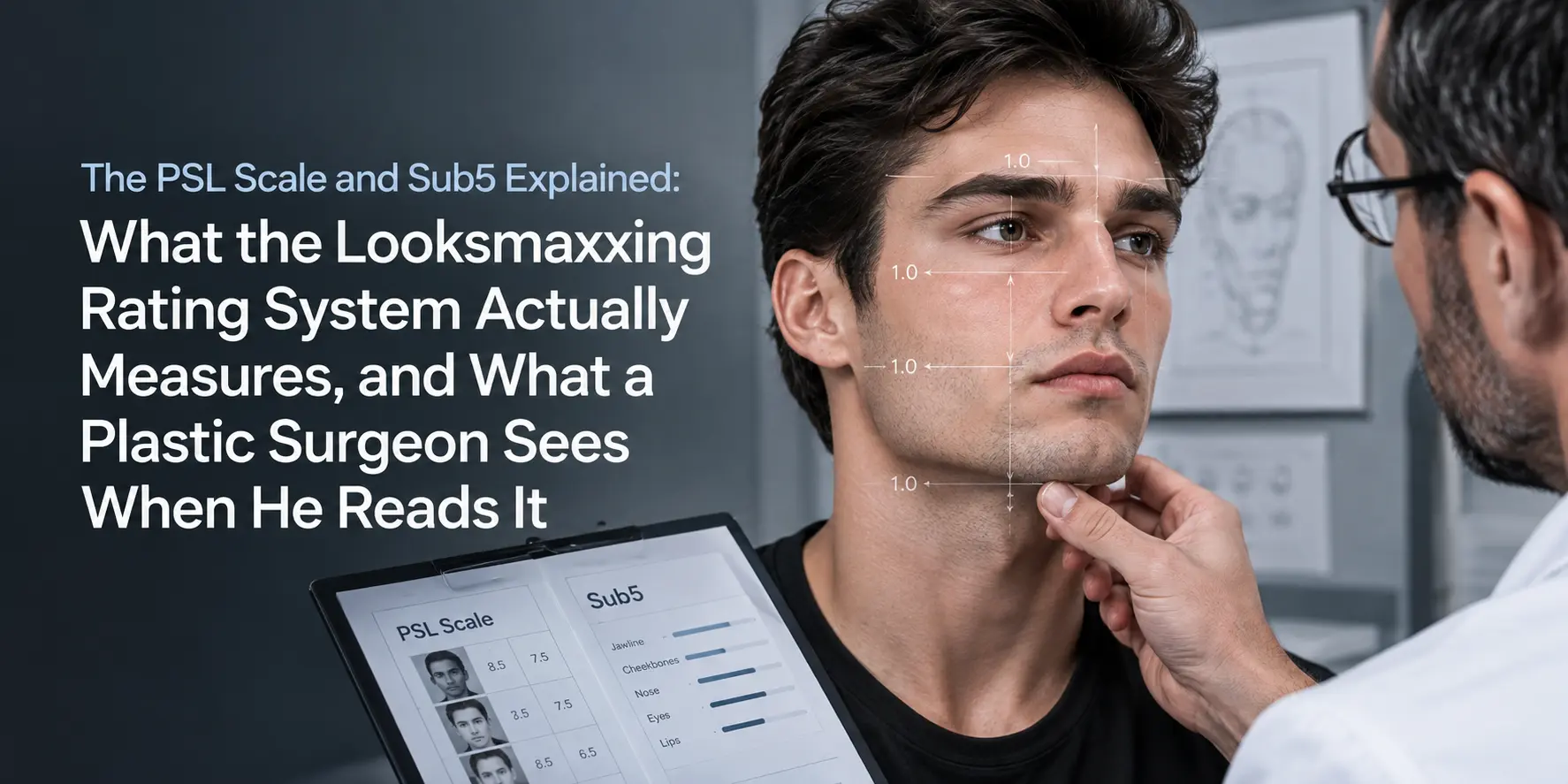
The PSL scale is built around four separable dimensions. A face receives a score on each, and the aggregate score determines the tier classification. The four dimensions are as follows:
| PSL Dimension | What the community says it measures |
|---|---|
| Facial harmony | Proportional balance across the thirds and fifths of the face; symmetry between left and right sides; alignment of features. |
| Sexual dimorphism | How strongly the face expresses features associated with masculine or feminine anatomy — jaw width, brow ridge, cheekbone projection, chin projection. |
| Angularity | Sharpness and definition of the underlying skeletal lines, especially the jaw angle, cheekbones, and lateral orbital rim. |
| Individual features | Specific isolated features — eye shape, canthal tilt, nose shape, lip fullness, chin projection assessed individually rather than as part of a whole. |
The critical observation from a surgeon’s perspective is that these four dimensions do describe anatomical variables that are real. Facial harmony, sexual dimorphism, angularity, and individual features are all things a craniofacial surgeon assesses at consultation. The problem is not that the categories are invented; the problem is what happens when they are compressed into a single-digit score and used to sort human beings into a hierarchy. That compression discards nearly all of the information a proper facial assessment relies on, and it introduces subjective judgement in the guise of measurement.
The PSL Tier Hierarchy: From Subhuman to Gigachad
Once the aggregate score is calculated, the PSL scale sorts the face into one of six tiers. The tier vocabulary is worth understanding because it is the linguistic infrastructure of the whole looksmaxxing conversation, and reading a discussion of looksmax content without knowing these terms is like reading a discussion of car culture without knowing the difference between a sedan and a coupe. The tiers are as follows:
| Tier | PSL Range | What the community claims it describes |
|---|---|---|
| Subhuman | 0 to 2 | Extreme dysmorphic classification. Frequently used pejoratively within the community. |
| Sub5 | 2 to 5 | The rebranded incel category. Any user who scores below 5 is classified here. |
| Normie | 5 to 6.5 | Average-appearing men. Considered by the community as the default population. |
| Chadlite | 6.5 to 7.5 | Above average. Community sees as attractive but not idealised. |
| Chad | 7.5 to 8.5 | Highly attractive per the scale’s internal criteria. |
| Gigachad | 8.5+ | Aspirational rare classification. Often used ironically. |
The distribution of scores within the community skews heavily toward the lower tiers. Because the scale was originally constructed by young men who felt that mainstream dating had failed them, the scoring conventions were tuned in ways that classify the majority of the community’s own membership as below average. This is not a coincidence. It is the mechanism by which the scale sustains the grievance that motivated its creation in the first place.
Why the Sub5 Rebrand Matters
The University of Portsmouth study cited above documented that incel accounts on TikTok and similar platforms have been systematically rebranding themselves as sub5 accounts to bypass content moderation policies that had begun to detect and remove overtly incel language. The word incel has become a moderation trigger; the term sub5 has not. The rebrand allows the same ideology to circulate under a new label, and importantly, the new label is attached to a superficially neutral rating system rather than to an overtly ideological identity.
From a public health perspective, this matters because the sub5 rebrand has opened the incel worldview to a much wider and younger audience. Teenagers who would have recognised and rejected an incel account will not recognise a sub5 account as the same thing. The University of Portsmouth researchers describe this as a specific vector of radicalisation, and the term is now embedded in the same content ecosystem that promotes bonesmashing, extreme dietary regimens, unregulated growth hormone use, and other physically or psychologically harmful practices that the site has covered in earlier pieces on bonesmashing and mewing.
This does not mean that every young man using the term sub5 has adopted the entire incel worldview. Many teenagers use the term casually, without understanding its origins, because it is the vocabulary of the community they are in. Distinguishing between casual language and ideological commitment matters, but the direction of drift is real and worth naming clearly.
Translating the Scale into Real Facial Anatomy: What a Surgeon Actually Sees
This is the section absent from every ranking article on the PSL scale. Journalists writing about looksmaxxing explain what the community claims the scale measures. Academic researchers writing about looksmaxxing explain what the scale does to the psychology of its users. Neither translates the scale’s four dimensions into the anatomical variables a plastic surgeon would recognise and, where appropriate, could actually improve. Doing that translation is the point of the section that follows.
Facial harmony translated: proportional analysis
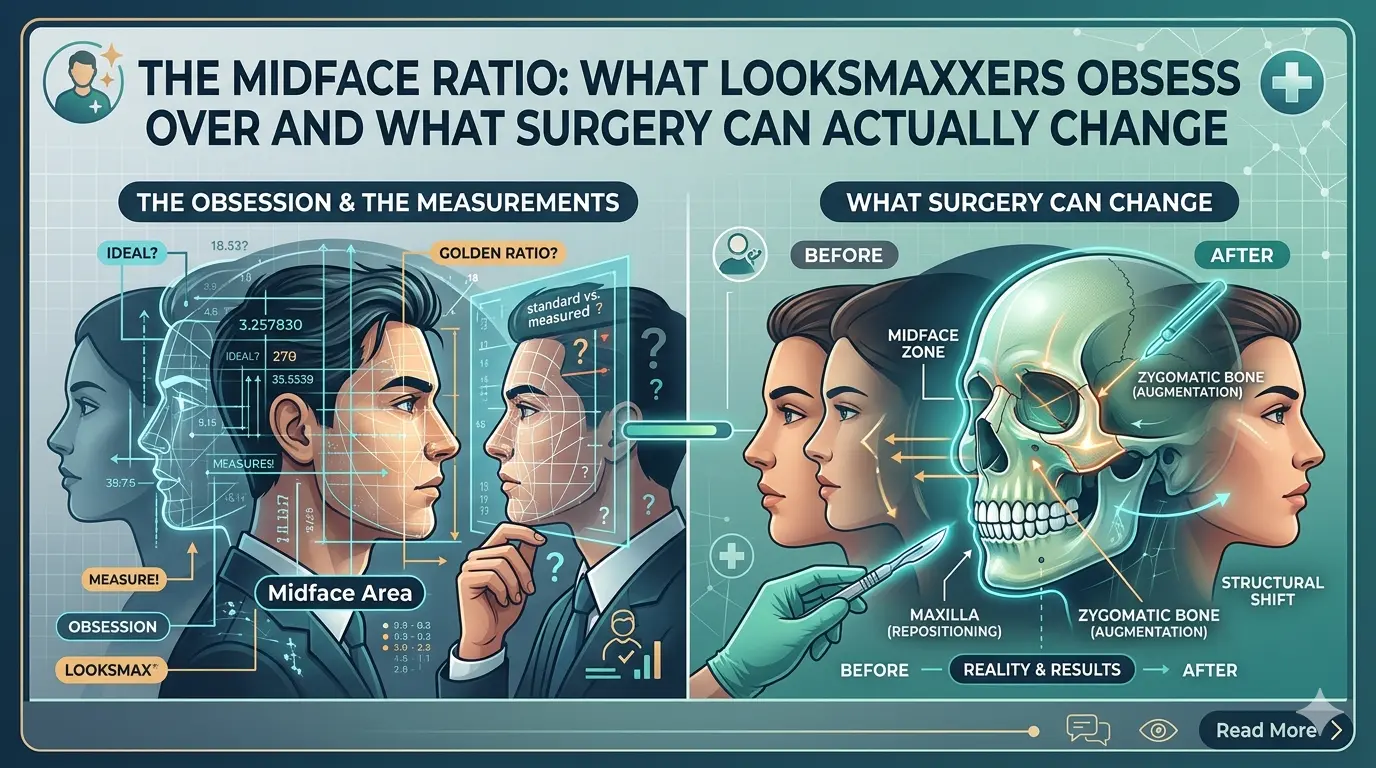
What the community calls facial harmony corresponds to what surgeons call proportional analysis — the assessment of how the facial features relate to one another across the horizontal thirds (hairline to brow, brow to nose base, nose base to chin) and the vertical fifths (five equal segments across the width of the face at the level of the eyes). Deviations from proportional balance are readable and, in many cases, correctable. A recessed chin can be addressed with sliding genioplasty or chin augmentation. A deficient midface can be assessed against the site’s midface ratio guide. A prominent nasal dorsum can be reshaped through rhinoplasty. The dimension is real; the response to it is measurable procedures, not a rating score.
Sexual dimorphism translated: skeletal masculinity or femininity
What the community calls sexual dimorphism corresponds to skeletal masculinity or femininity — the extent to which the underlying bones express male or female patterns. On the male side, this typically involves jaw width, mandibular angle sharpness, brow ridge prominence, and chin projection. On the female side, it involves softer jaw contours, a less prominent brow, higher and more medially positioned cheekbones, and a shorter distance from the base of the nose to the upper lip. Each of these features has surgical options. Male masculinisation typically involves mandibular angle implants and chin augmentation. Female feminisation typically involves formal facial feminisation surgery. The dimension the scale is grasping at is real anatomical patterning, and it can be modified with proper craniofacial planning.
Angularity translated: skeletal projection and definition
What the community calls angularity corresponds to skeletal projection and definition — how sharply the underlying bones define the visible contours of the face. This is where the site’s core hardmax audience most often lands their concern. The relevant anatomical variables are the position of the zygomatic bone (cheekbone), the projection of the mandibular angle, the position of the chin, and the sharpness of the jaw-to-neck transition. Genuine anatomical angularity is set by bone; apparent angularity is influenced by body fat percentage and skin quality. Real improvement in this dimension typically requires structural surgery through jaw implants, the orbital box osteotomy where appropriate, or, in more comprehensive cases, bimaxillary surgery.
Individual features translated: named anatomical variables
What the community calls individual features corresponds to the specific named anatomical variables surgeons discuss at consultation. Canthal tilt (positive versus negative) is assessed and, when medically appropriate, addressed through canthoplasty. Eye area geometry is assessed against the site’s hunter eyes surgery guide. Nose shape, lip fullness, and chin projection each have their own surgical, non-surgical, and non-intervention pathways. The critical clinical point is that these features are assessed individually against the specific concerns and anatomy of a specific patient, not aggregated into a single number and compared to a hierarchy.
If the Scale Is Real, What Actually Improves the Underlying Dimensions?
A responsible answer to the reader who has arrived here from the PSL scale is not to argue that facial appearance does not matter. It plainly does. The responsible answer is to explain what actually improves each of the underlying anatomical dimensions the scale is grasping at, and to be honest about what does not. Several interventions produce real and durable improvement in the anatomical variables the scale attempts to measure:
- Body fat reduction to a healthy sustainable range: the single largest visual factor in perceived angularity is body fat percentage. A defined jawline, sharper cheekbones, and a crisper jaw-to-neck transition all emerge naturally at lower body fat. This is the free option and it produces meaningful change without surgery.
- Skeletal surgery when the underlying anatomy is the limiting factor: mandibular angle implants, chin augmentation, sliding genioplasty, orbital box osteotomy, and bimaxillary surgery each address a specific anatomical variable that no non-surgical intervention can meaningfully change.
- Non-surgical refinements when the anatomy is close but not quite there: masseter botulinum toxin for a wide lower face driven by muscle bulk, chin filler for mild recession, jawline sculpting through targeted subcutaneous fat reduction.
- Skin quality improvement: a healthy skin envelope reads as youthful, well-cared-for, and confident. Sleep, hydration, sunscreen, and a proper skincare routine cost almost nothing and improve the visual reading of every other feature.
- Grooming, styling, posture, and confidence: the aspects of appearance that operate above the anatomical layer and that are entirely under the reader’s control.
Several interventions widely promoted within looksmaxxing communities do not, on any credible evidence, improve the underlying dimensions the scale attempts to measure. Bonesmashing, discussed in the site’s bonesmashing guide, produces micro-fractures and soft tissue trauma without meaningful bone remodelling. Jaw exerciser devices, discussed in the Jawzrsize guide, hypertrophy the masseter muscle in the direction opposite to what the scale rewards. Extreme dietary restriction, unregulated growth hormone use, and DIY procedures carry serious health risk without producing the desired changes.
| 🩺 Dr. Burak’s Clinical Note on the PSL Reader “The most useful thing I can say to a man who has arrived at my consultation with a PSL score in his head is this: I do not assess faces by giving them a number, and neither does any credible surgeon. I assess specific anatomical variables against specific patient concerns. If your assessment of yourself is a low number, that number is not a diagnosis. It is a story that the community you are in has taught you to tell about your own face. My job is to translate that story into a concrete anatomical conversation, and then to help you decide whether any part of that conversation is worth acting on.” |
When to Step Away from the Scale
Not every reader who has spent time with the PSL scale needs surgery, and not every reader who has spent time with it needs to worry about their mental health. But there is a subset of the community for whom continued engagement with the scale is doing real psychological damage, and it is worth being honest about the warning signs. Consider stepping away from the scale, or seeking psychological support, if any of the following applies:
- You have started photographing your face repeatedly throughout the day and comparing images side by side.
- You have started avoiding social situations, dating, or professional opportunities because of perceived inadequacy against the scale.
- You have considered or begun DIY practices such as bonesmashing that have documented medical harm.
- You have started making purchase or surgical decisions rapidly, under community pressure, rather than after unhurried reflection.
- You find yourself framing your entire self-worth through the scale rather than through the multiple dimensions of your actual life.
- You have experienced worsening low mood, hopelessness, or thoughts of self-harm connected to your perceived appearance.
The last of these is a mental health emergency and warrants immediate contact with a qualified psychological professional or emergency service. The others are strong signals to step back from the online conversation, ideally with the support of a therapist or counsellor experienced in body dysmorphic disorder. Body dysmorphic disorder is a diagnosable and treatable psychiatric condition, is more common among cosmetic surgery consultation populations than the general population, and can be actively worsened by unlimited feed access to comparative scoring systems.
Why Consider a Consultation in Istanbul
Istanbul is one of the leading global destinations for facial and craniofacial surgery, with JCI-accredited hospitals, deep concentration of specialist expertise, and total costs typically 50 to 70 percent lower than the equivalent care in the United States, United Kingdom, or Australia. For a reader who has genuinely decided to seek a proper facial assessment after reflection on the PSL scale, this cost differential can make specialist consultation accessible in ways that were not previously realistic. The credential to verify remains EBOPRAS certification, the European Board diploma held by Assoc. Prof. Dr. Burak Sercan Erçin alongside his Turkish Board certification and academic faculty position at Bahçeşehir University. His subspecialty background in reconstructive and craniofacial surgery, including training with Dr. Pedro Cavadas, is directly applicable to the anatomical assessments the PSL scale is grasping at.
Frequently Asked Questions
What does PSL stand for?
PSL is an acronym derived from the names of three parent online forums where the rating system was developed: PUAHate, Sluthate, and Lookism. It is not a clinical or scientific term. The scale itself was constructed by anonymous community members over several years and has no published inter-rater reliability data. It is a folk taxonomy rather than a validated instrument.
What does sub5 mean?
Sub5 refers to any face that scores below 5 out of 10 on the PSL scale. In practice, the term has become the community’s preferred self-identifier and, according to a University of Portsmouth research team, is the specific rebranded term through which incel accounts on TikTok have bypassed content moderation policies. Many young men use the term casually without understanding its ideological origins, but the direction of drift is documented and worth naming clearly.
What does the PSL scale actually measure?
The scale claims to measure four separable dimensions: facial harmony, sexual dimorphism, angularity, and individual features. Each of these dimensions describes a real anatomical variable that a plastic surgeon would recognise at consultation. The problem is not that the categories are invented; the problem is what happens when they are compressed into a single-digit score and used to sort human beings into a hierarchy. A proper facial assessment discards almost none of the information that a numerical PSL score discards.
Can plastic surgery improve my PSL score?
Plastic surgery can improve several of the underlying anatomical variables the PSL scale is grasping at, including jaw definition, chin projection, midface proportion, and canthal tilt. Whether it improves your community-assigned score depends on subjective community judgement, which is not something any surgeon can guarantee. A better framing is to ask whether specific procedures address specific anatomical variables that concern you, and to make surgical decisions based on that assessment rather than on the pursuit of a numerical improvement.
Is the PSL scale accurate?
The PSL scale has no published psychometric validation, no inter-rater reliability data, and no clinical or academic status. It is a community consensus rating system with well-documented internal biases. Whether it accurately describes any real dimension of attractiveness depends heavily on which community is doing the rating and against what reference norms. As a folk taxonomy it does describe real anatomical variables; as a numerical measurement instrument it is not validated.
Does Dr. Burak see patients who arrive after using the PSL scale?
Yes. A significant portion of Dr. Burak’s male aesthetic consultation caseload consists of patients who have engaged with looksmaxxing content, including the PSL scale, before seeking assessment. The consultation begins with a proper anatomical assessment rather than a score. Some patients leave with a surgical plan; many leave with a plan for non-surgical changes, and a small number leave with a recommendation to seek psychological support before any surgical decision. Visit the contact page or reach out via WhatsApp.
A Scale Is Not a Diagnosis
The PSL scale describes something real. Facial harmony, sexual dimorphism, angularity, and individual features are anatomical variables that surgeons assess and, where appropriate, can address. Where the scale goes wrong is not in what it points at but in what it does with what it points at: compressing complex assessments into a single digit, sorting human beings into a hierarchy, and lending itself to a rebranded incel vocabulary that is now radicalising a wider and younger audience than the original ideology ever reached.
For readers who have arrived here after time in the looksmaxxing community, the honest answer from a plastic surgeon is neither to endorse the scale nor to dismiss the underlying concern. The honest answer is that a properly conducted facial assessment discards almost none of the information the PSL score discards, that anatomical concerns can be addressed with proper surgical or non-surgical planning where appropriate, and that some readers will benefit far more from stepping away from the online scoring conversation than from any operation. For international patients considering a proper facial consultation in Istanbul, the pathway starts with a slow conversation, not a fast decision.
Why Assoc. Prof. Dr. Burak Sercan Erçin
Dr. Burak Sercan Erçin is an Istanbul-based Plastic, Reconstructive and Aesthetic surgeon with more than 15 years of experience and over 6,000 operations. He holds both Turkish Board and EBOPRAS certifications, trained alongside reconstructive microsurgeon Dr. Pedro Cavadas, and serves as academic faculty at Bahçeşehir University. He practices at Pendik Medical Park, Istanbul. His approach to the looksmaxxing ecosystem is grounded in a straightforward principle: give patients honest information about what surgery can and cannot achieve, translate online vocabularies into clinical language, and help each patient decide whether any part of the conversation is actually worth acting on. To discuss your case, book an online consultation or reach out via WhatsApp.
This content was written by Assoc. Prof. Dr. Burak Sercan Erçin in line with clinical experience and current medical literature. It is intended for general informational purposes only and does not constitute medical advice. A personal consultation with Dr. Erçin is recommended for individual assessment.
Faculty Member · Bahçeşehir University
Graduate of Ege University Faculty of Medicine, Assoc. Prof. Dr. Erçin completed advanced fellowships at Tampa General Hospital (USA) under Dr. Deniz Dayıcıoğlu in breast reconstruction and burn surgery, and at the clinic of Dr. Pedro Cavadas in Valencia, Spain in reconstructive microsurgery. After passing the EBOPRAS examination in 2018, he joined Bahçeşehir University as a faculty member and continues his private practice on Bağdat Avenue, Istanbul, specialising in face, breast and body aesthetics alongside complex reconstructive surgery.