This article was written by Assoc. Prof. Dr. Burak Sercan Erçin and is based on clinical experience. A specialist in Plastic, Reconstructive and Aesthetic Surgery; prepared in accordance with current medical literature and personal surgical data. A consultation is recommended before making any medical decisions.

Somewhere in your feed there is a before-and-after of a man who chewed mastic gum for six months and now has a jaw like a brick. The comments are full of people ordering their first pack. Mastic gum for jawline definition has become one of the most repeated tips in looksmaxxing, sitting next to mewing and bonesmashing as a free, at-home route to a sharper face.
This guide comes from a plastic surgeon in Istanbul. Much of his week goes on assessing jawlines, rebuilding them after trauma and reshaping them for patients who want more definition. The short version is that chewing does change your face. It just rarely changes it in the way the videos promise.
Does mastic gum give you a jawline?
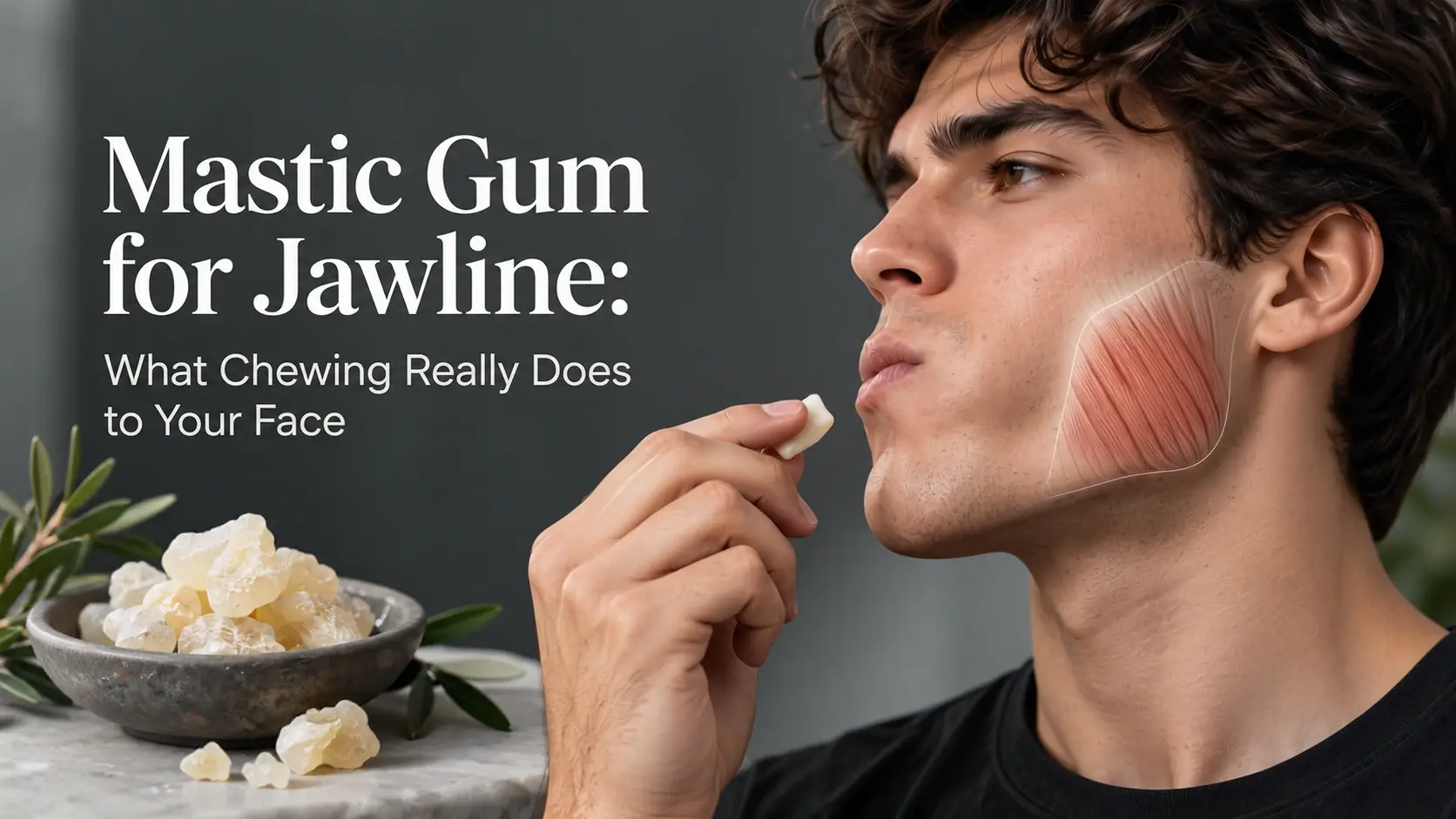
Mastic gum can enlarge the masseter, the main chewing muscle at the back of the jaw. That adds width at the jaw angle, which some faces wear well. It does not lengthen, project or reshape the jawbone. It does not remove fat under the chin either, and heavy daily use can strain the jaw joint and teeth.
The rest of this article explains why, layer by layer, and what to do if chewing has not given you the result you wanted.
What Is Mastic Gum, and Why Did Looksmaxxing Adopt It?
Mastic is a natural resin from the mastic tree, Pistacia lentiscus, grown mainly on the Greek island of Chios. It has been chewed around the eastern Mediterranean for centuries and still flavours sweets and desserts in Greece and Turkey. Raw mastic tears start brittle, soften in the mouth and then turn into a dense, rubbery lump that takes far more effort to chew than ordinary gum.
That resistance is the whole appeal. In looksmaxxing forums the logic runs like a gym routine. Harder gum means more load, more load means a bigger muscle, and a bigger muscle means a squarer jaw. Falim, a firm sugar-free gum made in Turkey, is often recommended as the cheaper daily option.
Silicone jaw exercisers sell the same idea in a different shape, and we looked at those separately in our review of whether jaw shapers like Jawzrsize work.
A typical protocol found online looks something like this. Two or more pieces at a time, one to three hours a day, alternating sides, for at least three months. Progress is tracked with front-on selfies. Very little of it has been tested, and almost none of it is written by anyone who treats jaws for a living.
Which Part of Your Jawline Can Chewing Actually Change?
A jawline is not a single structure. What you see in the mirror is the sum of four layers, and chewing reaches only one of them. Knowing which layer shapes your current jaw is the most useful thing to learn before buying a single pack.
| Layer | What it does for the jawline | Can chewing change it? |
|---|---|---|
| Mandible (jawbone) | Sets the length of the jaw, the angle at the back and how far the chin projects | No. Adult jawbone does not reshape in any meaningful way from chewing load. |
| Masseter muscle | Adds width and fullness at the angle of the jaw | Yes. It can enlarge with repeated heavy use, like any trained muscle. |
| Fat under the chin and along the jaw | Softens or blurs the edge of the jaw | No. Chewing does not spot-reduce fat. Overall body fat is what changes it. |
| Skin and neck support | Decides how crisp the line under the jaw looks, especially with age | No. Skin laxity and the angle between the neck and jaw stay the same. |
Bone is the layer most people believe they are changing. While the face is still growing, chewing function plays a part in how it develops. In adults the jawbone is mature.
Muscle pulling on it day after day does not lengthen it, push the chin forward or sharpen the angle. It is the same misunderstanding we unpicked in our article on bonesmashing: load does not sculpt finished bone into a new shape.
So, Does Mastic Gum Work for the Jawline?
Partly, and the part that works is often misunderstood. The masseter is a thick, strong muscle, and like the biceps it responds to repeated load. Research on chewing training has shown that regular hard chewing can increase bite force. When the muscle grows, the lower face gets wider at the jaw angle.
Whether that helps depends entirely on your face. On a narrow, long face with a soft angle, a little extra masseter bulk can read as structure. On a face that is already square or round, it moves the widest point lower and makes the face look heavier rather than sharper. It is the same muscle that many people pay to have reduced with masseter botulinum toxin injections.
There is also a ceiling. Muscle adds width at the side. It does not add length to a short jaw or projection to a chin that sits back. Those are the two features most people are really chasing when they say they want a jawline.
Dr. Burak's Clinical Note: width is not definition
Many of the young men who show me their chewing progress photos have built a perfectly good masseter. What they have not built is a chin. When I look at them in profile, the jaw ends early and the line under it stays soft. No amount of gum reaches either of those. Definition comes from the frame, and the frame is bone.
Assoc. Prof. Dr. Burak Sercan Erçin, EBOPRAS-certified plastic surgeon
That distinction decides whether chewing is a harmless habit or a delay on the way to the right answer.
The Chewing Protocol, Checked Claim by Claim
The advice that circulates online is remarkably consistent. Here is how the most common claims hold up against what is known about the jaw.
| The claim | What actually happens |
|---|---|
| Chew for two to three hours a day for faster results | Muscle growth needs recovery. Hours of continuous load are more likely to tire the muscle and irritate the jaw joint than to speed anything up. |
| Mastic beats normal gum because it is harder | Harder gum loads the muscle more. It also loads the teeth, fillings and joint more, so the risk rises with the resistance. |
| You will see a sharper jaw within weeks | Early changes in photos usually come from lighting, posture, water retention or fat loss. Real muscle growth takes months. |
| Alternate sides and you cannot get uneven | Most people have a dominant chewing side without knowing it. Uneven use can make an existing asymmetry more visible. |
| Chewing burns face fat | Chewing uses very little energy. Fat under the chin changes with overall body fat, not with local exercise. |
| It fixes a weak chin | Chin position is set by bone and by the bite. The muscle sits at the side of the jaw, not in front of the chin. |
None of this makes gum dangerous for everyone. The version promoted in looksmaxxing is the problem: high resistance, long hours and no rule for when to stop. It belongs to the same family as mewing and thumb pulling, free methods that promise bone change from habits that mostly reach soft tissue.
The Risks of Mastic Gum Nobody Posts in the Comments
These harms are rarely dramatic, which is exactly why they go unreported. They build slowly, and by the time they are obvious they have often been going on for months.
Jaw joint pain and TMJ disorders
The temporomandibular joint (TMJ) sits just in front of the ear and works every time you chew. Overloading it can cause pain, clicking, a jaw that catches or locks, and aching that spreads to the temples.
Patient guidance from health services such as the NHS lists avoiding gum chewing as part of TMJ self-care. If you already have symptoms, our list of 20 things that make TMJ worse covers the habits that keep them going.
Cracked teeth, worn enamel and loose fillings
Hard, sticky resin sends heavy, repeated force through the teeth. Heavy chewers can end up with chipped cusps, cracked teeth, worn enamel and dislodged fillings or crowns. Anyone with braces, crowns, veneers or recent dental work should ask their dentist before trying it.
A wider, heavier lower face
Masseteric hypertrophy (enlarged chewing muscles) is a recognised condition, most often linked to clenching and teeth grinding. It gives a square, bottom-heavy look and is one of the most common reasons people ask for masseter reduction. Chewing your way into it is entirely possible, and reversing it takes months.
Asymmetry
If one side does more work, one masseter grows more. A difference of a few millimetres is easy to miss in a selfie and obvious in a straight photo taken in neutral light. If you already worry about an uneven smile or a lopsided face, it is worth knowing before you start.
Headaches and stomach trouble
Overworked jaw muscles are a common driver of tension-type headaches. Many sugar-free gums also contain sorbitol or similar sweeteners, which act as a laxative in large amounts. A case report in the BMJ described chronic diarrhoea and serious weight loss traced back to heavy sugar-free gum use.
Stop chewing and get checked if you notice any of these
- 1.Pain in front of the ear, or pain when you open wide
- 2.New clicking or popping, or a jaw that catches or locks
- 3.Jaw ache on waking, or headaches at the temples
- 4.A tooth that hurts when you bite, or a filling that feels loose
- 5.One side of the lower face looking fuller than the other
Most of these settle once the load stops. A dentist is the right first stop for teeth and bite problems, and a TMJ specialist for joint pain that does not ease.
If You Still Want to Chew, How to Lower the Risk
Some readers will try it anyway, and practical limits help more than a lecture. If you choose to chew, these rules keep the risk lower:
- Short sessions with rest days, rather than hours every day.
- Ordinary gum first, before anything harder such as raw mastic.
- Stopping at the first sign of joint pain, clicking or tooth sensitivity.
- Skipping it entirely with TMJ symptoms, braces, crowns or recent dental work.
- Checking sugar-free labels and cutting back if your stomach complains.
- Progress photos in the same light and position, so you see real change rather than a better angle.
Judge the results with the same honesty. If several months of careful chewing has not given you the face you want, the limiting factor is very likely structural.
When the Problem Is Structural: Matching the Concern to the Right Treatment
Most people who turn to gum are reacting to one of five underlying features. Each has a different answer, and only one of them involves muscle.
| What you see | Usual cause | What can address it |
|---|---|---|
| The jaw ends early and the chin sits back in profile | A short or retruded chin | Sliding genioplasty or a chin implant |
| A flat, rounded angle at the back of the jaw | Low bony definition at the jaw angle | Jaw implants |
| Fullness under the chin that survives weight loss | Submental fat | Chin and neck liposuction |
| A wide, square lower face that feels too heavy | Enlarged masseter muscles | Masseter botulinum toxin from a qualified physician |
| Chin and jaw out of line with the teeth, or a bite problem | Jaw position and bite | Orthodontics with double jaw (bimax) surgery |
For a wider comparison that includes the non-surgical end, see our guide on how to get a better jawline. If you want the bigger picture of where lifestyle changes stop and surgery starts, our explainer on softmaxxing and hardmaxxing sets out the line.
Jawline Assessment in Istanbul: What a Consultation Looks Like
Many international patients first get in touch after months of DIY methods. The consultation starts with the same four layers: bone, muscle, fat and skin, looked at in profile and from the front, together with the bite. The aim is to name the feature that is actually limiting the jawline before anything is recommended.
Turkey is one of the busiest destinations for aesthetic surgery, and the standard of care varies between clinics, as it does anywhere. The safer approach is to judge the surgeon rather than the destination. Look for board certification, a reconstructive background, a hospital setting for operations under general anaesthesia and a follow-up plan for after you fly home.
Assoc. Prof. Dr. Burak Sercan Erçin holds the EBOPRAS diploma (European Board of Plastic, Reconstructive and Aesthetic Surgery), the European standard qualification in the specialty. His training includes reconstructive microsurgery with Dr. Pedro Cavadas. He has more than 15 years of experience and over 6,000 operations across reconstructive and aesthetic surgery.
Face and jaw surgery at the practice is planned around natural proportion, so the result fits the rest of the face rather than announcing itself. His full profile lists training and publications.
Dr. Burak's Clinical Note: the two-photo test
Before anyone books jaw surgery, I ask for two photographs: a straight profile and a relaxed front view, both without filters. In most cases the profile alone shows whether the limit is the chin, the angle, the fat under the jaw or the muscle. It takes a minute, and it often saves a year of chewing in the wrong direction.
Assoc. Prof. Dr. Burak Sercan Erçin, EBOPRAS-certified plastic surgeon
You can send those same two photographs before travelling, and the first conversation can happen by video call.
Frequently Asked Questions About Mastic Gum and the Jawline
These are the questions that come up most often from readers and patients who have tried jaw training with gum, or are about to.
How long does mastic gum take to change your jawline?
Visible muscle growth, where it happens at all, generally takes several months of regular use. Changes in the first few weeks usually come from lighting, posture, weight change or water retention. Because bone does not reshape, the most you can expect is extra muscle width at the jaw angle.
Is mastic gum bad for your teeth?
It can be. Mastic is hard and sticky, and heavy daily chewing raises the risk of cracked or chipped teeth, worn enamel and loosened fillings or crowns. Anyone with dental restorations, braces or sensitive teeth should speak to a dentist first.
Can chewing gum cause TMJ problems?
Long or forceful chewing can trigger or worsen jaw joint pain, clicking and muscle soreness. That is why cutting down on gum is standard advice for people with TMJ symptoms. If pain, locking or new clicking appears, stopping is the first step.
Is Falim gum better than mastic gum for the jawline?
Falim is a firm sugar-free gum made in Turkey, popular because it is cheaper and easier to find. It works the same muscle in the same way. Neither changes the jawbone, and both carry similar joint and dental risks with heavy use. Sugar-free versions can also upset the stomach in large amounts.
Can mastic gum make your face wider?
Yes. If the masseter grows, the lower face widens at the jaw angle. On some faces that looks more structured. On faces that are already square or round it can look heavier, which is why enlarged masseters are often reduced rather than built.
What actually gives you a sharper jawline?
It depends on which layer is limiting it. Losing overall body fat sharpens the line for many people. When the issue is a short chin, a soft jaw angle or the bite, the answer sits in the bone. Genioplasty, jaw implants or orthognathic surgery work on it directly, after a proper assessment.
Is jawline surgery in Turkey safe?
Jawline surgery in Turkey can be safe when a board-certified plastic surgeon performs it in a hospital setting, with proper assessment beforehand and follow-up afterwards. The risks depend on the procedure, not the country. Check credentials such as EBOPRAS certification, ask who will operate and how complications are handled, and allow enough recovery time before flying.
Before You Buy Another Pack
If chewing is your way of fixing something you dislike about your jawline, it is worth finding out what that something is. I review profile and front-view photographs from international patients and give a direct answer about whether the limit is muscle, fat, bone or bite. Sometimes the honest answer is that nothing needs doing at all.
This content is written by Assoc. Prof. Dr. Burak Sercan Erçin for informational purposes only. It does not constitute medical advice, diagnosis, or a treatment recommendation. Individual results may vary. Please schedule a consultation for a personalised assessment.
Find out what is really shaping your jawline
Send a straight profile and a relaxed front photo on WhatsApp. You will get a clear answer about what chewing can and cannot change for your face, and whether anything else is worth considering.
This content was written by Assoc. Prof. Dr. Burak Sercan Erçin in line with clinical experience and current medical literature. It is intended for general informational purposes only and does not constitute medical advice. A personal consultation with Dr. Erçin is recommended for individual assessment.
Faculty Member · Bahçeşehir University
Graduate of Ege University Faculty of Medicine, Assoc. Prof. Dr. Erçin completed advanced fellowships at Tampa General Hospital (USA) under Dr. Deniz Dayıcıoğlu in breast reconstruction and burn surgery, and at the clinic of Dr. Pedro Cavadas in Valencia, Spain in reconstructive microsurgery. After passing the EBOPRAS examination in 2018, he joined Bahçeşehir University as a faculty member and continues his private practice on Bağdat Avenue, Istanbul, specialising in face, breast and body aesthetics alongside complex reconstructive surgery.