This article was written by Assoc. Prof. Dr. Burak Sercan Erçin and is based on clinical experience. A specialist in Plastic, Reconstructive and Aesthetic Surgery; prepared in accordance with current medical literature and personal surgical data. A consultation is recommended before making any medical decisions.

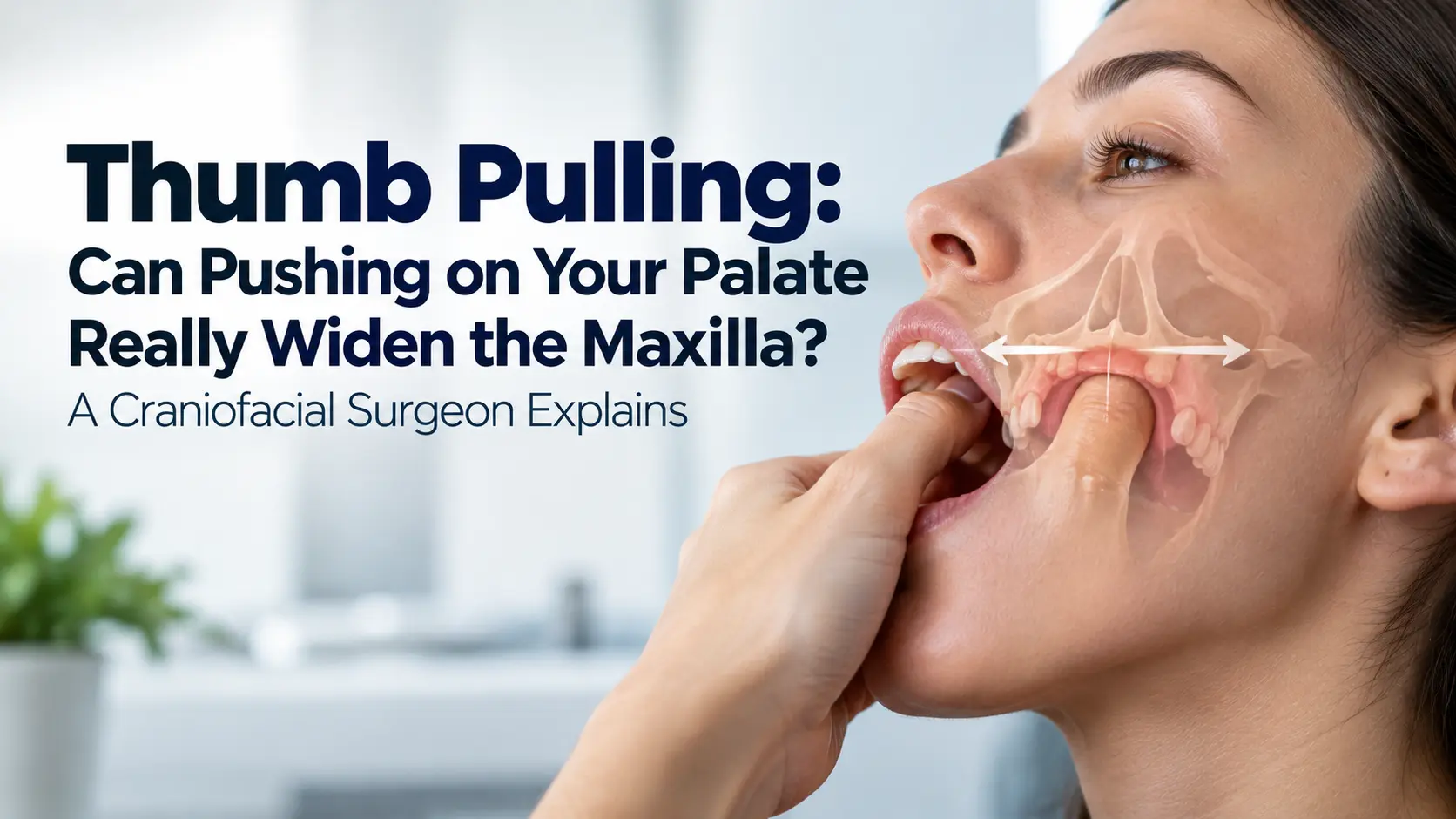
Thumb pulling is the looksmaxxing practice of pressing both thumbs against the roof of the mouth and pushing outward or forward. The hope is to widen or advance the upper jaw, known as the maxilla. It sits right beside bonesmashing and mewing in the DIY toolkit, and new forum threads about it appear almost daily.
Search for it and you mostly find tutorials, progress photos and arguments between anonymous users. You find very little from the surgeons who actually move upper jaws for a living. That gap is the reason for this guide.
It is written from the perspective of Assoc. Prof. Dr. Burak Sercan Erçin, an EBOPRAS-certified plastic and reconstructive surgeon in Istanbul with a craniofacial background. It covers what thumb pulling targets, what your thumbs can and cannot move, the real risks, and what genuinely widens or advances a maxilla at each age.
What Is Thumb Pulling?
In thumb pulling, a person places one or both thumbs on the hard palate and applies force for a few minutes at a time. Some routines repeat this several times a day, and a few prescribe short sessions every waking hour. The technique comes in three main variations.
- Lateral thumb pulling: the thumbs sit on the palate behind the back teeth and press outward toward the cheeks. The aim is a wider palate and a broader upper dental arch.
- Forward thumb pulling: the thumbs sit behind the front teeth and push forward and upward. The aim is what the community calls forward growth of the maxilla.
- Cheekbone pulling: the same idea aimed at the zygomatic area, usually combined with external massage of the cheeks.
Thumb pulling has close relatives. Face pulling uses straps, belts or masks to tug the midface forward from outside. More recently, some users buy palatal expanders online and turn the screw themselves. The logic behind all of them is identical: apply force, and hope bone follows.
Why People Try It
The concern behind the trend is often real. Some people genuinely have a narrow palate, crowded upper teeth, a crossbite or a flat midface. Others notice tired-looking under-eye areas or a weak cheek profile and are told online that a recessed maxilla is the cause.
In looksmax vocabulary, the maxilla gets blamed for almost everything. Flat cheekbones, a long face, a negative canthal tilt and an unbalanced midface ratio are all traced back to it. Thumb pulling then arrives as a free, private and instant fix.
The trend also borrows real medical language. Palatal expansion is a genuine orthodontic treatment that widens jaws every day. That borrowed credibility is exactly why thumb pulling spreads so easily. It sounds like a home version of something orthodontists already do.
The Anatomy Your Thumbs Are Pushing Against
The maxilla is not a single bone. It is two halves joined down the middle of the palate by the midpalatal suture. It is also locked to the rest of the skull by several other sutures around the nose, the cheekbones and the eye sockets.
The teeth sit in alveolar bone, a thinner ridge along the edge of the jaw. This distinction matters more than anything else in this article. Moving teeth through alveolar bone is easy. Moving the basal bone of the maxilla is not.
The midpalatal suture changes with age
In young children, the two halves of the palate are loosely joined, and expansion separates them easily. Through adolescence the suture becomes more interlocked. Later, bony bridges begin to form across it. The timing varies enormously from person to person.
Classic anatomical studies found some sutures still partly open into adulthood, while others had fused early. Orthodontists now often stage the suture on a CBCT scan instead of relying on age. The table below gives the general picture.
Ages here are approximate. In practice, a scan of the individual suture decides what will work, not the date on a birth certificate.
What your thumbs can move, and what they cannot
Bone remodels under sustained, controlled force. A real palatal expander is fixed in the mouth around the clock. It is turned in small, measured increments under supervision, and it is anchored to the teeth or directly to bone with miniscrews.
Even with that level of control, adult sutures often refuse to open without miniscrews or surgery. Thumbs deliver a few minutes of unmeasured force with no anchorage at all. There is no plausible way for that to separate a fused suture.
What intermittent pressure can do is tip teeth outward, irritate the lining of the palate and strain the jaw joints. Tipped teeth look like a wider arch on a ruler. That is why forum measurements between premolars are misleading. They measure teeth, not the bone underneath.
Does Thumb Pulling Work?
There is no controlled human study showing that thumb pulling widens or advances an adult maxilla. Clinical reviews of palatal expansion test appliances, not thumbs. Every claim of success rests on self-reported photos and measurements.
Those photos are persuasive for understandable reasons. Lens distance, head tilt, lighting, weight loss, better posture and morning swelling all change how a face looks. For teenagers there is a bigger confounder. They are still growing, so a year of normal growth gets credited to the thumbs.
Surgeon’s perspective
What a CT scan shows that a progress selfie never can
“When a patient shows me before and after photos of thumb pulling, I ask for one thing: a measurement taken the same way twice. A selfie changes with the lens, the head tilt and morning swelling. A CT scan shows the suture, the bone and the roots of the teeth. In fifteen years I have never seen a scan that showed thumbs opening an adult palate.”
The honest summary is simple. In adults, thumb pulling cannot do what it promises. In children and young teens, the suture is responsive, but that is precisely when supervised expansion is quick and predictable. Either way, DIY pressure is the wrong tool.
The Risks of Thumb Pulling
Because the force is unmeasured and unanchored, it goes wherever resistance is lowest. Usually that means the teeth and soft tissues rather than the bone people are trying to change.
- Tooth tipping and bite changes: teeth pushed outward can alter how the upper and lower arches meet. Small changes in the bite can be hard to undo.
- Gum recession: teeth pushed through thin alveolar bone can lose gum and bone coverage on their outer surface.
- Root damage: dentists commenting on DIY expansion devices have warned of root resorption, tooth mobility and lasting bite misalignment.
- Palate injury and infection: fingernails and unwashed hands can cause ulcers and infection on the palatal lining.
- Jaw joint strain: forceful pulling loads the temporomandibular joints. Anyone with clicking or jaw pain should read our guide to things that make TMJ worse before trying anything.
- Asymmetry: uneven force from one hand can shift teeth more on one side than the other.
- Delayed real care: the biggest risk for teenagers is time. A year of thumb pulling can use up the window when orthodontic expansion works best.
Surgeon’s perspective
Why a teenager who thumb pulls is often missing the one window that works
“The irony I see in consultation is painful. A fifteen-year-old spends a year pressing on his palate, convinced that bone is moving. Meanwhile the age at which an orthodontist can widen that palate quickly and predictably is passing. If the concern is real, the teenage years are exactly when to see a professional. They are the worst time to experiment alone.”
Adults face a different cost. Months spent on DIY routines delay a proper diagnosis, and some arrive at consultation with tipped teeth or gum recession that now needs fixing first.
Thumb Pulling vs Mewing vs Bonesmashing vs Real Expansion
Thumb pulling is usually discussed alongside other looksmax techniques and professional treatments. The comparison below puts them side by side, from DIY methods to surgery.
Mewing and bonesmashing each have their own detailed guide on the site. Our mewing fact or myth guide covers tongue posture, and the bonesmashing guide covers the hammering trend. Jaw exercise devices are reviewed in the Jawzrsize guide.
What Actually Widens or Advances the Maxilla
The right treatment depends on two questions. How old is the skeleton? And is the problem width, forward position, or simply the appearance of a flat midface? Each answer leads somewhere different.
Children and early teens: rapid palatal expansion
For growing patients, an orthodontist fits a tooth-borne expander with a central screw. Turned in small increments, it separates the two halves of the palate while the suture is still responsive. A retention phase then lets new bone fill the gap. This is routine orthodontics, and it is the reason teenagers should be seen early.
Late teens and young adults: bone-anchored expansion
When the suture has become stiffer, miniscrews can anchor the expander directly to the palatal bone. These appliances are known as MSE or MARPE. They deliver force to the bone rather than the teeth, and published series report good rates of suture opening in young adults. Success tends to fall as age rises.
Skeletally mature adults: surgically assisted expansion
In mature adults with a fused suture, surgically assisted rapid palatal expansion, or SARPE, is the established route. A surgeon releases the bony resistance, and an expander then widens the palate under control. It is a real operation with a real recovery, but it moves bone in a way no home routine can.
When the problem is forward position: Le Fort I and double jaw surgery
Widening does not bring the maxilla forward. When the upper jaw sits too far back, the solution is a planned osteotomy that moves it into a new position. This is usually done as part of orthognathic surgery, often on both jaws together.
Our guides to bimax surgery, double jaw surgery and jaw surgery in Turkey explain the planning. The jaw surgery recovery guide covers what the weeks afterwards look like.
When the bite is fine but the midface looks flat: camouflage options
Many people who blame their maxilla have a normal bite. What bothers them is a flat cheek or under-eye area. In these cases, a craniofacial surgeon may discuss augmentation rather than moving the jaw. Options include infraorbital rim implants, implants around the base of the nose, or fat grafting.
It is worth saying plainly that many people need none of these. A good assessment sometimes ends with reassurance, and that is a legitimate outcome.
Before booking anything, it helps to know which signs point to a genuine skeletal problem and which point to a looksmax forum talking.
Signs You May Have a Genuine Maxillary Problem
Some signs suggest a real transverse or forward deficiency of the maxilla. None of them can be confirmed at home, but they are good reasons to book an assessment.
- Crossbite: the upper back teeth sit inside the lower teeth when you bite together.
- Crowding: upper teeth overlap because the arch is too narrow for them.
- Underbite or concave profile: the lower teeth sit ahead of the upper teeth, or the middle of the face looks sunken in profile. Our guide to underbite and overbite explains the difference.
- Chronic nasal obstruction: long-term mouth breathing or a constantly blocked nose can sit alongside a narrow upper jaw.
- Jaw pain or bite discomfort: persistent symptoms deserve examination rather than more force.
Assessment usually combines a clinical examination, dental impressions or scans, and imaging such as a cephalometric X-ray or CBCT. Our guide to misaligned jaw correction shows how these findings shape treatment.

When the Trend Itself Is the Problem
Most people who try thumb pulling are simply curious. For some, though, the routine becomes a signal of something more serious. Hourly sessions, constant mirror checks and distress over millimetres are signs that the focus has moved beyond healthy self-improvement.
Body dysmorphic disorder is a recognised and treatable condition. It is more common among people seeking cosmetic procedures than in the general population. If a single facial feature dominates your day, a mental health professional is a better first appointment than any surgeon.
Parents of teenagers should know that the looksmax ecosystem is wide. Our looksmaxxing guide and softmaxxing versus hardmaxxing explainer map the safe and unsafe ends of it. Separate pieces cover surgerymaxxing, heightmaxxing and the female-side trend of boob-maxxing.
Frequently Asked Questions
These are the questions patients ask most often after watching thumb pulling tutorials. The answers below are general, and an individual assessment will always be more precise.
Does thumb pulling actually work?
There is no controlled evidence that thumb pulling widens or advances an adult maxilla. The suture is too stiff, and the force is too brief and unmeasured.
What it can do is tip teeth and irritate tissue. Those changes are sometimes mistaken for bone growth in progress photos.
Can you widen your palate after 18?
Yes, but not with your thumbs. Bone-anchored expanders (MSE or MARPE) can open the suture in many young adults. In fully mature adults, surgically assisted expansion is often needed.
A CBCT assessment of the suture usually decides which route is realistic.
Is thumb pulling safe for teenagers?
It is not recommended. Teenagers are the group most likely to tip teeth with it, and the group with most to gain from professional care.
If a teenager has a narrow palate or crowded teeth, an orthodontic consultation during growth is the effective option.
Can thumb pulling fix a recessed maxilla?
No. Forward position of the maxilla is set by the skeleton, and moving it forward requires a planned osteotomy such as a Le Fort I procedure.
If the bite is normal and only the midface looks flat, augmentation options may be more appropriate than jaw surgery.
How is thumb pulling different from mewing?
Mewing relies on light resting tongue pressure held for long periods. Thumb pulling applies stronger force for short bursts.
Neither has evidence of changing adult facial bone. Thumb pulling carries more physical risk because the force is greater and less controlled.
Does Dr. Burak treat maxillary problems?
Yes. Dr. Burak assesses patients with midface and jaw concerns and works with orthodontic colleagues when expansion or orthognathic surgery is planned.
International patients start with an online review of photos and scans. You can reach the team via WhatsApp or the contact page.
Your Maxilla Is Not Clay
Thumb pulling is attractive because it is free, private and borrows the language of real orthodontics. But the maxilla is anchored bone with a suture that stiffens through adolescence. A few minutes of thumb pressure cannot open it, and it can quietly damage the teeth that sit on it.
The good news is that every real version of the problem has a real answer. Growing patients have orthodontic expansion. Young adults have bone-anchored expansion. Mature adults have surgical expansion, orthognathic surgery or midface augmentation. The first step is finding out which problem you actually have.
Assoc. Prof. Dr. Burak Sercan Erçin is an EBOPRAS and Turkish Board certified plastic, reconstructive and aesthetic surgeon in Istanbul. He trained with reconstructive microsurgeon Dr. Pedro Cavadas, teaches at Bahçeşehir University and has more than 15 years of surgical experience. Read more on his profile page.
This content was written by Assoc. Prof. Dr. Burak Sercan Erçin in line with clinical experience and current medical literature. It is intended for general informational purposes only and does not constitute medical advice. A personal consultation with Dr. Erçin is recommended for individual assessment.
Faculty Member · Bahçeşehir University
Graduate of Ege University Faculty of Medicine, Assoc. Prof. Dr. Erçin completed advanced fellowships at Tampa General Hospital (USA) under Dr. Deniz Dayıcıoğlu in breast reconstruction and burn surgery, and at the clinic of Dr. Pedro Cavadas in Valencia, Spain in reconstructive microsurgery. After passing the EBOPRAS examination in 2018, he joined Bahçeşehir University as a faculty member and continues his private practice on Bağdat Avenue, Istanbul, specialising in face, breast and body aesthetics alongside complex reconstructive surgery.