This article was written by Assoc. Prof. Dr. Burak Sercan Erçin and is based on clinical experience. A specialist in Plastic, Reconstructive and Aesthetic Surgery; prepared in accordance with current medical literature and personal surgical data. A consultation is recommended before making any medical decisions.

The first months on Ozempic, Wegovy or Mounjaro usually feel like a win on every front. The scale moves, clothes fit again, blood sugar settles. Then a different message starts arriving in surgeons’ inboxes: the weight is gone, but the skin has stayed. The belly folds when you sit down, the upper arms swing when you wave, the face looks older rather than slimmer.
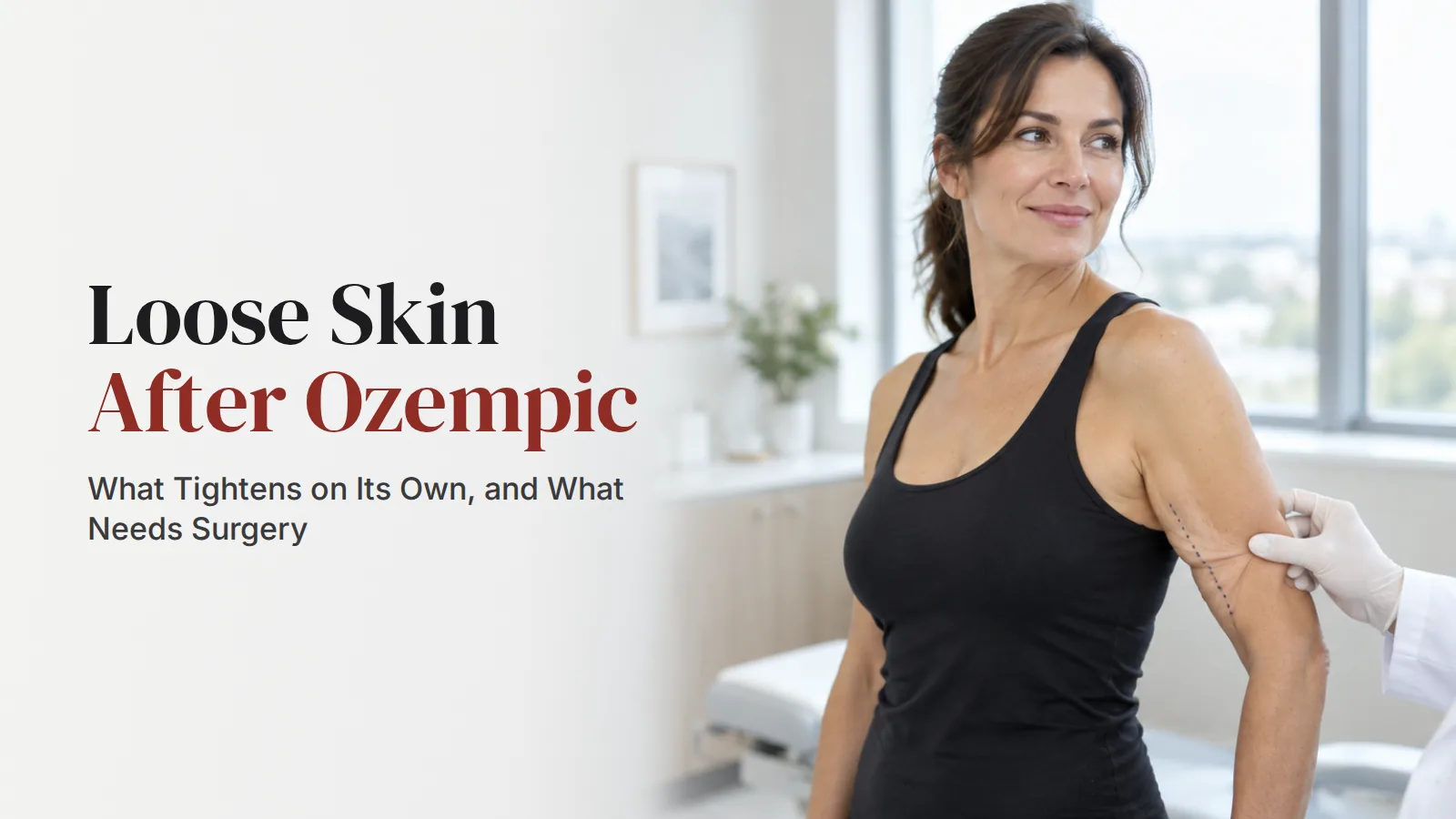
This guide is written from the operating side of that problem. Plastic surgeons are now seeing it every week, and the questions are always the same: will it go away, can anything tighten it without surgery, and if surgery is needed, when, where on the body, and what happens to the medication. The answers depend less on the drug than on how much weight you lost, how quickly, and what your skin was like before.
Does loose skin after Ozempic go away?
Some of it does. Mild laxity, especially in younger skin, keeps improving for six to twelve months after the weight stabilises. Skin that hangs in folds after a large loss does not retract on its own, because its collagen and elastin are already damaged. Creams and devices tighten mild laxity at most. Hanging skin is removed surgically, once your weight has been stable for months.
Below you will find a two-minute self-check to tell fat from skin, a table of which areas tighten and which do not, the operation that fixes each area, and what current guidance says about GLP-1 medication around surgery.
Why Ozempic Leaves Loose Skin
Ozempic does not damage skin directly. Loose skin is the result of what the drug does well: it removes a large volume of fat in a short time. Semaglutide led to an average loss of 14.9% of body weight over 68 weeks in the STEP 1 trial, and tirzepatide (Mounjaro, Zepbound) reached about 21% at the highest dose in SURMOUNT-1. For a person who weighed 100 kg, that is 15 to 20 kg gone in little more than a year.
Skin can shrink back only as far as its elastic fibres allow. Years of carrying extra weight stretch the skin and break down collagen and elastin. Histology studies of skin removed after massive weight loss show that this damage persists after the weight is gone. So the skin envelope stays larger than the body it now covers, and gravity does the rest.
Three more factors decide how much skin is left over:
- Age and sun damage. Skin over 40, and skin with years of sun exposure, has less collagen to begin with and retracts less.
- How long the weight was carried. Weight that was gained over two decades leaves more stretched skin than weight gained over two years.
- Muscle loss. Part of any rapid weight loss is lean tissue. In a body-composition analysis of SURMOUNT-1, roughly a quarter of the weight lost on tirzepatide was lean mass. Less muscle under the skin means less support for it, which is why arms and buttocks can look deflated as well as loose.
Speed matters less than the amount. Losing 10 kg quickly rarely leaves hanging skin; losing 40 kg slowly often does. That is also why “Ozempic face” and “Ozempic body” appear in the same patients: the face loses fat volume and the body loses fat volume, and both show what the skin cannot take back. Facial changes have their own guide, Ozempic face and how it is treated.
Fat, Skin or Muscle? A Two-Minute Self-Check
Before deciding on any treatment, it helps to know what you are looking at. Stand in front of a mirror in underwear, relaxed, in good light, and check each area you are unhappy with.
- Pinch test. Pinch the area between thumb and finger. If you hold a thick roll, there is still fat. If you hold mostly thin, crepey skin that you can pull well away from the body, the excess is skin.
- Lift test. Lift the loose area gently with your palm. If the shape you want appears, removing the extra skin would give that shape. If it still looks full, fat is part of the problem.
- Fold test. Sit down or bend forward. A fold that rests on the thighs or a pocket of skin under the arm when you raise it is a skin problem, not a weight problem.
Surgeons grade this more formally. The most widely used tool, the Pittsburgh Rating Scale, scores each body area from 0 to 3. The simplified version below is a guide for your own mirror, not a diagnosis, and the scale itself is known to vary between examiners. But it maps well onto what usually helps.
| Grade | What you see | What usually helps |
|---|---|---|
| 0 | Normal contour, skin follows the body | Nothing beyond exercise, protein and sun protection |
| 1 | Mild crepiness or a slight sag, no fold | Time, strength training, and possibly skin-tightening devices |
| 2 | A clear fold or redundant skin, but no hanging apron | Usually surgery for a smooth result; limited liposuction or devices only in selected cases |
| 3 | Skin hangs in an apron or deep folds; rashes or chafing underneath | Surgical excision: tummy tuck, panniculectomy, arm or thigh lift, body lift |
Simplified from the Pittsburgh Rating Scale (Song et al., Plastic and Reconstructive Surgery, 2005). Your surgeon grades each area at examination.
Grade 3 is not only cosmetic. In a study of patients after bariatric surgery, 44% reported skin problems such as pain, rashes, ulcers or infections in the folds. Those patients are not being vain when they ask about skin removal.
Not sure which grade you are?
Send four photos on WhatsApp, standing relaxed: front, both sides, and the area that bothers you most. You will get an honest answer about whether time, a device or surgery is the realistic option.
What Tightens on Its Own, and What Won’t
Every area of the body behaves differently. Some have thicker skin with good recoil; others have thin skin that hangs early. This is how they usually respond after a large GLP-1 weight loss.
| Area | How much it retracts on its own | What typically remains |
|---|---|---|
| Face and neck | Little. The face loses volume rather than gaining slack, and lost fat does not come back | Hollow cheeks and temples, jowls, loose neck skin |
| Upper arms | Poor. The inner arm skin is thin and hangs early | A “bat wing” from armpit to elbow |
| Breasts | Volume falls, skin does not shrink with it | Deflated, lower-sitting breasts; in men, loose chest skin |
| Abdomen | Moderate in younger skin without pregnancies; poor after large losses | An overhanging lower apron, sometimes a muscle gap |
| Flanks and back | Moderate | Rolls at the bra line and above the hips |
| Buttocks | Poor. Fat and muscle loss together | Flattened, lower-sitting buttocks (“Ozempic butt”) |
| Inner thighs | Poor | Loose skin that chafes, worst at the upper inner thigh |
The general rule is that whatever still looks loose a year after your weight stabilises will not change much more. Most visible improvement happens in the first six to twelve months. That is the main reason surgeons ask patients to wait before operating.
What Non-Surgical Treatment Can and Can’t Do
A large part of the advice online comes from brands selling creams, supplements or devices. Some of these help a little at grade 1. None removes a fold of skin.
Creams, oils and collagen drinks
Retinoids and vitamin C improve the surface quality of skin over months. Collagen supplements have small studies behind them for skin hydration and elasticity, but no evidence that they tighten loose skin after major weight loss. They are cheap to try and will not do harm. They will not change a grade 2 or 3 area.
Radiofrequency and ultrasound devices
Devices that heat the deeper skin, such as radiofrequency, microneedling with radiofrequency, and focused ultrasound, stimulate some new collagen. The effect builds over several months and is measured in millimetres, not centimetres. They suit mild laxity on the face, neck, arms or abdomen, and patients who want no downtime and accept a modest result.
Biostimulators and fillers
Injectable biostimulators improve skin thickness in selected areas, and fillers or fat grafting replace volume in the face. They treat the hollow look of “Ozempic face” better than they treat loose skin on the body.
Strength training and protein
This is the one non-surgical measure that every patient should use. Rebuilding muscle under the arms, buttocks and thighs fills some of the space the fat left behind, and protecting muscle during weight loss reduces how deflated an area looks. Bariatric nutrition guidance recommends at least 60 g of protein a day, up to 1.5 g per kilogram of ideal body weight, adjusted to the individual. Muscle does not tighten skin, but it changes how loose skin sits.
Which Surgery Fixes Which Area
When the self-check points to grade 2 or 3, the solution is surgical: the extra skin is removed and the remaining tissue is tightened and reshaped. Every operation leaves a scar, and the surgeon’s job is to place it where clothing hides it and to make the trade worth it.
| Area | Operation | Where the scar sits |
|---|---|---|
| Lower abdomen apron | Tummy tuck (abdominoplasty), with muscle repair if there is a gap; panniculectomy if only the apron is removed | Low across the bikini line, plus around the navel |
| Abdomen, flanks, back and buttocks together | Lower body lift (belt lipectomy), often with buttock lift | Around the waist, hidden by underwear |
| Upper arms | Arm lift (brachioplasty) | Along the inner arm, from armpit towards the elbow |
| Breasts (women) | Breast lift, with or without an implant or fat to restore volume | Around the areola and down the lower breast |
| Chest (men) | Chest lift and excess skin removal | Along the lower chest fold |
| Inner thighs | Thigh lift | In the groin crease, sometimes down the inner thigh |
| Buttocks | Buttock lift, sometimes with your own tissue used to add volume | Across the upper buttock, within the underwear line |
| Face and neck | Deep plane facelift and neck lift, with fat grafting to replace lost volume | Around the ears and into the hairline |
For most patients the abdomen is the first concern, and the tummy tuck is the operation that changes the most in one step. Women who have also had pregnancies often combine it with a breast lift as a mommy makeover. When a small amount of stubborn fat remains under good skin, liposuction can be added, but liposuction alone makes loose skin looser. For the face, the deep plane face and neck lift repositions the tissues that dropped, and fat grafting restores the volume the drug took away.
Demand is climbing. In a 2026 member survey by the American Society of Plastic Surgeons, 82% of plastic surgeons said they had received consultation requests related to GLP-1 weight loss, most often for the abdomen, breasts and arms.
When to Operate: What “Stable Weight” Really Means
Surgery on a body that is still losing weight gives a result that loosens again. Surgery before the skin has finished retracting removes skin that might have tightened by itself. Both are avoidable by waiting.
The American Society of Plastic Surgeons asks for weight that has stabilised without naming a number. In practice, most surgeons want your weight steady for at least six months, and closer to twelve after a large loss. Steady means within a few kilograms, at a weight you can realistically maintain.
GLP-1 medication adds a question that bariatric surgery never did: what happens if you stop? In the follow-up to STEP 1, people who stopped semaglutide regained about two-thirds of the weight they had lost within a year. If you plan to come off the medication, the safer order is to stop, see where your weight settles, and then plan surgery. If you plan to stay on a maintenance dose, your weight should be stable on that dose. Either way, the decision about the drug is made with the doctor who prescribes it.
Ozempic and Surgery: Stop or Continue?
This is the question most clinic pages answer with an old rule, usually “stop two weeks before”. The guidance has moved since then, and it now depends on your dose and symptoms. The concern is anaesthesia: GLP-1 drugs slow stomach emptying, and food left in the stomach raises the risk of aspiration while you are asleep.
| Guidance | What it says |
|---|---|
| American Society of Anesthesiologists, 2023 | Hold a weekly injection for one week before an elective procedure; hold daily doses on the day of surgery |
| Multi-society guidance, 2024 (endorsed by anaesthesia, gastroenterology, bariatric and endoscopy societies) | Most patients can continue the drug. Higher-risk patients (dose escalation, high dose, stomach symptoms) follow a 24-hour liquid diet before surgery, and an ultrasound of the stomach can be used |
| ISAPS patient safety guidance, 2025 | Defer elective aesthetic surgery during the dose-escalation phase and until stomach symptoms have settled; a liquid diet beforehand for higher doses |
What this means for you: do not stop or change your medication on your own. Tell your surgeon and your anaesthetist exactly which drug, which dose and when you last injected, and follow the plan they agree. Not being in the middle of a dose increase is the simplest way to make surgery safer.
Healing deserves attention too. In a 2026 study of panniculectomy patients in Plastic and Reconstructive Surgery, delayed wound healing occurred in 18.5% of GLP-1 users compared with 7.5% of non-users, while fluid collections were less common in GLP-1 users. Good protein intake, normal iron and vitamin levels, and no smoking are what tip healing in your favour.
Dr. Burak's Clinical Note: the scale is not the finish line
Patients often contact me the week they reach their goal weight. I understand why, but that is usually the week to start preparing, not the week to book. Give the skin its months to recover, rebuild some muscle, get your blood tests in order, and come with a weight you can keep. The operation that follows is safer, and the result lasts.
Assoc. Prof. Dr. Burak Sercan Erçin, EBOPRAS-certified plastic surgeon
Combining Procedures and the Usual Order
After a large weight loss, most people have more than one area to treat. Combining operations means one anaesthetic and one recovery, but the length of surgery has a safe limit, so very extensive plans are split into stages.
- The trunk usually comes first. A tummy tuck or lower body lift changes the most and affects how the thighs and buttocks sit, so it leads.
- Upper body next. Breasts, chest and arms are often done together in a second stage.
- Thighs and face last. The inner thighs benefit from the lift the trunk operation already gave, and the face is planned once body weight is final.
- Several months between stages. Three to six months lets you recover fully and lets the surgeon see how the first result has settled.
A patient with grade 2 changes in one or two areas often needs only a single operation. The plan follows your examination, not a package.
Recovery, and Coming to Istanbul for Surgery
Recovery depends on the operation. After an arm or breast lift, most people are back at desk work within one to two weeks. After a tummy tuck or lower body lift, plan for two to four weeks before returning to work and six weeks before heavy exercise, with a compression garment for several weeks. Scars are pink at first and keep fading for a year or more.
International patients usually stay in Istanbul for 10 to 14 days for body contouring: tests and examination, surgery with a hospital stay, early reviews, and drain and stitch checks before flying. Walking during the flight, staying hydrated and following the clot-prevention plan matter more after body surgery than after facial work. Follow-up continues remotely with photos once you are home. If you are considering a tummy tuck abroad, this guide on what to know before a tummy tuck in Turkey covers preparation in more detail.
Assoc. Prof. Dr. Burak Sercan Erçin holds the EBOPRAS diploma (European Board of Plastic, Reconstructive and Aesthetic Surgery) and has a background in reconstructive microsurgery. His practice holds the International Health Tourism Authorisation Certificate of the Republic of Türkiye Ministry of Health. You can read his full profile for training and publications.
Frequently Asked Questions About Loose Skin After Ozempic
These are the questions patients ask most often after GLP-1 weight loss.
Will loose skin after Ozempic go away on its own?
Mild laxity often improves for six to twelve months after your weight stabilises, especially in younger skin with little sun damage. Skin that hangs in a fold or apron after a large loss does not retract, because its collagen and elastin fibres are damaged. Whatever is still loose a year after your weight settles is unlikely to change much more.
How much weight loss causes loose skin?
There is no exact number. Many people who lose 10 to 15 percent of their body weight see only mild changes, while losses of 20 percent or more, or 40 kg and above, often leave folds that need surgery. Age, sun damage, pregnancies and how long the weight was carried matter as much as the number on the scale.
Does Ozempic cause loose skin, or is it the weight loss?
It is the weight loss. Semaglutide and tirzepatide do not damage skin directly. They remove a large amount of fat in a relatively short time, and stretched skin cannot always shrink back to match. The same happens after bariatric surgery or major diet-led weight loss.
Can I prevent loose skin while taking Ozempic or Mounjaro?
You cannot prevent it completely, but you can reduce how much remains. Strength training two to three times a week, eating enough protein, not smoking and protecting your skin from the sun all help. Losing weight at a steady pace under medical supervision gives the skin the best chance to follow.
Do skin-tightening devices work for loose skin after weight loss?
Radiofrequency, microneedling and focused ultrasound can improve mild laxity by stimulating some new collagen over several months. The change is modest. They do not remove folds or hanging skin, so they suit grade 1 changes rather than an abdominal apron or bat-wing arms.
Should I stop Ozempic before plastic surgery?
Do not stop or change it on your own. Guidance has changed: older advice was to hold a weekly injection for a week, while the 2024 multi-society guidance lets most patients continue, with a 24-hour liquid diet for higher-risk patients. Your surgeon, anaesthetist and prescribing doctor agree the plan based on your dose and symptoms.
How long should my weight be stable before skin removal surgery?
Most surgeons want your weight steady for at least six months, and closer to twelve months after a very large loss. Stable means within a few kilograms, at a weight you can maintain. If you plan to stop the medication, it is safer to see where your weight settles first.
What is the best surgery for loose belly skin after weight loss?
A tummy tuck removes the lower apron of skin, tightens the abdominal wall if there is a muscle gap, and gives the most complete result. A panniculectomy removes only the overhanging apron. When the loose skin wraps around the flanks and back, a lower body lift treats the whole waistline at once.
Can several skin removal procedures be done at the same time?
Yes, within safe limits on operating time. A tummy tuck is often combined with a breast lift, or arms with breasts. Very extensive plans are split into two or three stages, usually three to six months apart.
How long do I need to stay in Turkey for skin removal surgery?
Plan for about 10 to 14 days in Istanbul for body contouring. That covers the examination and tests, surgery with a hospital stay, early reviews and drain or stitch checks before you fly. Follow-up continues remotely with photographs once you are home.
Your Weight Loss Is the Hard Part; the Skin Can Be Solved
Losing a large amount of weight with Ozempic, Wegovy or Mounjaro changes your health far more than any operation can. Loose skin is the price of that success, not a sign that something went wrong. Give your skin time, protect your muscle, keep your weight steady, and then look at what is left with a surgeon who can tell you honestly whether it is a device, an operation or nothing at all.
This content is written by Assoc. Prof. Dr. Burak Sercan Erçin for informational purposes only. It does not constitute medical advice, diagnosis, or a treatment recommendation, and it is not advice to start, stop or change any medication. Decisions about GLP-1 medication are made with your prescribing doctor. Individual results may vary. Please schedule a consultation for a personalised assessment. Ozempic, Wegovy, Mounjaro and Zepbound are trademarks of their respective owners and are used here only to describe the medications.
Find out what will tighten and what needs surgery
Send front and side photos and a short note about how much weight you have lost and how long it has been stable. You will get a clear answer about your options and the right time to act.
This content was written by Assoc. Prof. Dr. Burak Sercan Erçin in line with clinical experience and current medical literature. It is intended for general informational purposes only and does not constitute medical advice. A personal consultation with Dr. Erçin is recommended for individual assessment.
Faculty Member · Bahçeşehir University
Graduate of Ege University Faculty of Medicine, Assoc. Prof. Dr. Erçin completed advanced fellowships at Tampa General Hospital (USA) under Dr. Deniz Dayıcıoğlu in breast reconstruction and burn surgery, and at the clinic of Dr. Pedro Cavadas in Valencia, Spain in reconstructive microsurgery. After passing the EBOPRAS examination in 2018, he joined Bahçeşehir University as a faculty member and continues his private practice on Bağdat Avenue, Istanbul, specialising in face, breast and body aesthetics alongside complex reconstructive surgery.